Thursday, September 13, 2007

Economic disaster in Iran

Iran and the Revolution's Economic Malaise

September 13, 2007
Khaleej Times Online
Matein Khaled

Source


We did not make the revolution to lower the price of watermelons”. Ayatollah Khoeimini’s observation was prescient.

The revolutionary era that began in 1979 has proved an economic catastrophe for Iran. US sanctions, colossal capital flight both under the Shah and the clerical regime, gasoline subsidies, erratic policy making, corruption, mismanagement of state companies, the economic monopolies of the bonyads (foundations) and the Revolutionary Guards, the international banking credit freeze engineered by US Treasury and the devastation from the war with Saddam’s Iraq have all contributed to Iran’s economic sclerosis.

Even though Iran earns more than $40 billion in oil revenues, Bank Markazi has $60 billion in central bank reserves and NIOC pumps more oil than any state owned oil company in the Gulf other than Saudi Aramco, the economic metrics of revolutionary Iran are pathetic. The state influences 80 per cent of the Iranian economy. Iran pumps a third less oil in 2007 than in the last year of Reza Shah Pahlavi’s reign in 1978. The jobless rate is estimated above 25 per cent. Gasoline rationing, unpaid wages low teacher salaries have triggered riots and street protests. Iran barely attracts $1 billion in FDI, one tenth the level of Turkey or Egypt, both comparable economies. The stock market has crashed since the election of President Ahmedinijad and his subsequent attack on the economic reforms and the business elite of the Khatami and Rafsanjani era. Iran’s uranium enrichment programme has only provoked US sanctions and deepened its international isolation. Even though Iran enjoyed a petrodollar windfall with $75 crude oil, no less than 150,000 Iranian university graduates emigrate each year and wealthy Iranians are desperate to find offshore nest eggs for hidden cash.

President Ahmedinijad campaigned on a platform of economic populism, fulminating against “oil mafias” and “capital speculators”, the cynical elite of past-Shah Iran, often the progeny of top Iranian officials and clerics. Yet the president’s erratic decisions have only worsened Iran’s economic malaise. Ahmedinijad ordered banks to slash interest rates during a time of high inflation without even consulting the governor of central bank or the minister of planning. The president also ordered the minimum wage to be increased by 50 per cent, thus ensuring that endemic unemployment became worse. His calls for “justice shares” for the poor in Iran’s state owned companies have been the kiss of death for the private sector’s interest in the regimes embryonic but deeply flawed privatisation programme.

Ahmedinijad has also strengthened the economic power of the Revolutionary Guards, awarding them valuable concessions, monopolies and a $2.3 billion contract to develop the South Pars natural gas oilfields. Now that the Bush White House has designed the Revolutionary Guards a terrorist organisation, vast swathes of the Iranian economy are off limits to foreign investors. International banks UBS, Deutsche, HSBC, Credit Suisse and Barclays have also ended their financial ties to Iran under American pressure. The US Treasury has also blackballed Bank Saderat and Bank Sepah from the international money markets, accusing the banks of financing arms shipments to Hezbollah and nuclear component smuggling.

Iran’s economic failure cannot be blamed on President Ahmedinijad alone. US sanctions have prevented Iran from importing American technology to develop its industrial base or oil infrastructure. While oil sales account for 80 per cent of Iranian exports, Teheran’s buyback terms and corrupt bureaucrats have inhibited production joint ventures with even Indian, Chinese and Russian oil companies.

The IMF estimates that Iran state subsidies on gasoline, food, housing, bank credit and fertiliser account for 25 per cent of GDP, a recipe for economic disaster. Government spending in Iran has gone ballistic with the rise in crude oil prices. The gasoline subsidy ensures Iran has the cheapest petrol in the world, a major factor that explains Teheran’s clogged traffic, pollution and oil smuggling syndicates. The billions of dollars Iran wastes in subsidising gasoline should have been used to build local refining capacity or upgrade ageing oilfields in a rational world but the economics of revolutionary Iran is anything but rational.

The state owned foundations (bonyads) wield extraordinary power in Iran, owning hundreds of companies whose output is 25 per cent of the national GDP. They enjoy tax subsidies and preferential access to the banking system that enable them to simply “crowd out” the private sector. Privatisation in Iran has proved an illusion, a mere reshuffle of state assets among companies owned by rival fractions in the theocratic elites of Qom and Teheran. It is ironic that though the merchants of the Teheran bazaars were the financiers of Ayatollah Khomeini in the last decade of the Shah’s regime and the pistachio magnate Ali Akber Hashemi Rafsanjani became the president of Iran and is still the regime’s eminence grise and power broker, no pro-business political party exists in Iran’s political constellation. The arbitrary intervention and quixotic decision making of President Ahmedinijad has dealt a serious blow to investor confidence. Iran’s economic failure is all the more poignant given the financial success and wealth creation in the GCC. The economic malaise of revolutionary Iran has hit its young hardest, 800,000 of who graduate from university each year in an anemic job market. This is a political time bomb for the regime in the years ahead.

Matein Khalid is a Dubai-based investment banker and economic analyst.

Wednesday, September 05, 2007

The Shah of Iran's speech on "Women's Day"

The Shah of Iran's speech on "Women's Day"


Shahanshah begins his speech by stating that Iran before the rise of Reza Shah the Great had in essence been reduced to nothing but a name and the country was controlled by foreigners who had their own interests at heart.

Shahanshah then talks of how half of Iran's population was for the first time in 1400 years (of Islamic occupation) once again allowed to participate in the country's daily affairs through the decree of his father Reza Shah the Great (Liberation of Iranian Women), despite the efforts by the sworn enemies of Iran - the "unholy alliance of red and black" (Communists and Islamists) - who were working to reverse the country's rapid progress.

His Imperial Majesty points out the invaluable work of Iranian women and refers to their success by them having reached many high positions in society. Shahanshah concludes that despite these difficult times he will stand up against those foreigners and enemies who wish ill upon Iran and go ahead with the plans for more freedoms which are envisioned by the Revolution of the King and the Nation ("White Revolution").

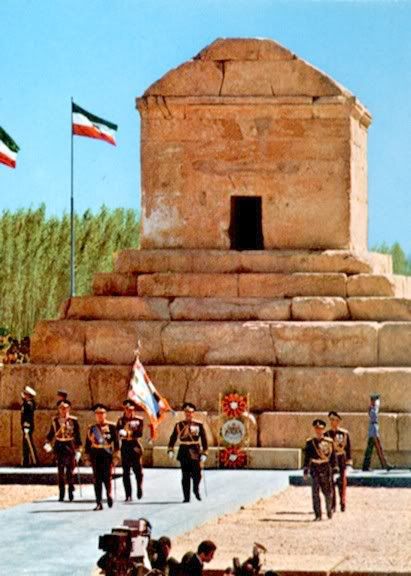
Celebrations of 2500 Years of Monarchy in Iran/Persia (1971)

Military honors at the tomb of Cyrus the Great

See my photo collection on this magnificent event by clicking HERE.

Wednesday, August 08, 2007

Quote...


Eslam Rishekan Nashavad, Iran Iran Nashavad
Eslam Rishekan Nashavad, Iran Virantar Mishavad
Eslam Rishekan Mishavad, Iran baz Iran Mishavad!!!

Iranian girl shot by Islamist security forces of the occupational regime

An Iranian girl shot by the savage occupational Islamic Republic's security forces:


Thanks to Kamangir for having uploaded this clip.

Friday, August 03, 2007

Mullahs' lobby organisations and lobbyists in the USA

Please read these very informative articles regarding the mullah's disinformation and manipulation campaign in the USA through various lobbyists and front organizations such as NIAC/AIC and lobbyists strategically placed in various Think Tanks. This particular article focuses on but one of these individuals - Dr Ray Takhey, a senior fellow at the Washington Think Tank "Council for Foreign Relations". The author has previously released a comprehensive report on the Islamic Republic's lobby organization in the USA which goes under the name "National Iranian American Council" (NIAC) and its President Trita Parsi.

View these two documents at:

Ayatollahs’ Lobby In Washington Offering Human Rights As A Negotiating Item

Pro-Ayatollah Disinformation and Manipulation Campaign by Washington Think Tankers

Occupational Islamist regime tries to instill fear in the populace


More pics HERE and HERE.

In recent days the occupational Islamist regime have carried out several barbaric public executions to instill fear amongst the populace. As per usual it buses in a crowd to watch the spectacle, which is also joined by Iranians who attend on their own free will - for what reasons these latter join I really cannot tell; the only reason in defense of them which I can think of is that they are either related to the victims in some way or are there to document the crime for human rights organisations and the general public inside and outside the country. What is even more disturbing is the attendance of children at these barbaric public shows of the Islamic regime which goes to show what kind of truly careless and shameless parents these children have - in a sane society the people who attend on their own free will, in particular those who drag their children to such horrific scenes, would be taken care of at either mental institutions or rehab centers in hope of curing their psychological illness.

The most recent public execution by the Islamist regime involved the killers of a filthy Islamic cleric who presides as a "Morality Judge", who without any doubt tortured, imprisoned, fined, and even killed many innocent Iranians on charges such as immodest dress, for extramarital relations and other absurd charges which are contrary to the inhumane Islamic doctrine. One of the individuals who participated in the killing of this Islamic judge held his head high as he faced his executioners with a smile on his face - this brave defiance must have really upset the Mullah's who are desperate to instill fear in the hearts and minds of the Iranian people with their barbaric Islamic rule.

To read more on the recent reign of terror of the Islamists occupying Iran please read THIS ARTICLE.

Wednesday, August 01, 2007

In Memory of My Brother - HIH Princess Ashraf Pahlavi

On the occasion of Shahanshah Aryamehr's passing his sister, Her Imperial Highness Princess Ashraf of Iran, pays an annual tribute to her brother by publishing a piece in the Herald Tribune newspaper; please find the original english article below, accompanied by a persian translation.


English Link
Persian Link (pdf)

Taller & Taller - Shahanshah Aryamehr


People not knowledgeable in Iranian affaires who have heard or read something here and there always bring up the argument of there not being an ideal democracy in place during the Shah and that it was for this reason that "the people" rose up against the Shah. Little do they know that the Shah's ultimate goal, and which was attested by the incremental freedoms being introduced into Iranian society, was to establish a sufficient democratic state where the people would be able to make informed decisions in regards to parliamentary elections and other areas concerning their future - however there was one step which had to be fulfilled before such democracy could be introduced and that was for the country's illiteracy and intellectual level to be raised to a satisfactory level; this was a point which the Shahanshah always stood by. If this intellectual level was not reached the Shahanshah of Iran knew that his people would be used as tools by foreign powers be they Communists, the backward and anti-Iranian Muslim clergy, and political factions in the USA and Europe. Winston Churchill hit the nail with his famous quote of "the best argument against democracy is a five-minute conversation with the average voter" - note that this quote refers to the average voter who presumably has achieved some form of recognized intellectual level! Not having yet reached that satisfactory point and seeing the impressive growth, progress, and influence which Iran under the leadership of Shahanshah Aryamehr was achieving, foreign powers, to protect their interests (oil and influence), decided to focus their efforts to bring the Shah down and revert the path of progress which the Pahlavi Dynasty had put the nation on; this would be achieved through an intense propaganda campaign and financial/logistical support to reactionary factions seeking to topple the Iranian government.

I do really hope that my compatriots, especially of the young generation which myself and the majority of the Iranian nation belongs to, finally see through the cloud of lies and that we can build a more solid future for our nation so that we never again have to endure another dark age of the kind we have witnessed for the past 28 years.


****

Taller and taller
He has given his answer to that fair and fearless judge called history

By Reza Bayegan
August 16, 2002
The Iranian
SOURCE


It was during the first days of Mehdi Bazargan's provisional government in February 1979. The country was still reeling from revolutionary intoxication. I was traveling in a bus going from Bandar Abbas to Kerman. Not before long a few passengers started chanting slogans and prompting other people with their hoarse voices to shouts of "begoo" this or "begoo" that. Many other people joined them and soon the whole bus was in uproar, cursing the ancien regime and blessing the unknown emerging new establishment.

I was looking out of the window surveying the vast bareness enveloping the asphalt road when all of a sudden I became sensible of a hush in the bus. The dignified, calm voice of a passenger sitting a few rows away from me made everyone sit up and take notice. All the clamor had died down. His indignant words could be heard admonishing the crowd: "Why are you insulting our country?"

Twenty-three years or so has passed from that day, but throughout this long hard period, the fearless, intelligent voice of that man still vibrates in my ear. Here there was a man in the middle of a bus swarming with rowdy passengers, who was not thinking as a member of the mob but as an
individual. He did not let himself be carried away and manipulated as someone else's pawn and mouthpiece. He dared to speak up risking attack, insults or even worse.

Whenever we have been able to rescue ourselves from mob mentality, thinking with fairness, courage and wisdom, in our heart of hearts we have honored and saluted the memory of the Shah Mohammad Reza Pahlavi.

The Shah spoke not to our mob mentality but addressed our intelligent self. He articulated himself slowly and deliberately, measuring every word. He was no rabble-rouser. He kept his focus on his country's long term interests rather than his own approval rates and popularity.

Although he was a man of faith, the Shah revered religion too much to use it in Hafez's words as a "snare of hypocrisy" and an instrument of power and control. Believing in the freedom of worship, he allowed people to choose their own way of reaching God and communicating with him.

Those people who envied him and resented their own inability to emulate his dignity and grace accused him of being a haughty man. It is true that he was a proud person. His pride however did not come from his self-centeredness or narcissism. It came from his deep belief in the greatness of the country in which he was the monarch. It was based on his total devotion to and admiration for his homeland.

After he left his country for exile, the mob and their leaders clamorously demanded that the Shah be sent back to Iran to face trial. In fact King Mohammad Reza Pahlavi has been facing trial every day for the past twenty-three years. Every day he has been standing taller in front of that
open and impartial court of justice.

The course of events have more than justified and proved him right. He has given his answer to that fair and fearless judge called history; a judge that cannot be flogged to submission or talked down or prompted to "begoo" this or "nagoo that.