Showing posts with label Bakhtiar. Show all posts
Showing posts with label Bakhtiar. Show all posts
Tuesday, February 07, 2012
Silent Majority - Pro Shah/Constitutionalists 1979
Pro Shah and Pro Constitutionalists gather in Amjadieh Stadium in Tehran in support of Prime Minister Shapour Bakhtiar’s government amidst the ever growing turmoil of the Islamist insurgency ("Islamic Revolution"). This vocal group from the silent majority dared to speak up in support of the Shah's last appointed government led by PM Shahpour Bakhtiar.


Friday, August 19, 2011
Saturday, September 04, 2010
Operation Shahrokhi Base
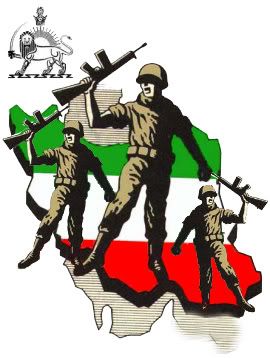
Operation Shahrokhi Base, later renamed to Nojeh, was an attempted coup d'état on July 11 (1980) by patriotic officers and servicemen of the Imperial Iranian Armed Forces, from the infantry, air force, army, and secret services under the leadership of the former Imperial Prime Minister of Iran - Shapour Bakhtiar; their mission was to eliminate Ayatollah Khomeini and overthrow the establishment of the newly proclaimed Islamic Republic.
A partial list of the fallen heroes of Operation Shahrokhi Base (aka Nojeh) who were executed by the terrorist Islamic Republic include:
1- General Saeed Mehdioun (Pilot) August 15, 1980 Tehran
2 - General Ayat Mohagheghi (Pilot) July 20, 1980 Tehran
3 - Colonel Daryoush Jalali (Pilot) July 31, 1980 Tehran
4 - Major Faroukhzad Jahangiri (Pilot) July 20, 1980 Tehran
5 - Major Iraj Soltani Jay (Pilot) August 7, 1980 Tehran
6 - Major Kavous Alizadeh August 7, 1980 Tehran
7 - Major Omid Ali Boveiri (Pilot) July 24, 1980 Tehran
8 - Captain Mohammad Malek (Pilot) July 20, 1980 Tehran
9 - Captain Bijan Iran Nejad Sabet July 20, 1980 Tehran
9 - Captain Karim Afrouz (Pilot) July 24, 1980 Tehran
10- Captain Mohammad Behrooz Fard (Pilot) July 31, 1980 Tehran
11 - Captain Hormoz Zamanpour August 15, 1980 Tehran
12 - Captain Ali Asgar Soleymani (Pilot) July 24, 1980 Tehran
13 - Captain Nasser Zandi (Pilot) July 24, 1980 Tehran
14 - Captain Ali Shafigh Sept. 16, 1980 Tehran
15 - Lt. Nejat Yahya (Pilot) July 31, 1980 Tehran
16 - Lt. Mohammad Ali Saghafi (Pilot) August 7, 1980 Tehran
17 - Lt. Hossein Shokri (Pilot) August 7, 1980 Tehran
18- Lt. Jafar Rastgoo August 7, 1980 Tehran
19 - Lt. Nasser Rokni (Pilot) August 7, 1980 Tehran
20- Lt. Jalal Asgari August 7, 1980 Tehran
21 - Lt. Ayoub Habibi July 24, 1980 Tehran
22- Lt. Mohammad Mehdi Azimi Far (Pilot) July 24, 1980 Tehran
23 - Lt. Mohammad Ali Farzam July 31, 1980 Tehran
24- Ho22mafar Yousef Pour Rezaee July 20, 1980 Tehran
25 - Homafar Jafar Mazaheri Kashani July 24, 1980 Tehran
26 - Sgt. Hossein Karimpourtari July 31, 1980 Tehran
27 - Sgt. Mojtaba Moradi July 31, 1980 Tehran
28 - Sgt. Siawash Nouroozi July 31, 1980 Tehran
29 - Sgt. Ahmad Mohamadi July 31, 1980 Tehran
30 - Sgt. Bakhsh Ali Karimian (and 22 other enlisted personnel)
(and over 112 Armed Forces Personnel + more than 40 civilians)
Footage of Gen. Mohagheghi's kangaroo trial before his execution:
civilians)
Saturday, October 17, 2009
Monday, May 07, 2007
PM Bakhtiar's Heroic Battle: 37 Days
Further on my entries on Dr Bakhtiar, Iran's last Prime Minister before the Islamist takeover, I would like to add this very telling interview which discusses the situation in the country at the time and Dr Bakhtiar's efforts in saving the country from the darkness which the Shah had warned the people of.

Bakhtiar's Heroic Battle: 37 Days
By Cyrus Kadivar
The man sitting in front of me in the quiet Parisian cafe Boulevard Montparnasse seemed lost in thought. Gazing out the window at the deserted streets that August afternoon he tried to recall the day he went to Niavaran Palace where Shapour Bakhtiar, the newly appointed prime minister, was due to present his cabinet to the Shah. He could not recall the exact day but he spoke calmly about the weather being soft, warm and bright on that winter's morning. >>> See photos
On that day, January 6th, 1979, Sirous Amouzegar and Dr Razmara, a Paris-educated Cardiologist who had accepted to become Health Minister, had shared a government car on the journey which was to take them from Bakhtiar's house to the northern suburbs of Tehran where the royal palace was situated.
"Although I had been named Information Minister," Amouzegar recalled, "I was genuinely nervous about the future. My heart was filled with pessimism. During the journey to the Palace, Manuchehr Razmara and I hardly spoke to each other. There was an incredible tension in the air. The future seemed very bleak. In part our silence was due to the heavy burden we felt on our shoulders. Neither of us, especially me, had any experience in the ways of government. But we had accepted to risk everything out of a sense of personal loyalty to our country and Dr Bakhtiar who was a truly brave and decent man."
In those revolutionary days, the entire area near Niavaran Palace was surrounded by Chieftain tanks and heavily armed elements of the imperial-guard force stationed at all strong points. The main gate was opened and the government car was swept through by an officer halting near the main entrance of one of the older palaces that served as the monarch's private office.
The ministers were greeted at the door by the elderly Court Minister Ardalan, a man with a full set of white hair and gentle demeanour, who led them across the splendid Persian carpets that covered the floor. Fragments of light bounced off the gilt-framed mirrors. Royal portraits of the Shah and Empress Farah competed with the antiques that stared at them from the walls and shelves.
In the waiting room, Bakhtiar's ministers sat on Louis XV chairs beneath the chandelier, sipping tea. "There were ten other faces in that room," Amouzegar recalled. "I sat down beside Mr Ahmad Mirfenderski, a former ambassador to Moscow who told me that the Prime Minister was in audience with His Majesty."
"Although we were not known to each other," Amouzegar said wiping his brow, "Mirfenderski and I were to become close friends. A man with a first-class mind, Bakhtiar had forced him out of semi-retirement to offer him the post of Foreign Minister."
There was a long wait -- one and a half hours -- during which the Shah and Bakhtiar remained closeted behind guarded doors discussing details to which nobody was privy. Some of the ministers became restless, even joking between themselves that perhaps the Shah had changed his mind about Bakhtiar. Every so often the Court Minister would shuffle in requesting the ministers to be patient. More tea was served by the few remaining palace staff.
"In the midst of the chatter," Amouzegar reflected, "I sat on my chair looking out the window at the trees in the royal garden. I was filled with doubts about our chances of stopping Khomeini. The clock on the mantelpiece was ticking like my heartbeat. All I could think of on that gloomy day was how did I get here?"
There was a moment of silence during which I observed this tall man with the features of De Gaulle. At the time of the revolution he had been 44 years old. Now at 67 Amouzegar complained of diabetes and sore feet. His memory was also rusty when it came to dates.
"I don't read anymore," he said, playing with the glasses which hung from his neck. "It tires me. I used to have a great library in Iran with 7,000 books. I tried to write my memoirs but gave up although I have given a few interviews to a radio in Los Angeles."
Amouzegar now plunged into a rambling discourse on the events that had led the Shah to turn to a member of the National Front to save his throne. "Two years before the revolution," he resumed, "the Shah had become obsessed with his legacy and the future of the dynasty and his son's sucession. Coupled with the military and economic development programs he now contemplated democracy."
According to him the Shah and Prime Minister Hoveyda had made secret overtures to members of Mossadeq's then banned National Front to ask them to take up seats in the Majlis as members of a loyal opposition. The Shah's only condition was that they accept the monarchy and his undisputed position as king.
In 1977, three members of the National Front, Karim Sanjabi, Daryoush Forouhar and Dr Shapour Bakhtiar, had sent the Shah a letter asking him in respectable language to heed their calls for greater freedoms within the Constitution. "The Shah read the letter with little reaction," Amouzegar said. "Despite a few clumsy attempts to intimidate the signatories the Shah soon realised that the time for change had come. Impressed by the example of Franco and Juan Carlos he believed that Iran could take a giant leap from autocracy to democracy."
But events were already working against the Shah's regime. The gradual opening of the imperial system coincided with a rise in dissident activities from Islamic fundamentalists and leftist guerrilla groups. University students and bazaar merchants were grumbling.
By 1978 the government of Jamshid Amouzegar (a first-rate technocrat) was struggling to reverse the sudden downturn in the once prosperous oil-driven economy. At the same time he initiated a series of unpopular fiscal reforms and halted the funds paid to the clergy. Such policies led to the riots in Qom and Tabriz which took a nasty turn when ill-equipped security forces opened fire thus creating the first martyrs of the revolution.
At about this time, the Shah intensified his efforts to co-opt the liberal opposition into forming a national government that would be acceptable to both sides. "Suspicions ran deep and little headway was made," Sirous Amouzegar told me. "A few patriotic people tried very hard to make it work but egos got in the way."
One day, in the spring of 1978 a friend invited Amouzegar to a party where he was to meet a man who changed his life. "I first met Shapour Bakhtiar at a marvelous barbecue," he recalled. "I was impressed by his noble character and extraordinary knowledge of French literature, Persian poetry, European history and Iranian traditions. Whether quoting Hafez or discussing Voltaire he demonstrated a rare intelligence that often left me in awe. As I got to know him better I became convinced of his integrity and patriotism. He was rather unique."
An elegant and well-mannered man, Shapour Bakhtiar had led a life full of adversity. Born in 1914 in the south western Bakhtiari region of Iran he had lost his mother when he was seven. Attending elementary school in Shahr-e Kord and then secondary school in Esfahan he was sent to Beirut, Lebanon where he received a high school diploma from a French school. Later while studying in Paris in 1934 he learned the tragic news that his beloved father, Sardar Fatteh, a powerful khan, had been hanged on orders of Reza Shah Pahlavi.
Bakhtiar returned to Iran and remained there for two years. He then went back to France in 1936, where he earned degrees in political science, philosophy and law in 1939. In the same year, he married a French woman. In 1940 he served in the "Orleans" battalion and fought the Nazis with the French resistance.
In the winter of 1946, Bakhtiar returned to Iran armed with a PH. D from the Sorbonne and later entered the Ministry of Labour in 1951. After the 1953 events that led to the fall of Mossadeq's government Bakhtiar opened a law practice.
Although related to Queen Soraya, the Shah's second wife, Bakhtiar repeatedly found himself in trouble with the regime. In the following years he was jailed for opposition political activities and rose to deputy chief of the banned National Front.
Stubborn by nature, Bakhtiar remained a firm critic of the Shah's regime and was subsequently imprisoned for a total of nearly six years and prohibited from leaving the country for a period of ten years.
"When I met him," Amouzegar explained, "Bakhtiar was making a good living with a French-Iranian firm called Vatan. Despite his pro-Mossadeq views and his grudge against Reza Shah for executing his father, Bakhtiar remained a monarchist."
In June 1978 the Shah replaced the long-time head of SAVAK, General Nassiri, with General Nasser Moghaddam who had good contacts with the religious and liberal opposition. At this point, Khomeini had still not emerged as the unquestioned leader. On several occasions Moghaddam approached Bakhtiar to seek his views.
That same summer, Amouzegar travelled to England for a medical check up. Three months earlier he had suffered a mild heart-attack in Tehran and his wife insisted that he needed a rest. While in Porthsmouth one day, Amouzegar walked into a pub. On the television he saw a map of Iran and a brief report about the latest disturbances. "When I asked the grumpy pub manager what was going on he simply shrugged his shoulders," Amouzegar recalled. "I later discovered to my horror that over 400 innocent people had been burned alive in Abadan after Cinema Rex was torched by Islamic terrorists."
The Abadan tragedy was quickly exploited by revolutionary agents who blamed SAVAK for the "hideous crime." The Shah who had on August 5th promised free parliamentary elections for the following year, removed Jamshid Amouzegar, Hoveyda's successor, and appointed as prime minister Jaafar Sharif Emami. The new government tried hard to win over an angry public.
"I returned to Tehran immediately," Amouzegar explained. "Soon afterwards I joined a committee of 40 influential people determined to find a solution to the political crisis. I held long discussions with Bakhtiar. We used to walk around his pool in the garden of his house or discuss the future in his basement library."
Bakhtiar's sense of loyalty and history prevented him from calling for the Shah's overthrow.He was worried that a revolution would mean Iran's ruin and feared that the communists and mullahs would take over. At the same time he advocated a constitutional monarchy where the King would reign over a democratic parliament. On a number of occasions, even after Sharif Emami had become prime minister, Bakhtiar tried to send word to the Shah through Jamshid Amouzegar and later via SAVAK General Moghaddam that the National Front was prepared to negotiate over a truly representative government.
When the Shah agreed to consider an appropriate candidate the National Front leaders could not agree on a name. By September 8th, rioting had reached such proportions that the Shah was forced to impose martial law in Tehran and eleven other cities. Two months later, when Sharif Emami failed to restore order the Shah appointed the ineffectual General Azhari as head of a new military government.
On November 6th during an emotional television and radio speech the Shah urged the nation to give him time and stressed that he had finally heard the "voice of the revolution". Calling on all patriots to join hands in ending the crisis he promised to rectify past errors and lead Iran towards a truly democratic system.
By now every mosque in Iran had become the hotbeds of dissent where the faithful flocked to hear the taped cassettes of Ayatollah Khomeini who had taken refuge in the French village of Neauphle-le-Chateau near Paris. As the situation deteriorated further the Shah came under increasing pressure by his generals to order a massive crackdown. But the Shah hesitated, caught in a tragic dilemma.
At the end, Shah Mohammed Reza convinced himself that a sovereign could not save his throne by shedding his countrymen's blood. Isolated at Niavaran Palace he spent most of his time on the telephone. "Do the impossible to avoid bloodshed," he told a general who had just witnessed a crowd pulling down his statue.
In his private conversations with the US Ambassador Sullivan and British Ambassador Sir Anthony Parsons, the Shah subjected them to long, rambling soliloquies expressing his doubt, impotence, and frustration. The anguish was clearly etched on his face.
Amouzegar reminded me that throughout November and December 1978 the Shah had resumed his secret talks with opposition leaders. He contacted Dr Sadighi, a member of the National Front. Sadighi agreed without conditions to try to form a coalition but urged the Shah not to leave the country warning of the dangers of collapse.
When Sadighi failed to form a government the Shah turned to Karim Sanjabi who had met with Ayatollah Khomeini a few days earlier in Paris. The antipathy between both men was too great and the talks ended after thirty minutes.
In his memoirs, the Shah wrote that Bakhtiar had "behaved in a discreet and reserved manner." The Shah had agreed to receive him. General Moghaddam had brought him to the Palace one evening. They had had a lengthy conversation in which Bakhtiar profusely expressed his loyalty to the Constitution and the Monarchy. He wanted to adhere to the Constitution and name a Regency Council before the Shah left the country ostensibly for a long "holiday."
"One day over lunch," Amouzegar said, "Bakhtiar told me and Dr Razmara that he had received a call from Lord George Brown, once Foreign Secretary in Britain's Labor Government. Brown had met the Shah and persuaded him to name Bakhtiar prime minister. We spent the next few days drawing a list of potential ministers. There was a lot of pressure from the Court and even the Empress for results. The National Front did everything to discourage people from joining us."
On the evening of December 29th, General Badrei, the commander of the Imperial Guard, escorted the slender and mustached Bakhtiar up the staircase of Niavaran Palace to the Shah's private office. It was Bakhtiar's second audience.
"Time is pressing," the Shah said impatiently. "Tell me if you are ready to form a government?" Bakhtiar explained the difficulties he was facing to find the right people and asked for another ten days. "It's too much," the Shah said pacing the room. "Sire, I cannot go any faster," Bakhtiar replied. "But I will try, Majesty."
After the audience, Bakhtiar left the Palace with a heavy heart. He kept reminding himself that if the Shah had summoned him it was because he had no one else to turn to.
"At this point," Bakhtiar later wrote in his memoirs, "I was tempted to tell the Shah to go find someone else. Yet, the truth is that it no longer concerned the Shah, not even the Constitution, but Iran. Iran, a reality superior to all other considerations."
With mandate in hand, the prime minister designate faced his colleagues with the task ahead.
"Karim Sanjabi was jealous," Amouzegar remembered. "Forouhar was fearful of a split in the opposition and afraid that Bakhtiar might have gotten a jump on him. The rest of the National Front members accused him of betrayal. After three hours of shouting, Bakhtiar left the meeting with a red face. The next morning, Sanjabi rang him to say that he had been unanimously expelled from the party."
On January 1st, 1979, Shapour Bakhtiar went on television and publicly reaffirmed that His Majesty intended to leave the country once he had formed a Cabinet. The reaction from the military hardliners was swift. General Manuchehr Khosrowdad, a dashing paratrooper declared: "His Majesty has no intention to leave the country at such a critical moment, not even for a holiday!"
"From the very beginning Bakhtiar upset the military high command," Amouzegar reminded me. "It was an uneasy relationship with neither side trusting each other. This distrust did not bode well for the future but Bakhtiar felt he could win the generals over once they appreciated his efforts on behalf of Iran."
And so on January 6th, 1979, Amouzegar arrived at Niavaran Palace which resembled an abandoned castle. Gone were the regiments of footmen, pages, butlers, adjudants, servants, orderlies, protocol officers, guards and other palace officials, only a handful of the faithful had remained. Others had either asked for sick leave or simply vanished. All this added to an already depressing atmosphere. Everything appeared faded and triste in the vast royal abode.
The ministers were now led into a large reception room beautifully decorated with Persian glass and chandeliers. "None of us wore any gold-braided uniforms," Amouzegar remembered. "The Court Minister did not even bother to line us up according to our ranks. This would have been unthinkable a few months ago."
When the Shah walked into the room Amouzegar was startled by his grave appearance. The monarch looked pale and there was a slight tremble in his face and hands. Looking tired and drawn in a somber business suit, he turned to Prime Minister Bakhtiar who courteously introduced his ministers. Despite his deteriorating health and anxious state of mind the Shah tried to keep up his haughty bearing.
"His Majesty walked down the row extending his hand for the nervous ministers to kiss," Amouzegar recounted. "When he approached me I simply bowed and shook the royal hand much to Bakhtiar's displeasure who later scolded me."
When he had finished greeting the ministers, the Shah turned and asked for a microphone so that he could make a small speech. "It was an embarrassing moment," Amouzegar said, rolling his eyes. "For a moment the Shah stood there waiting for someone to hand him the microphone but there was nobody there to help. It was a tragic moment. At the end, Bakhtiar had to leave the room and look for the microphone. It was really the end of the Shah's absolute rule."
Finally, the Shah addressed his ministers. "For some time," he said, "I have been ill and in need of medical treatment which due to the situation in the country has been long overdue. I urge you gentlemen to serve your country and support the Prime Minister. In my absence a Regency Council will be created. The Shahbanou and I plan to go abroad for a short trip and much needed rest."
On January 16th 1979 Sirous Amouzegar, now settled in his ministerial office, watched the royal departure on Iranian television. "Bakhtiar had gone to the airport to bid the Shah and the Empress farewell having received a confirmation vote from both houses of Parliament," he said. "When I saw the Shah's tears I could not hold back my own. A few moments before several loyal officers had thrown themselves at his feet urging him not to go. It was a pathetic scene."
No sooner had the Shah's plane lifted into the sky that the streets exploded with jubilant demonstrators burning his portrait and honking their car horns."Looking out my window," Amouzegar said, "I felt disgusted and told myself that in their hysteria the people were completely unaware of the dark future awaiting them. It was like witnessing a nation commit collective suicide. That day I decided to put a picture of the Shah on my desk. Whenever a colleague told me to remove it I said that I considered him the lawful king of our country until stated otherwise."
A few days later, Prime Minister Bakhtiar held his first Cabinet meeting in a large room. The ministers sat around a polished table. Khomeini and Sanjabi had called his government "illegal" and were urging his ministers to resign or face the music later. In Tehran and other major cities thousands of hysteric demonstrators marched chanting, "Bakhtiar, Nokar bee ekhtiyar, Bakhtiar, the Servant with no power."
Standing beside a photo of Mossadeq, Bakhtiar addressed his ministers in a strong voice. "Gentlemen," he said, "Our country is in mortal danger and we all bear a heavy burden on our conscience. I believe that if we stand firm and demonstrate our courage in the difficult days ahead we will be able to weather the coming storm. Of course, any minister who does not want to stick around can resign."
"Listening to Shapour Bakhtiar that day," Amouzegar confessed, "I was filled with renewed optimism. A few weeks ago I would have given him a five percent chance of success. But as he spoke my confidence rose and so did my belief that we could halt the madness and prevent Khomeini's followers from seizing the country. Only one minister resigned that day and ironically he was thrown in jail after the revolution. Each time I felt low Bakhtiar would raise my morale and urge me to hang in there. We needed three months to win public opinion and prepare the grounds for a genuine referendum and free elections, he would tell me."
Dubbed "the Iranian Kerensky" by foreign reporters, Bakhtiar made daily appearances on radio and television warning his compatriots of a dictatorship worse than anything seen in Iranian history. At the parliament he unveiled several measures designed to appeal to elements in the opposition. He lifted restrictions on the press; the newspapers, on strike since November, resumed publication. He set free the remaining political prisoners and promised the dissolution of the secret police, the lifting of martial law and free elections. But the masses ignored him.
On February 1st, after refusing to see Bakhtiar in Paris, Ayatollah Khomeini flew to Tehran amidst great popular acclaim. "Until the last minute the government was torn between diverting his plane to Kish Island in the Persian Gulf or letting him land," Amouzegar revealed. "A few Air Force officers like General Ayat Mohagheghi volunteered to crash their jets against the chartered Air France plane. At the end permission was granted and Khomeini landed safely with his entourage. During the coverage of his arrival a few loyalists interrupted the TV programme with a portrait of the Shah and the imperial anthem."
Escorted to the Behesht Zahra Cemetery where many of the revolution's martyrs were buried, Khomeini announced that he would "smash in the mouth of the Bakhtiar government." He called for strikes and demonstrations to continue. The military high command kept their nerve and General Abbas Gharabaghi, the Chief of the Supreme Commanders Staff, warned his fellow officers against any rash attempts to stage a coup against the Bakhtiar government.
But the loyalty of the imperial iranian armed forces was already eroding after months of confrontation with the people on the streets. Desertions became commonplace.
Meanwhile, a girls' secondary school at which Khomeini established his headquarters in Tehran became the center of the revolutionary movement. A multitude of decisions were handled here by what came to be known as the Komiteh-ye Imam, or the Imam's Committee. On Febuary 5th, Khomeini named Mehdi Bazargan as prime minister of a provisional government while in many large urban centers the local komitehs (revolutionary committees) seized control.
Bakhtiar reacted in true style. "The Iranian nation and the Iranian state are indivisable entities," he said. "One country, one government, one constitution, or nothing else."
Several pro-Bakhtiar demonstrations in the Aryamehr Stadium were held in Tehran with elegant men and women waving tricolor flags and weeping their support. "Bakhtiar hold your position," they chanted. The crowds soon grew from 40,000 to 100,000.
Encouraged by the demonstrations in his favour Bakhtiar declared: "I shall remain in the position of the legitimate prime minister of this country until future free elections are held. Whoever enjoys a majority, shall govern -- An Islamic government limited to Qom is permissible, and we shall then have a Vatican too."
Behind the scene however Bakhtiar and Bazargan engaged in furious secret negotiations. "Many meetings were held either at my house or that of Senator Jaffroudi," Amouzegar said. "Both sides were afraid of a civil war. One day Amir Entezam told me to quit. He said that many generals had secretly joined the revolution. I laughed. But when he hinted that Gharabaghi was among them I lost my smile."
On February 8th, uniformed airmen appeared at Khomeini's home and pledged their allegiance to him. "The armed forces must return to the people," the Ayatollah said. "They will be welcomed with open arms. Islam is a forgiving religion."
The end began unexpectedly on a Friday night, February 9th. In order to discredit Khomeini, Bakhtiar had instructed the television networks to broadcast the Ayatollah's interview with a foreign journalist before his return to Iran. Asked about his feelings after spending 15 years in exile, Khomeini had replied, "Nothing!"
Instead of generating support for the government's position the film provoked a mutiny among Homafar air force technicians at Doshan Tappeh Air Base outside Tehran. They poured out of the mess hall chanting religious slogans in support of Khomeini and attacked the outnumbered pro-Shah officers sent to arrest them.
"I rang the Prime Minister and gave him the news," Amouzegar explained. "It was about midnight. Someone woke up Bakhtiar. When he came to the phone he told me that he had heard about the troubles but that it was nothing serious and went back to sleep."
When units of the Imperial Guards failed to put down the mutiny the situation turned into an insurrection. By Saturday, February 10th, the arsenal was opened, and thousands of weapons were distributed to crowds outside the air base.
It was 3a.m. when Bakhtiar rang Amouzegar. "He sounded concerned," Amouzegar remembered. "We talked about a counter-insurgency plan which he planned to unveil later in the day at a special meeting of the National Security Council."
As people barricaded themselves against the tanks and jeeps sent to enforce a military curfew, Bakhtiar ordered the Air Force Chief General Rabii to bomb the defense and ammunitions factory. Rabii refused calling the plan crazy and impractical. Discussion then turned to a list that SAVAK General Moghaddam had prepared.
"The list which had included 200 names a few weeks ago had grown to 308," Amouzegar revealed. "These people were to be arrested and taken to a deserted camp near Tehran. They included Ayatollah Khomeini, his comrades at the Alavi School, and scores of journalists and national front and leftist activists."
For some mysterious reason the plan was never carried out. Worse the news was leaked to the revolutionary camp and this led to further fighting.Unable to enforce the curfew, General Mehdi Rahimi, the military governor, watched helplessly as the mob captured the key police stations, prisons, barracks, and ministry buildings.
By Sunday, February 11th, the military machine and its leadership were in complete disarray. The events that followed sealed the fate of Bakhtiar's government forever. On that fateful Sunday, Amouzegar telephoned Bakhtiar early in the morning.
"The Prime Minister sounded upset," Amouzegar recalled. "It was 8a.m. and he was looking for Khosrowdad who was nowhere to be found. Later he complained that he could not find Rabii. Finally, after some calls, he had been told that the generals had been summoned to a military briefing by General Gharabaghi."
Depending on which version one refers to, the role of General Gharabaghi in undermining Bakhtiar's government is irrefutable. There are those who call him a traitor and a turn-coat. Others believe that he did what he could to maintain the cohesion of the armed forces -- an impossible task once the Shah had left the country. Gharabaghi himself denied the charges and blamed Bakhtiar.
"Gharabaghi never got on with Shapour Bakhtiar," Amouzegar said. "Whether he was a traitor or not the fact is that he was not made for the job which he had been selected. An Azerbaijani officer who spoke Farsi with a heavy Turkish accent he was not popular among his peers. At the end he chose to compromise."
In any case, while Bakhtiar waited for Gharabaghi to report to his office, the latter had summoned 27 military commanders to the largest meeting in the history of the Imperial Iranian Armed Forces to consider their options. The picture from the front was dismal. Every commander declared that they no longer could count on their forces to establish order. The best solution was to round up their troops from the streets and retreat back to barracks. Few had any illusions.
After two hours of discussion it was agreed that a communique be issued in which the High Council of the Imperial Iranian Armed Forces would declare their "neutrality" in the political rift. The text was hand written by General Hatam and signed by every officer in the room except for General Shafaqat, Bakhtiar's War Minister, who crossed out his name.
At about 10:20a.m. Gharabaghi telephoned Senator Jaffroudi who had planned to hold a meeting at 4p.m. with Bakhtiar, Gharabaghi, Bazargan and Ayatollah Motahari, at his house. Some have speculated that Bakhtiar was planning to offer his resignation to Bazargan but Amouzegar maintained that this was not the case.
If Senator Jaffroudi's version is true, Gharabaghi had asked him to be put in touch with Bazargan, Khomeini's designated prime minister of the shadow government. The Field Marshal went on to explain the Army's decision to declare its "neutrality" and that all the senior military commanders had endorsed the decision.
"Do you understand the consequences of this decision?" Jaffroudi repeated, angrily. "It means you have surrendered the state. I suggest you contact the Prime Minister immediately. His life is in danger and you are responsible for his safety."
It was half-past-ten when General Gharabaghi rang Bakhtiar and told him the news. It was a hard blow. Everything was lost. The generals had by their actions destroyed the last pillar capable of holding back Khomeini. At 1p.m., after an hours delay, Amouzegar authorised the radio to play the Army's communique.
For a moment the Prime Minister sat at his desk in front of a late and cold lunch. He had no appetite. A half-bitten green apple lay on a plate. Suddenly machine-gun bullets hit the Prime Minister's office. Amouzegar rang him and asked if he needed a car. "Bakhtiar turned down my offer to come and fetch him," Amouzegar said. "He said that he was leaving soon with his security officers."
In his memoirs, Bakhtiar explained how he calmly took his winter coat and bade farewell with Pari Kalantari, his loyal secretary. As he climbed down the stairs, she asked him if he were coming back. "I will be back," Bakhtiar told her.
Soon afterwards, Bakhtiar vanished. Gharabaghi changed into civilian clothes and left his H.Q. for Jaffroudi's house where after meeting with Bazargan he went into hiding. Both men eventually escaped to Paris. For the others, a worse fate awaited them. Hundreds of other generals and imperial officials believing in Khomeini's mercy would soon be shot by firing squads. At 6p.m. rebels captured the NIRT station. A presenter announced: "This is the Voice of the Revolution!"
As Tehran fell under mob rule, Sirous Amouzegar became the last minister to leave his post. As he related the story to me in that Paris cafe, Amouzegar's eyes clouded over with tears. It was the first and last time he showed any emotion.
During the dying hours of the Bakhtiar government, Amouzegar had been sitting in his office pondering the future. No more than ten employees remained in the Ministry of Information building. There was a knock. A sergeant walked into the room and saluted smartly. He was dressed in full battle gear.
"Yes, what do you want?" Amouzegar asked. "What is going to happen to us now, Sir?" the sergeant wanted to know. He had heard the army's announcement and felt torn between his sense of duty and the crumbling situation. For two days his men had not eaten anything as the cooks were on strike.
"I told him to go home," Amouzegar said. "But, Sir, we have our orders to defend all government installations until the last bullet, the young sergeant insisted."
Continuing his story, he said: "I told the sergeant that it was all over and suggested that he hide his weapon somewhere in the building and change out of uniform. I told him to leave at once. Save yourself, I told him, before it's too late."
Swallowing a glass of water, Amouzegar paused for a moment, trying to control his tears. More than twenty-three years had passed from that day but the feelings were the same. The world was crumbling all around him even here in this French cafe, here the bored waiter looked at his watch praying for us to leave.
"The generals may have betrayed us," Amouzegar said. "But the rank-and-file were loyal and waiting for their orders. The poor sergeant came up to me and placed his head on my shoulders and wept like a child. I was so overwhelmed that tears flowed down my face. Later, the sergeant saluted me and disappeared."
Amouzegar was the last person to leave the Ministry and dutifully switched off the lights on his way out.
Angry crowds were milling in the streets looking for enemies of the revolution. As he stood on the steps a van appeared and a voice shouted: "Get in, Mister!"
"I looked up and immediately recognised him," he said. "The driver used to deliver copies of Talash magazines between the printing house and the Prime Minister's office. I thanked him and said that I would make my own way. That night, as the capital burned, I drove to my house and when it became too dangerous I slept at Abbas Qholi Bakhtiar's place before moving in with my sister."
Amouzegar kept low for a while until the snow had melted spending his time listening to the radio and reading the depressing stories in the daily newspapers. Arbitrary arrests, summary executions and chaos was the order of the day.
After several weeks in hiding, Amouzegar could no longer take it. He decided to call Admiral Ahmad Madani who held the senior post of Defense Minister in the Provisional Government. "I'm fed up of hiding," he told Madani. "If they want to arrest me they can come and do it now!"
Madani replied that in a recent meeting Prime Minister Bazargan had said that the country needed "good people" even those who had served in the Shah's imperial regime. "If you wish," Madani said offering an olive branch, "I will come and fetch you tomorrow and take you to see Bazargan. I'm sure he will help."
Amouzegar declined Madani's offer. After some assurances he decided to go back to his own house.
Few days after the Persian New Year, on March 27th, 1979, Amouzegar went to see his friend Dr Razmara. They chatted about old times and the situation in the country. Bakhtiar was still in hiding somewhere in Tehran despite a nation wide search for his arrest. When he returned home that evening, Amouzegar received a visitor.
The man was anxious to get him out of the country. "There is a car waiting for you outside," he told him. "I will drive you to a secret spot where you will board a helicopter that will fly you to Turkey. From there you will be free to join your family in Paris."
"It was a difficult choice to make," Amouzegar confessed. "I went upstairs and asked my old father's advice. He went into deep thought and began pacing the room." When the pacing had stopped, the old man told his son that it was better if he did not escape. "A fugitive can never live in peace. Stay here. You have not done anything wrong. At most you will be arrested and spend a month in jail then released."
The man who had come to save Amouzegar was furious when he heard the decision. "You are both insane," he shouted as he left the house, slamming the door behind him.
At midnight the doorbell rang. "I opened the door," Amouzegar remembered. "It was Dr Razmara." For an instant, Razmara stood there smiling. Then slowly he said, "They finally got me." As he spoke two armed men emerged from the shadows.
In a few minutes, Sirous Amouzegar and Dr Razmara, two of Bakhtiar's senior ministers, were sitting in a car watched by Pasdarans, or Revolutionary Guards. "Where are you taking us?" one of them asked. "Ghasr Prison," came the reply.
During his eight months captivity in revolutionary hands, Amouzegar was convinced that he would soon be released. One day at Ghasr Prison where many of the Shah's closest officials awaited trial, Amouzegar noticed the ex-prime minister, Amir Abbas Hoveyda taking some exercise in the same courtyard where he eventually met his ignominious death a few days later on April 7th, 1979.
"I saw him standing in that courtyard," Amouzegar revealed emotionally. "He had lost some weight. But he still managed a smile and waved at me. I waved back at Hoveyda not realising that it was for the last time. I was very upset by his fate."
Life in Ghasr was no picnic. "These were horrible times with countless executions taking place regularly," Amouzegar said. One night they shot 22 people among them the distinguished Dr Khalatbary, Hassan Pakravan, Mansour Rouhani, General Nader Jahanbani, and Parviz Nikkhah. Another day it was the turn of Air force Chief Amir Hossein Rabii and SAVAK Chief Moghaddam.
"One of my cellmates was General Ali Neshat, the former commander of the Imperial Guard," he said. During their walks in prison a crestfallen Neshat told Amouzegar how he had been forced to hand over Niavaran and the remaining royal palaces to save his men. It had been a humiliating affair. He also told him that had the order been given his artillery guns could have wiped out Khomeini's headquarters.
"Then why didn't you?" Amouzegar had asked him. General Neshat who was soon to face a firing squad had fallen silent.
For the next three months, Amouzegar was subjected to long hours of interrogation. "I was not tortured," he said. "But eventually I told my interrogator that I would tell him everything if he would just say what was my crime." According to Amouzegar the interrogator had stared at him and in a cold voice said, "We have a taped conversation between Shapour Bakhtiar and yourself on the eve of 22 Bahman. Every word has been transcripted and is in your file."
Returning to his cell Amouzegar looked like a ghost. When Ahmad Mirfenderski, also in prison, asked him what was the matter, Amouzegar opened up to him. Mirfenderski also went pale. "Just deny it's your voice," he advised.When Abbas Qholi Bakhtiar heard the story he told Amouzegar not to worry. "The worst that can happen is that you will be shot," he said jokingly at the thought. "It will be a quick death. A bullet and a little smoke, then it's all over."
Luckily nothing happened after that. On July 7th, a prison guard called out Amouzegar's name. "I went down the steps fearing the worst," Amouzegar said. "The guard said that he had a message from Abbas Qholi. I asked what it was and he said, 'Agha raft.' In this way I learned that Shapour Bakhtiar had fled the country. This shows how popular Bakhtiar was even among the prison guards."
Amouzegar was released from Evin prison on August 19th soon after his transfer from Ghasr a few weeks earlier. "I still remember the day. It was the day they executed Mr Khoshkish, the ex-head of the central bank. The newspaper on that day carried a photo of me with a caption that read, 'A dangerous man.' "Did you know that I am the only Minister of Information who was not shot?"
Soon after his release, Sirous Amouzegar phoned Dr Bakhtiar in Paris where the former Prime Minister had formed the Iranian Resistance Movement which apparently had the late Shah's covert blessing. He asked him if he wanted him to join him. "It's better if you stay where you are," Bakhtiar advised. "We are planning something big. Your presence in Iran may become invaluable one day."
A year later a group of Air Force officers and civilians were arrested by the revolutionary authorities in the aftermath of the July 1980 plot. It soon transpired that the conspirators had received financial and logistical support from Bakhtiar's office and had hoped to bomb Ayatollah Khomeini's residence and forment a coup.
Over 300 people were shot in the terrible days that followed. "I was arrested again," Amouzegar explained. "This time my house was ransacked by the authorities. They threw all my music and book collection into the street and drove their cars over them. My poor mother kept shaking her head. Fortunately, I was released after a few questions and shortly afterwards I fled Iran."
In Paris Amouzegar joined Bakhtiar's movement. "Bakhtiar was full of confidence that we could overthrow the mullahs. He had received a lot of money for his operations. We worked together until 1986 when we parted ways. " It was twilight. We had already left the cafe and were heading towards the Metro. There was so much more I wanted to know. I was conscience of the fact that nearby in the Montparnasse cemetery was the lonely grave of a brave man who had tried in vain to reverse the Ayatollah's nightmarish plans for Iran.
"One day I would like to place some flowers on Bakhtiar's grave," I said suddenly. Amouzegar stopped and looked at me, his eyes shining like those of a grateful man. "What a great idea," he said genuinely touched. "I am sure Dr Bakhtiar would like that very much." I kept my head down. Earlier, Amouzegar had told me that despite his loyalty to the man, Bakhtiar had his weaknesses.
Towards the end of his life, Bakhtiar had alienated many of his followers and lost any illusions of seeing his country again. He remarried a young Iranian woman who bore him a son. Almost bankrupt, Bakhtiar had closeted himself at his heavily guarded villa on 37 rue Cluseret in the Parisian suburb of Suresnes.
On the night of August 6th 1991, the 77-year old Bakhtiar and his secretary Soroush Katibeh were brutally assassinated by three undercover agents sent from Tehran.
"They cut his throat with a kitchen knife and left him to bleed to death on his leather sofa," Amouzegar said. "I know that he put up a fight until the end. At his funeral I was in a state of shock. I could hardly talk." We felt sad for Bakhtiar, an Iranian patriot and liberal who had placed such great faith in France as a bastion of democracy and human values. As we talked in the semi-darkness on that August night a sense of disgust pervaded the gentle air.
Clearly, the negligence of the French police chosen for Bakhtiar's safety and the trial of the suspects charged with the gruesome murders, continued to haunt Amouzegar. Although the court concluded that the killings had been ordered by the leaders of the Islamic republic, the Mitterand government had appeared ready to put the incident behind them in favour of lucrative trade deals.
The French, who had once harboured Khomeini as the leader of the revolution against the Shah did not want to upset the mullahs. Two of the assassins, Fereydoun Boyerahmadi and Mohammed Azadi, managed to escape to Iran.
"We Iranians are an ungrateful bunch," Amouzegar told me before descending into the Metro. For a moment we were interrupted by the roaring trains in the tunnels.
"What do you mean?" I asked. Amouzegar smoothed his moustache with his fingers. "Had Bakhtiar, or even Hoveyda, been Europeans," he said, "they would have been honoured by their people. Both men were exceptional in their own right. Both men paid a terrible price for their service to Iran and their beliefs."
As the train pulled away I waved at Amouzegar who smiled from behind the window. It was almost nine in the evening and hardly anyone in sight as I went back home.
For the rest of the night I thought about his final words to me. "During those 37 vital days Dr Bakhtiar put up a brave struggle against Khomeini," the ex-minister had said. "He showed moral courage and inspired us to support him to the end. History today has shown that he was right to stand up to the storm." >>> See photos
The dark night, the fear of waves,
the terrifying whirlpool,
how can they know of our state,
those who go lightly along the shore
- Hafez of Shiraz
Author's Note: "My interview with Mr S. Amouzegar took place in Paris last August 2002. Story completed on February 10th, 2003. - Cyrus Kadivar"
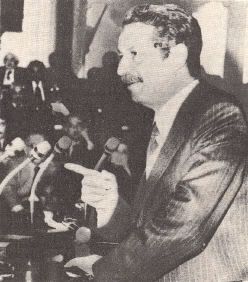
 Dr Bakhtiar's gravesite in Paris
Bakhtiar's Heroic Battle: 37 Days
By Cyrus Kadivar
The man sitting in front of me in the quiet Parisian cafe Boulevard Montparnasse seemed lost in thought. Gazing out the window at the deserted streets that August afternoon he tried to recall the day he went to Niavaran Palace where Shapour Bakhtiar, the newly appointed prime minister, was due to present his cabinet to the Shah. He could not recall the exact day but he spoke calmly about the weather being soft, warm and bright on that winter's morning. >>> See photos
On that day, January 6th, 1979, Sirous Amouzegar and Dr Razmara, a Paris-educated Cardiologist who had accepted to become Health Minister, had shared a government car on the journey which was to take them from Bakhtiar's house to the northern suburbs of Tehran where the royal palace was situated.
"Although I had been named Information Minister," Amouzegar recalled, "I was genuinely nervous about the future. My heart was filled with pessimism. During the journey to the Palace, Manuchehr Razmara and I hardly spoke to each other. There was an incredible tension in the air. The future seemed very bleak. In part our silence was due to the heavy burden we felt on our shoulders. Neither of us, especially me, had any experience in the ways of government. But we had accepted to risk everything out of a sense of personal loyalty to our country and Dr Bakhtiar who was a truly brave and decent man."
In those revolutionary days, the entire area near Niavaran Palace was surrounded by Chieftain tanks and heavily armed elements of the imperial-guard force stationed at all strong points. The main gate was opened and the government car was swept through by an officer halting near the main entrance of one of the older palaces that served as the monarch's private office.
The ministers were greeted at the door by the elderly Court Minister Ardalan, a man with a full set of white hair and gentle demeanour, who led them across the splendid Persian carpets that covered the floor. Fragments of light bounced off the gilt-framed mirrors. Royal portraits of the Shah and Empress Farah competed with the antiques that stared at them from the walls and shelves.
In the waiting room, Bakhtiar's ministers sat on Louis XV chairs beneath the chandelier, sipping tea. "There were ten other faces in that room," Amouzegar recalled. "I sat down beside Mr Ahmad Mirfenderski, a former ambassador to Moscow who told me that the Prime Minister was in audience with His Majesty."
"Although we were not known to each other," Amouzegar said wiping his brow, "Mirfenderski and I were to become close friends. A man with a first-class mind, Bakhtiar had forced him out of semi-retirement to offer him the post of Foreign Minister."
There was a long wait -- one and a half hours -- during which the Shah and Bakhtiar remained closeted behind guarded doors discussing details to which nobody was privy. Some of the ministers became restless, even joking between themselves that perhaps the Shah had changed his mind about Bakhtiar. Every so often the Court Minister would shuffle in requesting the ministers to be patient. More tea was served by the few remaining palace staff.
"In the midst of the chatter," Amouzegar reflected, "I sat on my chair looking out the window at the trees in the royal garden. I was filled with doubts about our chances of stopping Khomeini. The clock on the mantelpiece was ticking like my heartbeat. All I could think of on that gloomy day was how did I get here?"
There was a moment of silence during which I observed this tall man with the features of De Gaulle. At the time of the revolution he had been 44 years old. Now at 67 Amouzegar complained of diabetes and sore feet. His memory was also rusty when it came to dates.
"I don't read anymore," he said, playing with the glasses which hung from his neck. "It tires me. I used to have a great library in Iran with 7,000 books. I tried to write my memoirs but gave up although I have given a few interviews to a radio in Los Angeles."
Amouzegar now plunged into a rambling discourse on the events that had led the Shah to turn to a member of the National Front to save his throne. "Two years before the revolution," he resumed, "the Shah had become obsessed with his legacy and the future of the dynasty and his son's sucession. Coupled with the military and economic development programs he now contemplated democracy."
According to him the Shah and Prime Minister Hoveyda had made secret overtures to members of Mossadeq's then banned National Front to ask them to take up seats in the Majlis as members of a loyal opposition. The Shah's only condition was that they accept the monarchy and his undisputed position as king.
In 1977, three members of the National Front, Karim Sanjabi, Daryoush Forouhar and Dr Shapour Bakhtiar, had sent the Shah a letter asking him in respectable language to heed their calls for greater freedoms within the Constitution. "The Shah read the letter with little reaction," Amouzegar said. "Despite a few clumsy attempts to intimidate the signatories the Shah soon realised that the time for change had come. Impressed by the example of Franco and Juan Carlos he believed that Iran could take a giant leap from autocracy to democracy."
But events were already working against the Shah's regime. The gradual opening of the imperial system coincided with a rise in dissident activities from Islamic fundamentalists and leftist guerrilla groups. University students and bazaar merchants were grumbling.
By 1978 the government of Jamshid Amouzegar (a first-rate technocrat) was struggling to reverse the sudden downturn in the once prosperous oil-driven economy. At the same time he initiated a series of unpopular fiscal reforms and halted the funds paid to the clergy. Such policies led to the riots in Qom and Tabriz which took a nasty turn when ill-equipped security forces opened fire thus creating the first martyrs of the revolution.
At about this time, the Shah intensified his efforts to co-opt the liberal opposition into forming a national government that would be acceptable to both sides. "Suspicions ran deep and little headway was made," Sirous Amouzegar told me. "A few patriotic people tried very hard to make it work but egos got in the way."
One day, in the spring of 1978 a friend invited Amouzegar to a party where he was to meet a man who changed his life. "I first met Shapour Bakhtiar at a marvelous barbecue," he recalled. "I was impressed by his noble character and extraordinary knowledge of French literature, Persian poetry, European history and Iranian traditions. Whether quoting Hafez or discussing Voltaire he demonstrated a rare intelligence that often left me in awe. As I got to know him better I became convinced of his integrity and patriotism. He was rather unique."
An elegant and well-mannered man, Shapour Bakhtiar had led a life full of adversity. Born in 1914 in the south western Bakhtiari region of Iran he had lost his mother when he was seven. Attending elementary school in Shahr-e Kord and then secondary school in Esfahan he was sent to Beirut, Lebanon where he received a high school diploma from a French school. Later while studying in Paris in 1934 he learned the tragic news that his beloved father, Sardar Fatteh, a powerful khan, had been hanged on orders of Reza Shah Pahlavi.
Bakhtiar returned to Iran and remained there for two years. He then went back to France in 1936, where he earned degrees in political science, philosophy and law in 1939. In the same year, he married a French woman. In 1940 he served in the "Orleans" battalion and fought the Nazis with the French resistance.
In the winter of 1946, Bakhtiar returned to Iran armed with a PH. D from the Sorbonne and later entered the Ministry of Labour in 1951. After the 1953 events that led to the fall of Mossadeq's government Bakhtiar opened a law practice.
Although related to Queen Soraya, the Shah's second wife, Bakhtiar repeatedly found himself in trouble with the regime. In the following years he was jailed for opposition political activities and rose to deputy chief of the banned National Front.
Stubborn by nature, Bakhtiar remained a firm critic of the Shah's regime and was subsequently imprisoned for a total of nearly six years and prohibited from leaving the country for a period of ten years.
"When I met him," Amouzegar explained, "Bakhtiar was making a good living with a French-Iranian firm called Vatan. Despite his pro-Mossadeq views and his grudge against Reza Shah for executing his father, Bakhtiar remained a monarchist."
In June 1978 the Shah replaced the long-time head of SAVAK, General Nassiri, with General Nasser Moghaddam who had good contacts with the religious and liberal opposition. At this point, Khomeini had still not emerged as the unquestioned leader. On several occasions Moghaddam approached Bakhtiar to seek his views.
That same summer, Amouzegar travelled to England for a medical check up. Three months earlier he had suffered a mild heart-attack in Tehran and his wife insisted that he needed a rest. While in Porthsmouth one day, Amouzegar walked into a pub. On the television he saw a map of Iran and a brief report about the latest disturbances. "When I asked the grumpy pub manager what was going on he simply shrugged his shoulders," Amouzegar recalled. "I later discovered to my horror that over 400 innocent people had been burned alive in Abadan after Cinema Rex was torched by Islamic terrorists."
The Abadan tragedy was quickly exploited by revolutionary agents who blamed SAVAK for the "hideous crime." The Shah who had on August 5th promised free parliamentary elections for the following year, removed Jamshid Amouzegar, Hoveyda's successor, and appointed as prime minister Jaafar Sharif Emami. The new government tried hard to win over an angry public.
"I returned to Tehran immediately," Amouzegar explained. "Soon afterwards I joined a committee of 40 influential people determined to find a solution to the political crisis. I held long discussions with Bakhtiar. We used to walk around his pool in the garden of his house or discuss the future in his basement library."
Bakhtiar's sense of loyalty and history prevented him from calling for the Shah's overthrow.He was worried that a revolution would mean Iran's ruin and feared that the communists and mullahs would take over. At the same time he advocated a constitutional monarchy where the King would reign over a democratic parliament. On a number of occasions, even after Sharif Emami had become prime minister, Bakhtiar tried to send word to the Shah through Jamshid Amouzegar and later via SAVAK General Moghaddam that the National Front was prepared to negotiate over a truly representative government.
When the Shah agreed to consider an appropriate candidate the National Front leaders could not agree on a name. By September 8th, rioting had reached such proportions that the Shah was forced to impose martial law in Tehran and eleven other cities. Two months later, when Sharif Emami failed to restore order the Shah appointed the ineffectual General Azhari as head of a new military government.
On November 6th during an emotional television and radio speech the Shah urged the nation to give him time and stressed that he had finally heard the "voice of the revolution". Calling on all patriots to join hands in ending the crisis he promised to rectify past errors and lead Iran towards a truly democratic system.
By now every mosque in Iran had become the hotbeds of dissent where the faithful flocked to hear the taped cassettes of Ayatollah Khomeini who had taken refuge in the French village of Neauphle-le-Chateau near Paris. As the situation deteriorated further the Shah came under increasing pressure by his generals to order a massive crackdown. But the Shah hesitated, caught in a tragic dilemma.
At the end, Shah Mohammed Reza convinced himself that a sovereign could not save his throne by shedding his countrymen's blood. Isolated at Niavaran Palace he spent most of his time on the telephone. "Do the impossible to avoid bloodshed," he told a general who had just witnessed a crowd pulling down his statue.
In his private conversations with the US Ambassador Sullivan and British Ambassador Sir Anthony Parsons, the Shah subjected them to long, rambling soliloquies expressing his doubt, impotence, and frustration. The anguish was clearly etched on his face.
Amouzegar reminded me that throughout November and December 1978 the Shah had resumed his secret talks with opposition leaders. He contacted Dr Sadighi, a member of the National Front. Sadighi agreed without conditions to try to form a coalition but urged the Shah not to leave the country warning of the dangers of collapse.
When Sadighi failed to form a government the Shah turned to Karim Sanjabi who had met with Ayatollah Khomeini a few days earlier in Paris. The antipathy between both men was too great and the talks ended after thirty minutes.
In his memoirs, the Shah wrote that Bakhtiar had "behaved in a discreet and reserved manner." The Shah had agreed to receive him. General Moghaddam had brought him to the Palace one evening. They had had a lengthy conversation in which Bakhtiar profusely expressed his loyalty to the Constitution and the Monarchy. He wanted to adhere to the Constitution and name a Regency Council before the Shah left the country ostensibly for a long "holiday."
"One day over lunch," Amouzegar said, "Bakhtiar told me and Dr Razmara that he had received a call from Lord George Brown, once Foreign Secretary in Britain's Labor Government. Brown had met the Shah and persuaded him to name Bakhtiar prime minister. We spent the next few days drawing a list of potential ministers. There was a lot of pressure from the Court and even the Empress for results. The National Front did everything to discourage people from joining us."
On the evening of December 29th, General Badrei, the commander of the Imperial Guard, escorted the slender and mustached Bakhtiar up the staircase of Niavaran Palace to the Shah's private office. It was Bakhtiar's second audience.
"Time is pressing," the Shah said impatiently. "Tell me if you are ready to form a government?" Bakhtiar explained the difficulties he was facing to find the right people and asked for another ten days. "It's too much," the Shah said pacing the room. "Sire, I cannot go any faster," Bakhtiar replied. "But I will try, Majesty."
After the audience, Bakhtiar left the Palace with a heavy heart. He kept reminding himself that if the Shah had summoned him it was because he had no one else to turn to.
"At this point," Bakhtiar later wrote in his memoirs, "I was tempted to tell the Shah to go find someone else. Yet, the truth is that it no longer concerned the Shah, not even the Constitution, but Iran. Iran, a reality superior to all other considerations."
With mandate in hand, the prime minister designate faced his colleagues with the task ahead.
"Karim Sanjabi was jealous," Amouzegar remembered. "Forouhar was fearful of a split in the opposition and afraid that Bakhtiar might have gotten a jump on him. The rest of the National Front members accused him of betrayal. After three hours of shouting, Bakhtiar left the meeting with a red face. The next morning, Sanjabi rang him to say that he had been unanimously expelled from the party."
On January 1st, 1979, Shapour Bakhtiar went on television and publicly reaffirmed that His Majesty intended to leave the country once he had formed a Cabinet. The reaction from the military hardliners was swift. General Manuchehr Khosrowdad, a dashing paratrooper declared: "His Majesty has no intention to leave the country at such a critical moment, not even for a holiday!"
"From the very beginning Bakhtiar upset the military high command," Amouzegar reminded me. "It was an uneasy relationship with neither side trusting each other. This distrust did not bode well for the future but Bakhtiar felt he could win the generals over once they appreciated his efforts on behalf of Iran."
And so on January 6th, 1979, Amouzegar arrived at Niavaran Palace which resembled an abandoned castle. Gone were the regiments of footmen, pages, butlers, adjudants, servants, orderlies, protocol officers, guards and other palace officials, only a handful of the faithful had remained. Others had either asked for sick leave or simply vanished. All this added to an already depressing atmosphere. Everything appeared faded and triste in the vast royal abode.
The ministers were now led into a large reception room beautifully decorated with Persian glass and chandeliers. "None of us wore any gold-braided uniforms," Amouzegar remembered. "The Court Minister did not even bother to line us up according to our ranks. This would have been unthinkable a few months ago."
When the Shah walked into the room Amouzegar was startled by his grave appearance. The monarch looked pale and there was a slight tremble in his face and hands. Looking tired and drawn in a somber business suit, he turned to Prime Minister Bakhtiar who courteously introduced his ministers. Despite his deteriorating health and anxious state of mind the Shah tried to keep up his haughty bearing.
"His Majesty walked down the row extending his hand for the nervous ministers to kiss," Amouzegar recounted. "When he approached me I simply bowed and shook the royal hand much to Bakhtiar's displeasure who later scolded me."
When he had finished greeting the ministers, the Shah turned and asked for a microphone so that he could make a small speech. "It was an embarrassing moment," Amouzegar said, rolling his eyes. "For a moment the Shah stood there waiting for someone to hand him the microphone but there was nobody there to help. It was a tragic moment. At the end, Bakhtiar had to leave the room and look for the microphone. It was really the end of the Shah's absolute rule."
Finally, the Shah addressed his ministers. "For some time," he said, "I have been ill and in need of medical treatment which due to the situation in the country has been long overdue. I urge you gentlemen to serve your country and support the Prime Minister. In my absence a Regency Council will be created. The Shahbanou and I plan to go abroad for a short trip and much needed rest."
On January 16th 1979 Sirous Amouzegar, now settled in his ministerial office, watched the royal departure on Iranian television. "Bakhtiar had gone to the airport to bid the Shah and the Empress farewell having received a confirmation vote from both houses of Parliament," he said. "When I saw the Shah's tears I could not hold back my own. A few moments before several loyal officers had thrown themselves at his feet urging him not to go. It was a pathetic scene."
No sooner had the Shah's plane lifted into the sky that the streets exploded with jubilant demonstrators burning his portrait and honking their car horns."Looking out my window," Amouzegar said, "I felt disgusted and told myself that in their hysteria the people were completely unaware of the dark future awaiting them. It was like witnessing a nation commit collective suicide. That day I decided to put a picture of the Shah on my desk. Whenever a colleague told me to remove it I said that I considered him the lawful king of our country until stated otherwise."
A few days later, Prime Minister Bakhtiar held his first Cabinet meeting in a large room. The ministers sat around a polished table. Khomeini and Sanjabi had called his government "illegal" and were urging his ministers to resign or face the music later. In Tehran and other major cities thousands of hysteric demonstrators marched chanting, "Bakhtiar, Nokar bee ekhtiyar, Bakhtiar, the Servant with no power."
Standing beside a photo of Mossadeq, Bakhtiar addressed his ministers in a strong voice. "Gentlemen," he said, "Our country is in mortal danger and we all bear a heavy burden on our conscience. I believe that if we stand firm and demonstrate our courage in the difficult days ahead we will be able to weather the coming storm. Of course, any minister who does not want to stick around can resign."
"Listening to Shapour Bakhtiar that day," Amouzegar confessed, "I was filled with renewed optimism. A few weeks ago I would have given him a five percent chance of success. But as he spoke my confidence rose and so did my belief that we could halt the madness and prevent Khomeini's followers from seizing the country. Only one minister resigned that day and ironically he was thrown in jail after the revolution. Each time I felt low Bakhtiar would raise my morale and urge me to hang in there. We needed three months to win public opinion and prepare the grounds for a genuine referendum and free elections, he would tell me."
Dubbed "the Iranian Kerensky" by foreign reporters, Bakhtiar made daily appearances on radio and television warning his compatriots of a dictatorship worse than anything seen in Iranian history. At the parliament he unveiled several measures designed to appeal to elements in the opposition. He lifted restrictions on the press; the newspapers, on strike since November, resumed publication. He set free the remaining political prisoners and promised the dissolution of the secret police, the lifting of martial law and free elections. But the masses ignored him.
On February 1st, after refusing to see Bakhtiar in Paris, Ayatollah Khomeini flew to Tehran amidst great popular acclaim. "Until the last minute the government was torn between diverting his plane to Kish Island in the Persian Gulf or letting him land," Amouzegar revealed. "A few Air Force officers like General Ayat Mohagheghi volunteered to crash their jets against the chartered Air France plane. At the end permission was granted and Khomeini landed safely with his entourage. During the coverage of his arrival a few loyalists interrupted the TV programme with a portrait of the Shah and the imperial anthem."
Escorted to the Behesht Zahra Cemetery where many of the revolution's martyrs were buried, Khomeini announced that he would "smash in the mouth of the Bakhtiar government." He called for strikes and demonstrations to continue. The military high command kept their nerve and General Abbas Gharabaghi, the Chief of the Supreme Commanders Staff, warned his fellow officers against any rash attempts to stage a coup against the Bakhtiar government.
But the loyalty of the imperial iranian armed forces was already eroding after months of confrontation with the people on the streets. Desertions became commonplace.
Meanwhile, a girls' secondary school at which Khomeini established his headquarters in Tehran became the center of the revolutionary movement. A multitude of decisions were handled here by what came to be known as the Komiteh-ye Imam, or the Imam's Committee. On Febuary 5th, Khomeini named Mehdi Bazargan as prime minister of a provisional government while in many large urban centers the local komitehs (revolutionary committees) seized control.
Bakhtiar reacted in true style. "The Iranian nation and the Iranian state are indivisable entities," he said. "One country, one government, one constitution, or nothing else."
Several pro-Bakhtiar demonstrations in the Aryamehr Stadium were held in Tehran with elegant men and women waving tricolor flags and weeping their support. "Bakhtiar hold your position," they chanted. The crowds soon grew from 40,000 to 100,000.
Encouraged by the demonstrations in his favour Bakhtiar declared: "I shall remain in the position of the legitimate prime minister of this country until future free elections are held. Whoever enjoys a majority, shall govern -- An Islamic government limited to Qom is permissible, and we shall then have a Vatican too."
Behind the scene however Bakhtiar and Bazargan engaged in furious secret negotiations. "Many meetings were held either at my house or that of Senator Jaffroudi," Amouzegar said. "Both sides were afraid of a civil war. One day Amir Entezam told me to quit. He said that many generals had secretly joined the revolution. I laughed. But when he hinted that Gharabaghi was among them I lost my smile."
On February 8th, uniformed airmen appeared at Khomeini's home and pledged their allegiance to him. "The armed forces must return to the people," the Ayatollah said. "They will be welcomed with open arms. Islam is a forgiving religion."
The end began unexpectedly on a Friday night, February 9th. In order to discredit Khomeini, Bakhtiar had instructed the television networks to broadcast the Ayatollah's interview with a foreign journalist before his return to Iran. Asked about his feelings after spending 15 years in exile, Khomeini had replied, "Nothing!"
Instead of generating support for the government's position the film provoked a mutiny among Homafar air force technicians at Doshan Tappeh Air Base outside Tehran. They poured out of the mess hall chanting religious slogans in support of Khomeini and attacked the outnumbered pro-Shah officers sent to arrest them.
"I rang the Prime Minister and gave him the news," Amouzegar explained. "It was about midnight. Someone woke up Bakhtiar. When he came to the phone he told me that he had heard about the troubles but that it was nothing serious and went back to sleep."
When units of the Imperial Guards failed to put down the mutiny the situation turned into an insurrection. By Saturday, February 10th, the arsenal was opened, and thousands of weapons were distributed to crowds outside the air base.
It was 3a.m. when Bakhtiar rang Amouzegar. "He sounded concerned," Amouzegar remembered. "We talked about a counter-insurgency plan which he planned to unveil later in the day at a special meeting of the National Security Council."
As people barricaded themselves against the tanks and jeeps sent to enforce a military curfew, Bakhtiar ordered the Air Force Chief General Rabii to bomb the defense and ammunitions factory. Rabii refused calling the plan crazy and impractical. Discussion then turned to a list that SAVAK General Moghaddam had prepared.
"The list which had included 200 names a few weeks ago had grown to 308," Amouzegar revealed. "These people were to be arrested and taken to a deserted camp near Tehran. They included Ayatollah Khomeini, his comrades at the Alavi School, and scores of journalists and national front and leftist activists."
For some mysterious reason the plan was never carried out. Worse the news was leaked to the revolutionary camp and this led to further fighting.Unable to enforce the curfew, General Mehdi Rahimi, the military governor, watched helplessly as the mob captured the key police stations, prisons, barracks, and ministry buildings.
By Sunday, February 11th, the military machine and its leadership were in complete disarray. The events that followed sealed the fate of Bakhtiar's government forever. On that fateful Sunday, Amouzegar telephoned Bakhtiar early in the morning.
"The Prime Minister sounded upset," Amouzegar recalled. "It was 8a.m. and he was looking for Khosrowdad who was nowhere to be found. Later he complained that he could not find Rabii. Finally, after some calls, he had been told that the generals had been summoned to a military briefing by General Gharabaghi."
Depending on which version one refers to, the role of General Gharabaghi in undermining Bakhtiar's government is irrefutable. There are those who call him a traitor and a turn-coat. Others believe that he did what he could to maintain the cohesion of the armed forces -- an impossible task once the Shah had left the country. Gharabaghi himself denied the charges and blamed Bakhtiar.
"Gharabaghi never got on with Shapour Bakhtiar," Amouzegar said. "Whether he was a traitor or not the fact is that he was not made for the job which he had been selected. An Azerbaijani officer who spoke Farsi with a heavy Turkish accent he was not popular among his peers. At the end he chose to compromise."
In any case, while Bakhtiar waited for Gharabaghi to report to his office, the latter had summoned 27 military commanders to the largest meeting in the history of the Imperial Iranian Armed Forces to consider their options. The picture from the front was dismal. Every commander declared that they no longer could count on their forces to establish order. The best solution was to round up their troops from the streets and retreat back to barracks. Few had any illusions.
After two hours of discussion it was agreed that a communique be issued in which the High Council of the Imperial Iranian Armed Forces would declare their "neutrality" in the political rift. The text was hand written by General Hatam and signed by every officer in the room except for General Shafaqat, Bakhtiar's War Minister, who crossed out his name.
At about 10:20a.m. Gharabaghi telephoned Senator Jaffroudi who had planned to hold a meeting at 4p.m. with Bakhtiar, Gharabaghi, Bazargan and Ayatollah Motahari, at his house. Some have speculated that Bakhtiar was planning to offer his resignation to Bazargan but Amouzegar maintained that this was not the case.
If Senator Jaffroudi's version is true, Gharabaghi had asked him to be put in touch with Bazargan, Khomeini's designated prime minister of the shadow government. The Field Marshal went on to explain the Army's decision to declare its "neutrality" and that all the senior military commanders had endorsed the decision.
"Do you understand the consequences of this decision?" Jaffroudi repeated, angrily. "It means you have surrendered the state. I suggest you contact the Prime Minister immediately. His life is in danger and you are responsible for his safety."
It was half-past-ten when General Gharabaghi rang Bakhtiar and told him the news. It was a hard blow. Everything was lost. The generals had by their actions destroyed the last pillar capable of holding back Khomeini. At 1p.m., after an hours delay, Amouzegar authorised the radio to play the Army's communique.
For a moment the Prime Minister sat at his desk in front of a late and cold lunch. He had no appetite. A half-bitten green apple lay on a plate. Suddenly machine-gun bullets hit the Prime Minister's office. Amouzegar rang him and asked if he needed a car. "Bakhtiar turned down my offer to come and fetch him," Amouzegar said. "He said that he was leaving soon with his security officers."
In his memoirs, Bakhtiar explained how he calmly took his winter coat and bade farewell with Pari Kalantari, his loyal secretary. As he climbed down the stairs, she asked him if he were coming back. "I will be back," Bakhtiar told her.
Soon afterwards, Bakhtiar vanished. Gharabaghi changed into civilian clothes and left his H.Q. for Jaffroudi's house where after meeting with Bazargan he went into hiding. Both men eventually escaped to Paris. For the others, a worse fate awaited them. Hundreds of other generals and imperial officials believing in Khomeini's mercy would soon be shot by firing squads. At 6p.m. rebels captured the NIRT station. A presenter announced: "This is the Voice of the Revolution!"
As Tehran fell under mob rule, Sirous Amouzegar became the last minister to leave his post. As he related the story to me in that Paris cafe, Amouzegar's eyes clouded over with tears. It was the first and last time he showed any emotion.
During the dying hours of the Bakhtiar government, Amouzegar had been sitting in his office pondering the future. No more than ten employees remained in the Ministry of Information building. There was a knock. A sergeant walked into the room and saluted smartly. He was dressed in full battle gear.
"Yes, what do you want?" Amouzegar asked. "What is going to happen to us now, Sir?" the sergeant wanted to know. He had heard the army's announcement and felt torn between his sense of duty and the crumbling situation. For two days his men had not eaten anything as the cooks were on strike.
"I told him to go home," Amouzegar said. "But, Sir, we have our orders to defend all government installations until the last bullet, the young sergeant insisted."
Continuing his story, he said: "I told the sergeant that it was all over and suggested that he hide his weapon somewhere in the building and change out of uniform. I told him to leave at once. Save yourself, I told him, before it's too late."
Swallowing a glass of water, Amouzegar paused for a moment, trying to control his tears. More than twenty-three years had passed from that day but the feelings were the same. The world was crumbling all around him even here in this French cafe, here the bored waiter looked at his watch praying for us to leave.
"The generals may have betrayed us," Amouzegar said. "But the rank-and-file were loyal and waiting for their orders. The poor sergeant came up to me and placed his head on my shoulders and wept like a child. I was so overwhelmed that tears flowed down my face. Later, the sergeant saluted me and disappeared."
Amouzegar was the last person to leave the Ministry and dutifully switched off the lights on his way out.
Angry crowds were milling in the streets looking for enemies of the revolution. As he stood on the steps a van appeared and a voice shouted: "Get in, Mister!"
"I looked up and immediately recognised him," he said. "The driver used to deliver copies of Talash magazines between the printing house and the Prime Minister's office. I thanked him and said that I would make my own way. That night, as the capital burned, I drove to my house and when it became too dangerous I slept at Abbas Qholi Bakhtiar's place before moving in with my sister."
Amouzegar kept low for a while until the snow had melted spending his time listening to the radio and reading the depressing stories in the daily newspapers. Arbitrary arrests, summary executions and chaos was the order of the day.
After several weeks in hiding, Amouzegar could no longer take it. He decided to call Admiral Ahmad Madani who held the senior post of Defense Minister in the Provisional Government. "I'm fed up of hiding," he told Madani. "If they want to arrest me they can come and do it now!"
Madani replied that in a recent meeting Prime Minister Bazargan had said that the country needed "good people" even those who had served in the Shah's imperial regime. "If you wish," Madani said offering an olive branch, "I will come and fetch you tomorrow and take you to see Bazargan. I'm sure he will help."
Amouzegar declined Madani's offer. After some assurances he decided to go back to his own house.
Few days after the Persian New Year, on March 27th, 1979, Amouzegar went to see his friend Dr Razmara. They chatted about old times and the situation in the country. Bakhtiar was still in hiding somewhere in Tehran despite a nation wide search for his arrest. When he returned home that evening, Amouzegar received a visitor.
The man was anxious to get him out of the country. "There is a car waiting for you outside," he told him. "I will drive you to a secret spot where you will board a helicopter that will fly you to Turkey. From there you will be free to join your family in Paris."
"It was a difficult choice to make," Amouzegar confessed. "I went upstairs and asked my old father's advice. He went into deep thought and began pacing the room." When the pacing had stopped, the old man told his son that it was better if he did not escape. "A fugitive can never live in peace. Stay here. You have not done anything wrong. At most you will be arrested and spend a month in jail then released."
The man who had come to save Amouzegar was furious when he heard the decision. "You are both insane," he shouted as he left the house, slamming the door behind him.
At midnight the doorbell rang. "I opened the door," Amouzegar remembered. "It was Dr Razmara." For an instant, Razmara stood there smiling. Then slowly he said, "They finally got me." As he spoke two armed men emerged from the shadows.
In a few minutes, Sirous Amouzegar and Dr Razmara, two of Bakhtiar's senior ministers, were sitting in a car watched by Pasdarans, or Revolutionary Guards. "Where are you taking us?" one of them asked. "Ghasr Prison," came the reply.
During his eight months captivity in revolutionary hands, Amouzegar was convinced that he would soon be released. One day at Ghasr Prison where many of the Shah's closest officials awaited trial, Amouzegar noticed the ex-prime minister, Amir Abbas Hoveyda taking some exercise in the same courtyard where he eventually met his ignominious death a few days later on April 7th, 1979.
"I saw him standing in that courtyard," Amouzegar revealed emotionally. "He had lost some weight. But he still managed a smile and waved at me. I waved back at Hoveyda not realising that it was for the last time. I was very upset by his fate."
Life in Ghasr was no picnic. "These were horrible times with countless executions taking place regularly," Amouzegar said. One night they shot 22 people among them the distinguished Dr Khalatbary, Hassan Pakravan, Mansour Rouhani, General Nader Jahanbani, and Parviz Nikkhah. Another day it was the turn of Air force Chief Amir Hossein Rabii and SAVAK Chief Moghaddam.
"One of my cellmates was General Ali Neshat, the former commander of the Imperial Guard," he said. During their walks in prison a crestfallen Neshat told Amouzegar how he had been forced to hand over Niavaran and the remaining royal palaces to save his men. It had been a humiliating affair. He also told him that had the order been given his artillery guns could have wiped out Khomeini's headquarters.
"Then why didn't you?" Amouzegar had asked him. General Neshat who was soon to face a firing squad had fallen silent.
For the next three months, Amouzegar was subjected to long hours of interrogation. "I was not tortured," he said. "But eventually I told my interrogator that I would tell him everything if he would just say what was my crime." According to Amouzegar the interrogator had stared at him and in a cold voice said, "We have a taped conversation between Shapour Bakhtiar and yourself on the eve of 22 Bahman. Every word has been transcripted and is in your file."
Returning to his cell Amouzegar looked like a ghost. When Ahmad Mirfenderski, also in prison, asked him what was the matter, Amouzegar opened up to him. Mirfenderski also went pale. "Just deny it's your voice," he advised.When Abbas Qholi Bakhtiar heard the story he told Amouzegar not to worry. "The worst that can happen is that you will be shot," he said jokingly at the thought. "It will be a quick death. A bullet and a little smoke, then it's all over."
Luckily nothing happened after that. On July 7th, a prison guard called out Amouzegar's name. "I went down the steps fearing the worst," Amouzegar said. "The guard said that he had a message from Abbas Qholi. I asked what it was and he said, 'Agha raft.' In this way I learned that Shapour Bakhtiar had fled the country. This shows how popular Bakhtiar was even among the prison guards."
Amouzegar was released from Evin prison on August 19th soon after his transfer from Ghasr a few weeks earlier. "I still remember the day. It was the day they executed Mr Khoshkish, the ex-head of the central bank. The newspaper on that day carried a photo of me with a caption that read, 'A dangerous man.' "Did you know that I am the only Minister of Information who was not shot?"
Soon after his release, Sirous Amouzegar phoned Dr Bakhtiar in Paris where the former Prime Minister had formed the Iranian Resistance Movement which apparently had the late Shah's covert blessing. He asked him if he wanted him to join him. "It's better if you stay where you are," Bakhtiar advised. "We are planning something big. Your presence in Iran may become invaluable one day."
A year later a group of Air Force officers and civilians were arrested by the revolutionary authorities in the aftermath of the July 1980 plot. It soon transpired that the conspirators had received financial and logistical support from Bakhtiar's office and had hoped to bomb Ayatollah Khomeini's residence and forment a coup.
Over 300 people were shot in the terrible days that followed. "I was arrested again," Amouzegar explained. "This time my house was ransacked by the authorities. They threw all my music and book collection into the street and drove their cars over them. My poor mother kept shaking her head. Fortunately, I was released after a few questions and shortly afterwards I fled Iran."
In Paris Amouzegar joined Bakhtiar's movement. "Bakhtiar was full of confidence that we could overthrow the mullahs. He had received a lot of money for his operations. We worked together until 1986 when we parted ways. " It was twilight. We had already left the cafe and were heading towards the Metro. There was so much more I wanted to know. I was conscience of the fact that nearby in the Montparnasse cemetery was the lonely grave of a brave man who had tried in vain to reverse the Ayatollah's nightmarish plans for Iran.
"One day I would like to place some flowers on Bakhtiar's grave," I said suddenly. Amouzegar stopped and looked at me, his eyes shining like those of a grateful man. "What a great idea," he said genuinely touched. "I am sure Dr Bakhtiar would like that very much." I kept my head down. Earlier, Amouzegar had told me that despite his loyalty to the man, Bakhtiar had his weaknesses.
Towards the end of his life, Bakhtiar had alienated many of his followers and lost any illusions of seeing his country again. He remarried a young Iranian woman who bore him a son. Almost bankrupt, Bakhtiar had closeted himself at his heavily guarded villa on 37 rue Cluseret in the Parisian suburb of Suresnes.
On the night of August 6th 1991, the 77-year old Bakhtiar and his secretary Soroush Katibeh were brutally assassinated by three undercover agents sent from Tehran.
"They cut his throat with a kitchen knife and left him to bleed to death on his leather sofa," Amouzegar said. "I know that he put up a fight until the end. At his funeral I was in a state of shock. I could hardly talk." We felt sad for Bakhtiar, an Iranian patriot and liberal who had placed such great faith in France as a bastion of democracy and human values. As we talked in the semi-darkness on that August night a sense of disgust pervaded the gentle air.
Clearly, the negligence of the French police chosen for Bakhtiar's safety and the trial of the suspects charged with the gruesome murders, continued to haunt Amouzegar. Although the court concluded that the killings had been ordered by the leaders of the Islamic republic, the Mitterand government had appeared ready to put the incident behind them in favour of lucrative trade deals.
The French, who had once harboured Khomeini as the leader of the revolution against the Shah did not want to upset the mullahs. Two of the assassins, Fereydoun Boyerahmadi and Mohammed Azadi, managed to escape to Iran.
"We Iranians are an ungrateful bunch," Amouzegar told me before descending into the Metro. For a moment we were interrupted by the roaring trains in the tunnels.
"What do you mean?" I asked. Amouzegar smoothed his moustache with his fingers. "Had Bakhtiar, or even Hoveyda, been Europeans," he said, "they would have been honoured by their people. Both men were exceptional in their own right. Both men paid a terrible price for their service to Iran and their beliefs."
As the train pulled away I waved at Amouzegar who smiled from behind the window. It was almost nine in the evening and hardly anyone in sight as I went back home.
For the rest of the night I thought about his final words to me. "During those 37 vital days Dr Bakhtiar put up a brave struggle against Khomeini," the ex-minister had said. "He showed moral courage and inspired us to support him to the end. History today has shown that he was right to stand up to the storm." >>> See photos
The dark night, the fear of waves,
the terrifying whirlpool,
how can they know of our state,
those who go lightly along the shore
- Hafez of Shiraz
Author's Note: "My interview with Mr S. Amouzegar took place in Paris last August 2002. Story completed on February 10th, 2003. - Cyrus Kadivar"
 Dr Bakhtiar's gravesite in Paris
Saturday, April 28, 2007
An Interview With Dr. Amir Aslan Afshar
Accompanying this well-written transcript by Mr Kadivar is what I believe is the original interview recording in persian which my Iranian readers can review. I include the links to the interview which is divided into 6 parts here:
PART 1, PART 2, PART 3, PART 4, PART 5, PART 6, PART 7
When I was reviewing the text I noticed that one certain part could have been translated better.
The part had to do with His Imperial Majesty Shahanshah Aryamehr's last words to Prime Minister Bakhtiar which were spoken on the stairs leading up to the Official Imperial Aircraft ("Shahin"):
Please pass this article on to your friends and family as it contains historical facts which, especially us in the "new generation" or "burnt generation", need to be aware of.
**************

15th January 1979. One day before his departure from Tehran, Shah Mohammed Reza Pahlavi stood in front of a statue of Reza Shah I in one of the rooms at the Niavaran Palace and expressed his regrets for deciding to leave Iran and said farewell to his father. Dr Amir Aslan Afshar, Chief of Protocol at the Imperial Court, stands to the right of the Emperor.
An Interview With Dr. Amir Aslan Afshar
By Dr Mostafa Alamouti
Translated from the Persian edition of Dr Mostafa Alamouti’s series “Iran During the Pahlavi Era” Vol.15 (1994) by Cyrus Kadivar, 28 November 2003, London, UK.
Introduction: Dr Amir Aslan Afshar is among the few knowledgeable Iranian diplomats with a distinguished career as a former ambassador to the United States, Germany, Austria and Mexico. His last role was Protocol Chief at the Imperial Court of Iran. Dr Aslan Afshar served the second Pahlavi during his final months in power and accompanied the emperor on his flight from Iran and remained by his side until the very end. He currently lives between Nice and Vienna.
Dr Mostafa Alamouti(MA): You were close to the Shah during those turbulent days. Why did the Shah’s morale weaken so much that in late 1978 he was unable to take any decisions? I still recall the day when the Shah granted an audience to a high level parliamentary delegation. It was clear to me that he no longer had the will to run the nation’s affairs.
Dr Amir Aslan Afshar(AAA): Soon after the liberalisation policy was declared His Majesty wished to see his people participate in their national affairs within a constitutional framework. Unfortunately, his internal and external opponents took advantage of the situation and totally paralysed the country. His Majesty soon realised that the scope of the agitation was very great and those who came to see him offered their own set of solutions. None of them were able to calm matters. As things grew worse day by day His Majesty’s morale grew weaker and his opponents exploited the situation and did their utmost to strike against the imperial regime.
MA: Don’t you think that the Shah’s flagging morale had something to do with his cancer? Was His Majesty aware of his illness? Were you who met the Shah regularly aware of his cancer? Or did they, as Dr Safavian has said, kept the cancer a secret from the Shah?
AAA: I was unaware of His Majesty’s cancer until the day we left the country together. His Majesty never said anything about his illness. I suspect that at first he was not aware of it. After the Revolution when I met Professor Karl Fellinger, the Shah’s medical consultant, in Austria, he told me that he was aware of the Shah’s illness and that he had discussed it with Dr Ayadi and that he too had been of the view that the Shah’s cancer be kept a secret. Once when I was working at the Imperial Court His Majesty informed me that two French doctors would be coming to Tehran the next day and asked that they be welcomed by a protocol officer and that upon their departure they should each be given a special gift. When this repeated itself a few times I asked my colleague Rostam Bakhtiar, “Who are these doctors that His Majesty keeps talking about?” He said that the issue was very secret because the Queen Mother has cancer and that they were coming to treat her. (Of course it was a rumour.)
MA: What was the reason behind the change in the Shah’s decision to appoint General Azhari instead of General Oveissi as prime minister? Who were the people who influenced him?
AAA: The American and British ambassadors frequently visited His Majesty for consultations. Since His Majesty considered the disturbances in the country as being political in nature he was naturally seeking a political solution which is why he paid so much attention to their views. In those troubled days, especially during the last days of the Sharif Emami government when I saw how desperate the situation had become, a few of my friends including General Badrei, General Hashemi Nejad, General Khosrowdad, General Moinzadeh, Kambiz Atabai and Jahanbini came to my office. It was early evening. They pleaded with me to tell His Majesty to do something before the country was lost. In front of these gentlemen I threw myself at the Shah’s feet besides his car and said, “Your Majesty, think of something, because this situation can not last like this, the banks and shops are being set on fire, security is non-existent and the people are miserable.” Khosrowdad had tears in his eyes. He said that the demonstrators were insulting his troops in the capital. His Majesty was very moved by what he had heard and told me: “Go and phone Oveissi and tell him to stay at his office because I want to talk to him.” All those present, especially the military, were overjoyed as they assumed that Oveissi would be asked to name his cabinet and restore order. I went and informed Oveissi. Moments later, His Majesty asked me to summon the American and British ambassadors to the Palace. I phoned the U.S. ambassador [William H. Sullivan] and he said that the town was noisy and since the embassy was in the northern part of the town he would still be able to come but since the British embassy had been set on fire, the British ambassador had sought refuge in the French embassy and asked that I should call him there. I rang and he [Sir Anthony Parsons] said that I have no security and I am afraid of coming over. I promised to send him an armoured car belonging to the army and did so. The American and British ambassadors were granted an audience and began their talks. They also met with Her Majesty, the Shahbanou, and exchanged views. Later His Majesty told me that he had decided to ask Azhari to form a cabinet. “And what about Oveissi?” I asked. His Majesty replied: “Call him and say that I don’t need him anymore.” As it transpired, the American and British ambassadors were of the opinion that Oveissi would use violence which would make matters worse and even Her Majesty, Shahbanou Farah, believed that the demonstrators should not be maltreated. As a result His Majesty changed his mind about making Oveissi prime minister and immediately summoned Azhari and asked him to form a cabinet. Later in Morocco when I asked His Majesty why he had changed his mind, he replied that the American and British ambassadors were convinced that Oveissi would advocate tougher measures and that this would only further complicate the situation. It was therefore more sensible to appoint a milder person to quiet down the masses. In my humble opinion all these things were part of a plan and I believe the United States and Britain did not want to calm the situation.
MA: After the revolution certain individuals claimed or wrote that during the final days of the late Shah’s rule they visited him regularly to offer him their blunt advice. How true is this?
AAA: I have read most of these claims. In my opinion the majority of these stories are not true. These are empty talks in exile. During the final days of His Majesty’s stay in Iran the number of people requesting an audience were very few. One day His Majesty said: “Why are there so few visitors today? What am I to do all day?” For this reason I decided to contact various personalities and invited them to come and meet with His Majesty and many of them I invited by telephoning them. Some of them visited him one or two times but all of them were polite and respectful during their conversations usually offering friendly advice on how to deal with the crisis. I advised His Majesty that in order for the people to be aware of what was happening to their country it would be better if we invited the heads of various guilds, the merchants, and other classes, to Saadabad Palace to talk with His Majesty. He agreed and this was done one or two times. When the people of southern Tehran came and met with His Majesty they expressed their support in an emotional manner. This lifted His Majesty’s spirits. Unfortunately, as the crisis worsened these meetings were abandoned. Those people who have written that they met the Shah many times and spoke to him for long hours are simply exaggerating.
MA: Some people believe that a foreign conspiracy led to the collapse of the imperial regime in Iran. What is your view on the role played by foreigners in creating the 1979 crisis?
AAA: The truth of the matter is that when His Majesty was fighting to raise the price of oil and leading other OPEC members to do the same the oil companies became very angry with His Majesty and decided to avenge themselves by using their influence in the media. Even the Israelis who enjoyed excellent relations with Iran became worried when they saw how much Arab-Iranian relations had advanced. They were alarmed when relations between Iran and Iraq improved in the aftermath of the Algiers Agreement [1975] and Iran sent troops to Oman to quell the Dhofar rebellion. The Israelis felt that the close relations between Iran and the Arabs was too dangerous. For this reason they decided to change their stance and by using their influence in the world media they began a vicious publicity campaign against Iran and the monarch. The Americans and the British had their own reasons to be unhappy with the Shah and the situation in Iran and supported the agitation. His Majesty told me in Morocco that these [powers] did not want me no matter what I did. One day I suggested to His Majesty that now that the Americans and the Europeans are agitating against Iran it is better that we get closer to the Russians so that they understand that Iran would review its foreign policy, or that His Majesty should visit Brezhnev or that we invite Brezhnev to Iran. His Majesty accepted my proposal and summoned the Russian ambassador. The next day the Russian ambassador was given an audience during which His Majesty reminded him of the friendly relations between Iran and Russia and there was talk of inviting Brezhnev to Iran and His Majesty’s visit to Moscow and the ambassador happily agreed to inform Moscow of the royal decision. The following day the Russian ambassador invited me to dinner and said that he planned to host a reception in honour of the Shahbanou’s mother. It was a private dinner with about 16 guests. After our meal the Russian ambassador made a very lengthy speech about the expanding and friendly relations between Iran and the Soviet Union and hailed the stability and advances made under the leadership of His Majesty. After hearing this speech I was sure that a state visit would soon take place. The Russian ambassador went to Moscow and we never heard from him again and the daily problems did not allow a follow up. When I asked His Majesty in Morocco about the whereabouts of the Russian ambassador and whether he ever gave an answer to our proposal for a state visit, His Majesty replied that the ambassador had left and did not return until after Khomeini seized power and this proved that even the Russians wanted to see a change of regime. What other way could the Russians rid themselves of 40,000 Americans in Iran? How else could they dismantle the listening posts along the Caspian Sea? Then His Majesty added: “Therefore, the best way to achieve their goals was to destroy me.” His Majesty also told me that [before leaving] the British ambassador had told him that if Khomeini entered the United Kingdom he would not require a visa but when he had wanted to go to England they had refused. This proves that the foreign powers were implicated in a plot against Iran.
MA: What is your opinion about the BBC broadcasts during that time?
AAA: During his final days in Iran, His Majesty ordered me to summon the British ambassador to my office and tell him that the BBC was causing a sensation. I was to say that although the Imperial Guard possessed the equipment to jam the BBC broadcasts we preferred not to do so and instead request that such programs be halted. The British ambassador came to my office of protocol and I told him the matter. Of course, as always he said that the BBC was not state-controlled but free and that the British government could not interfere in its work. He promised to contact London and report back the outcome. A few days later the ambassador returned to my office and explained that a few nights ago British television had aired a programme ( BBC interview with members of the IRA) and added that these terrorists had agreed to be interviewed on the condition that they wear masks over their faces. During the interview they attacked the British government and stated that they would fight to the bitter end using their weapons and any method to advance their patriotic goals despite being accused of terrorism. The British ambassador said that when British television showed such programmes which went against British interests and ignored the wishes of the government how could we expect that they prevent its radio broadcasts? The BBC he said was free and did not receive orders from any public or private organisation. Later we discovered that after the ambassador’s report was sent to London with our request to halt the BBC’s provocative broadcasts they had staged a fake interview using their own staff who had Irish accents to appear on television so that their ambassador could give a reasonable answer and justify the free nature of the BBC and its independence from the government. Of course, I do not understand why despite what is taking place in Iran these days the BBC has gone quiet. And why did this programme take place two or three days after our request when the conflict between the English and the Irish had been going on for years?
MA: When in January 1979 His Majesty was leaving Tehran did he still hope to return to Iran? Or did he think that the monarchy in Iran was about to collapse?
AAA: His Majesty always complained that Sullivan, the US ambassador in Iran, is incapable of reporting the true situation in Iran to the State Department and the White House and that Iranian officials are equally unable to shed light on matters, so I have to go to the US myself and tell Carter and other American officials that what is taking place will create a lot of problems for Iran and the region, maybe in this way they will come to their senses and find a sensible political solution and in any case prevent them from taking action against Iran. For this reason His Majesty would say that he would be travelling at most for two or three months and that his destination is the United States and part of his luggage was flown by plane to America. During the last days of his stay in Iran, Carter suggested that it would be better if His Majesty would stop in Egypt on his way and participate in discussions between ex-President Ford and Anwar Sadat so that they may benefit from his views on the Egypt-Israel (Camp David) peace plans. The reason was that His Majesty was always telling Sadat that Egypt’s national interest lay in making peace with Israel because you are the one facing danger while the other Arab countries simply watch. One year before His Majesty’s trip, Sadat made a few secret visits to Iran and met privately with His Majesty at Saadabad Palace. His Majesty told him: “You should make peace with Israel and I will help.” Because His Majesty had an important role in the advancement of these talks the Americans wanted that he pay a visit to Egypt on his way to the United States. Three days after staying in Aswan the Americans informed His Majesty that his visit to the United States would be inadvisable. That’s when Ardeshir Zahedi arranged His Majesty’s trip to Morocco where we went and witnessed the collapse of everything. Maybe when Carter had asked His Majesty to come to the United States (we had sent the luggage to America) he had used the talks in Aswan to delay the trip. An interesting point was when we wanted to go from Iran to Egypt all our communication had been cut because of the continuous strikes and we were unable to get in touch with Egypt and the US ambassador kept asking every day for His Majesty’s departure date. Since I had no interest in leaving, I kept saying that we were still unable to establish contact and that once we did I would let him know. At midnight the ambassador telephoned me and said: “We have radioed our embassy in Egypt. Hosni Mubarak said that the day after tomorrow at 2p.m. Anwar Sadat is expecting His Majesty’s arrival to Aswan.”
MA: His Majesty’s trip to Egypt and Morocco took place with the royal aircraft piloted by Colonel Moezzi who is now the head of the military wing of the Mujaheddin-eh Khalq. How could such a person have gained His Majesty’s trust?
AAA: While I was still in Iran, the pilot Moezzi was among His Majesty’s most trusted officers and was always beside him during all his trips and at the end of each flight he would receive a reward. The day we wanted to leave Iran, His Majesty was in the Imperial Pavilion waiting for the parliament members to give their vote of confidence to the Bakhtiar government. I must add something here that three days before this date [16th January 1979] a group of parliamentarians came to the protocol office to ask me to inform His Majesty that should he leave Iran they would not vote for Bakhtiar. I passed on their message and His Majesty said: “We shall be going abroad for only three months to hold political talks and receive medical treatment and then we shall return.” In any case while His Majesty waited at the Imperial Pavilion all the telephone lines went down and we were unable to contact the Majlis (Parliament) to find out the outcome of the vote. Finally, using the equipment of the Imperial Guard we made contact and sent a helicopter to the Majlis’s parking to pick up the prime minister and the chief of parliament after the vote of confidence to the Imperial Pavilion so that His Majesty could make his farewells. After saying goodbye at the airport, Bakhtiar came into the plane and His Majesty said: “You have all the powers, I leave Iran to you, and God Protect you.” His Majesty piloted the aircraft while he was over Iran but later handed the controls to Moezzi who flew the rest of the journey. When His Majesty was ready to take lunch we discovered that there was no dining service in the plane and that at the airport no food had been loaded unto the aircraft. I asked the hostess: “Did you not contact that officer at the airport responsible for the Shah’s trips?” The reply was: “Yes, I did contact him (I have forgotten his name) and he said to give him sandwiches.” Finally, Kabiri, the Shah’s private cook, put a pot of lentil rice he had carefully prepared for the security guards on the table and there was no sign of any service. This proved how much the opposition had infiltrated the regime that they had even prevented the plane from being properly stocked. Another point worth mentioning is that I have read in certain publications that the pilot Moezzi had said that he had not wanted to pilot for the Shah and that during the flight he had considered crashing the aircraft killing the emperor and himself. Moezzi’s statement is a complete lie. He always had the Shah’s trust and he left Morocco on orders from His Majesty and he returned the plane to Iran. All those who were with him during their farewell at the palace in Morocco fell to the ground and kissed the emperor’s feet and said: “Majesty, we will avenge you.” But now that his political loyalties have changed he says these things which are not true. Once I wrote an article protesting that the pilot Moezzi was forbidden to make such statements and reminded him that this was not in line with the behaviour of an officer of the Imperial Iranian Air Force. Of course, he never replied. Before His Majesty left Tehran I showed him a statement and suggested that His Majesty refer to the great things that were done in our country so that people could be more aware. His Majesty said: “These things are for someone who plans to leave the country forever and wants to say farewell to his nation while we will soon be coming back. In the past, did we always make a statement to our nation each time we went on vacation?” I must add that a few days before His Majesty’s departure abroad, the former British Foreign Minister (George Brown) accompanied by Sir David Alliance (an Iranian textile businessman living in England) came to Tehran and met with His Majesty. The next day he called me and said he wanted to meet me. I asked His Majesty’s permission and he said go and see what he wants. I went to see him at the Hilton hotel. George Brown said: “I have suggested to His Majesty that now that you are leaving the country for two or three months it would be a good thing that Aslan Afshar whom you trust should be your only contact with Bakhtiar so that he can carry your messages to Tehran and bring back the replies. I have mentioned this to His Majesty and he has agreed. I just wanted to let you know this.”
MA: In the diaries of Alam I read that His Majesty had called certain people names or used bad words about them which I personally never witnessed nor heard from his close relations. You who were close to HIM did you ever hear him use such [alleged] foul language about people or his intimate circle?
AAA: I always found His Majesty well-mannered and kind. I never heard him shout or use a bad word against anybody, not even his enemies. Only once he told me to tell so-and-so minister that if the rumours I hear about you are true I will pull your father out of the grave. When I hesitated to make sure that was what he wanted me to say, His Majesty said: “Tell him these exact words.” I phoned the minister and relayed the message and he laughed and said that His Majesty could be assured that these stories were untrue and simply gossip and that the matter was being taken care of. Of course, after some time the minister was dismissed. After that I never ever heard such words from His Majesty, not even during the most difficult times. I do not know where Alam had picked up such harsh words. His Majesty was an extremely polite person. His Majesty often travelled to Switzerland for his winter holidays and once while I was posted in Austria he came to a skiing village. On the day of his departure as he left the hotel his car was followed by police cars and those of his entourage. We were a few kilometres away from the village when His Majesty’s car halted. His entourage stepped out and I saw that he was scolding Dr Ayadi: “We forgot to say goodbye to the hotel porter.” Ayadi replied: “But we gave him a good tip.” His Majesty said: “You talk about money all the time. Is money really the solution to everything? This porter was always shaking the snow off my clothes, removing my boots, polishing my skiing gear. Such an individual at least expects a simple thank you. Let us return to the hotel.” We made our way back to the hotel with some difficulty through the narrow mountain passes. The hotel manager who could see the Shah’s car in the distance became worried that something bad had happened. The Shah got out of the car and walked over to the hotel porter and shook hands with him and said: “I am sorry it was too busy and I was not able to say goodbye. Thank you for all the kindness and hard work.” The Shah was very shy, considerate and kind. Each time he was upset with someone he never told them directly but relayed his feelings through some other person. One day during an official ceremony the Shah became upset at one of the protocol officers who happened to be his adjudant and told me: “Pull this fellow’s ears.” When I left His Majesty’s office he added: “Make sure you don’t pull too hard. I don’t want his ears to fall off!”
MA: What was the situation like outside the country during the period which you spent with His Majesty?
AAA: His Majesty was of course very upset by what had happened to Iran. He used to say: “All the achievements of my father and me and the Iranian nation during the past 57 years has gone up in smoke. Iran is experiencing the Great Terror and this will last for a long time. People will later understand what has happened to them but by then it will be too late.” I must admit that His majesty truly loved Iran. Of course, even a lover makes mistakes. One day in Morocco while walking with King Hassan he turned to the Shah and said: “Reza, one of your greatest mistakes was that you loved Iran more than the Iranian people and you wanted Iran to advance too quickly.” His Majesty replied: “I loved both Iran and the Iranian people. Was not everything I did for the farmers, workers, scholarships for students studying abroad, free meals for students in Iran, and other things, for the glory and prosperity of the Iranian nation?” In Morocco I told His Majesty that in our country many things took place which Your Majesty was not informed about. For instance, during the 2,500 years celebrations when I was the Iranian ambassador in the United States I suggested that with the cooperation of the American authorities we try to catalogue all Iranian objects gathered in the US museums. It was a complete project. I prepared a report on the subject among other things and His Majesty liked the idea so much that he asked [Court Minister] Alam to execute it. A meeting was held with Dr Eghbal. The Court Minister said: “I want to thank you in the presence of Dr Eghbal who has allocated One Million Dollars to be sent to you.” I also thanked them and returned to Washington. When I got to America all I received was $100,000 and there was no sign of the remaining $900,000 and the Court Ministry never gave me an explanation. When I told His Majesty this story he said: “Why did you not inform me? It was your fault.” I replied: “On numerous occasions Your Majesty expressed satisfaction regarding my work as ambassador in Austria, USA, Germany and Mexico. Nevertheless, I was certain that if I had complained I would have received a telegram a few months later thanking me for my services and informing me of another posting and ordering me to hand over my office to a member of the embassy staff.” His Majesty laughed and said: “Maybe you are right.” One day, while I was serving as the Iranian ambassador to Washington, I received the CFO of the company that built Phantom jets at the Imperial Iranian Embassy. I asked him why there had been such a long delay in the delivery of the Phantoms? The fellow said that they were trying their best but that they were busy with the Vietnam War and would try to deliver the jets in the near future. He said: “The real reason for my visit is that Mr Mahvi has approached us and has asked to be given the agency for the Phantoms but as you well know the Phantoms are not Cadillacs to require an agency and such a thing is unheard of, which is why I have come for your help?” I replied: “I don’t know, let me ask Tehran.” I sent a coded message to the Court Ministry since I knew His Majesty’s great interest in Phantom jets. From Tehran I received a reply signed by Mr Alam, the Court Minister, that: “I passed on the message. His Majesty wants to know what does this have to do with our past instructions?” The meaning of this telegram was that we were eager to receive the jets and that the rest is not of your business. At the time I thought that Mr Alam had presented the report [to the Shah] in such a way to help Mr Mahvi. One day in Morocco I told this story and His Majesty replied that he was unaware of it and that Alam had never raised the subject.
MA: In exile, did His Majesty ever complain of the ingratitude of those closest to him and who did he name? What were his feelings about his childhood friend [General] Fardoust?
AAA: His Majesty often complained about Behbahanian. During the final days when I was with him at the hospital in Cairo he said: “He [Behbahanian] treated us very badly.” About Fardoust he did not want to believe that he could have been so disloyal. As for Hossein Sadegh and Khosravi who had been serving at the Rome Embassy between 19-22 August [1953] and who had proved their loyalty in those days, he asked: “Why are they not here? They have not even telephoned once or written a letter.” I said: “Regarding these matters perhaps you have been misinformed. Your Majesty should not upset yourself. Inshallah, you will soon get better and return to the country.” His Majesty said: “With my health problems and after what the people did to me, how could I possibly return? In any case, I did everything in my power to serve my nation and now I await my fate. I have always been close to God and continue to be so. I always talk to my God but what can I do, the conversation is one way and I hear no response.” During the last days of his life, His Majesty had grown very weak. Instead of thinking about his illness, he was thinking about his country and the Iranian nation and with great emotion he would say: “We wanted to guide Iran towards the Great Civilization but the current regime will definitely take Iran towards final destruction. I fear that Iran will be dismembered.” His Majesty would say: “You know, the rate of suicide is greater in the advanced nations than those of the Third World. Take Sweden as an example. Despite having the highest standard of living it has the highest rate of suicide in the world. But in countries like Biaphra or Eritrea where people do not even have enough food to eat nobody thinks about suicide. If the Iranian people were fair and compared their situation with other countries and how Iran was 50 years ago, they would see that they were living in peace. They had it so easy that they decided to have a revolution to supposedly further improve their lives. But this was not a revolution of the Iranian people. In fact it was collective suicide on a national scale that took place at the height of prosperity.” Two days after saying these words, His Majesty passed away and joined immortality.
PART 1, PART 2, PART 3, PART 4, PART 5, PART 6, PART 7
When I was reviewing the text I noticed that one certain part could have been translated better.
The part had to do with His Imperial Majesty Shahanshah Aryamehr's last words to Prime Minister Bakhtiar which were spoken on the stairs leading up to the Official Imperial Aircraft ("Shahin"):
"I'm pleased to hear that your nomination was approved and that you have received a vote of confidence by the parliament - I now leave the country in your hands. God bless you."
With that PM Bakhtiar kisses the late Shah's hand and the Shah enters the aircraft.
Please pass this article on to your friends and family as it contains historical facts which, especially us in the "new generation" or "burnt generation", need to be aware of.
**************
An Interview With Dr. Amir Aslan Afshar
December 01, 2003, Iran va Jahan - Cyrus Kadivar
December 01, 2003, Iran va Jahan - Cyrus Kadivar

15th January 1979. One day before his departure from Tehran, Shah Mohammed Reza Pahlavi stood in front of a statue of Reza Shah I in one of the rooms at the Niavaran Palace and expressed his regrets for deciding to leave Iran and said farewell to his father. Dr Amir Aslan Afshar, Chief of Protocol at the Imperial Court, stands to the right of the Emperor.
An Interview With Dr. Amir Aslan Afshar
By Dr Mostafa Alamouti
Translated from the Persian edition of Dr Mostafa Alamouti’s series “Iran During the Pahlavi Era” Vol.15 (1994) by Cyrus Kadivar, 28 November 2003, London, UK.
Introduction: Dr Amir Aslan Afshar is among the few knowledgeable Iranian diplomats with a distinguished career as a former ambassador to the United States, Germany, Austria and Mexico. His last role was Protocol Chief at the Imperial Court of Iran. Dr Aslan Afshar served the second Pahlavi during his final months in power and accompanied the emperor on his flight from Iran and remained by his side until the very end. He currently lives between Nice and Vienna.
Dr Mostafa Alamouti(MA): You were close to the Shah during those turbulent days. Why did the Shah’s morale weaken so much that in late 1978 he was unable to take any decisions? I still recall the day when the Shah granted an audience to a high level parliamentary delegation. It was clear to me that he no longer had the will to run the nation’s affairs.
Dr Amir Aslan Afshar(AAA): Soon after the liberalisation policy was declared His Majesty wished to see his people participate in their national affairs within a constitutional framework. Unfortunately, his internal and external opponents took advantage of the situation and totally paralysed the country. His Majesty soon realised that the scope of the agitation was very great and those who came to see him offered their own set of solutions. None of them were able to calm matters. As things grew worse day by day His Majesty’s morale grew weaker and his opponents exploited the situation and did their utmost to strike against the imperial regime.
MA: Don’t you think that the Shah’s flagging morale had something to do with his cancer? Was His Majesty aware of his illness? Were you who met the Shah regularly aware of his cancer? Or did they, as Dr Safavian has said, kept the cancer a secret from the Shah?
AAA: I was unaware of His Majesty’s cancer until the day we left the country together. His Majesty never said anything about his illness. I suspect that at first he was not aware of it. After the Revolution when I met Professor Karl Fellinger, the Shah’s medical consultant, in Austria, he told me that he was aware of the Shah’s illness and that he had discussed it with Dr Ayadi and that he too had been of the view that the Shah’s cancer be kept a secret. Once when I was working at the Imperial Court His Majesty informed me that two French doctors would be coming to Tehran the next day and asked that they be welcomed by a protocol officer and that upon their departure they should each be given a special gift. When this repeated itself a few times I asked my colleague Rostam Bakhtiar, “Who are these doctors that His Majesty keeps talking about?” He said that the issue was very secret because the Queen Mother has cancer and that they were coming to treat her. (Of course it was a rumour.)
MA: What was the reason behind the change in the Shah’s decision to appoint General Azhari instead of General Oveissi as prime minister? Who were the people who influenced him?
AAA: The American and British ambassadors frequently visited His Majesty for consultations. Since His Majesty considered the disturbances in the country as being political in nature he was naturally seeking a political solution which is why he paid so much attention to their views. In those troubled days, especially during the last days of the Sharif Emami government when I saw how desperate the situation had become, a few of my friends including General Badrei, General Hashemi Nejad, General Khosrowdad, General Moinzadeh, Kambiz Atabai and Jahanbini came to my office. It was early evening. They pleaded with me to tell His Majesty to do something before the country was lost. In front of these gentlemen I threw myself at the Shah’s feet besides his car and said, “Your Majesty, think of something, because this situation can not last like this, the banks and shops are being set on fire, security is non-existent and the people are miserable.” Khosrowdad had tears in his eyes. He said that the demonstrators were insulting his troops in the capital. His Majesty was very moved by what he had heard and told me: “Go and phone Oveissi and tell him to stay at his office because I want to talk to him.” All those present, especially the military, were overjoyed as they assumed that Oveissi would be asked to name his cabinet and restore order. I went and informed Oveissi. Moments later, His Majesty asked me to summon the American and British ambassadors to the Palace. I phoned the U.S. ambassador [William H. Sullivan] and he said that the town was noisy and since the embassy was in the northern part of the town he would still be able to come but since the British embassy had been set on fire, the British ambassador had sought refuge in the French embassy and asked that I should call him there. I rang and he [Sir Anthony Parsons] said that I have no security and I am afraid of coming over. I promised to send him an armoured car belonging to the army and did so. The American and British ambassadors were granted an audience and began their talks. They also met with Her Majesty, the Shahbanou, and exchanged views. Later His Majesty told me that he had decided to ask Azhari to form a cabinet. “And what about Oveissi?” I asked. His Majesty replied: “Call him and say that I don’t need him anymore.” As it transpired, the American and British ambassadors were of the opinion that Oveissi would use violence which would make matters worse and even Her Majesty, Shahbanou Farah, believed that the demonstrators should not be maltreated. As a result His Majesty changed his mind about making Oveissi prime minister and immediately summoned Azhari and asked him to form a cabinet. Later in Morocco when I asked His Majesty why he had changed his mind, he replied that the American and British ambassadors were convinced that Oveissi would advocate tougher measures and that this would only further complicate the situation. It was therefore more sensible to appoint a milder person to quiet down the masses. In my humble opinion all these things were part of a plan and I believe the United States and Britain did not want to calm the situation.
MA: After the revolution certain individuals claimed or wrote that during the final days of the late Shah’s rule they visited him regularly to offer him their blunt advice. How true is this?
AAA: I have read most of these claims. In my opinion the majority of these stories are not true. These are empty talks in exile. During the final days of His Majesty’s stay in Iran the number of people requesting an audience were very few. One day His Majesty said: “Why are there so few visitors today? What am I to do all day?” For this reason I decided to contact various personalities and invited them to come and meet with His Majesty and many of them I invited by telephoning them. Some of them visited him one or two times but all of them were polite and respectful during their conversations usually offering friendly advice on how to deal with the crisis. I advised His Majesty that in order for the people to be aware of what was happening to their country it would be better if we invited the heads of various guilds, the merchants, and other classes, to Saadabad Palace to talk with His Majesty. He agreed and this was done one or two times. When the people of southern Tehran came and met with His Majesty they expressed their support in an emotional manner. This lifted His Majesty’s spirits. Unfortunately, as the crisis worsened these meetings were abandoned. Those people who have written that they met the Shah many times and spoke to him for long hours are simply exaggerating.
MA: Some people believe that a foreign conspiracy led to the collapse of the imperial regime in Iran. What is your view on the role played by foreigners in creating the 1979 crisis?
AAA: The truth of the matter is that when His Majesty was fighting to raise the price of oil and leading other OPEC members to do the same the oil companies became very angry with His Majesty and decided to avenge themselves by using their influence in the media. Even the Israelis who enjoyed excellent relations with Iran became worried when they saw how much Arab-Iranian relations had advanced. They were alarmed when relations between Iran and Iraq improved in the aftermath of the Algiers Agreement [1975] and Iran sent troops to Oman to quell the Dhofar rebellion. The Israelis felt that the close relations between Iran and the Arabs was too dangerous. For this reason they decided to change their stance and by using their influence in the world media they began a vicious publicity campaign against Iran and the monarch. The Americans and the British had their own reasons to be unhappy with the Shah and the situation in Iran and supported the agitation. His Majesty told me in Morocco that these [powers] did not want me no matter what I did. One day I suggested to His Majesty that now that the Americans and the Europeans are agitating against Iran it is better that we get closer to the Russians so that they understand that Iran would review its foreign policy, or that His Majesty should visit Brezhnev or that we invite Brezhnev to Iran. His Majesty accepted my proposal and summoned the Russian ambassador. The next day the Russian ambassador was given an audience during which His Majesty reminded him of the friendly relations between Iran and Russia and there was talk of inviting Brezhnev to Iran and His Majesty’s visit to Moscow and the ambassador happily agreed to inform Moscow of the royal decision. The following day the Russian ambassador invited me to dinner and said that he planned to host a reception in honour of the Shahbanou’s mother. It was a private dinner with about 16 guests. After our meal the Russian ambassador made a very lengthy speech about the expanding and friendly relations between Iran and the Soviet Union and hailed the stability and advances made under the leadership of His Majesty. After hearing this speech I was sure that a state visit would soon take place. The Russian ambassador went to Moscow and we never heard from him again and the daily problems did not allow a follow up. When I asked His Majesty in Morocco about the whereabouts of the Russian ambassador and whether he ever gave an answer to our proposal for a state visit, His Majesty replied that the ambassador had left and did not return until after Khomeini seized power and this proved that even the Russians wanted to see a change of regime. What other way could the Russians rid themselves of 40,000 Americans in Iran? How else could they dismantle the listening posts along the Caspian Sea? Then His Majesty added: “Therefore, the best way to achieve their goals was to destroy me.” His Majesty also told me that [before leaving] the British ambassador had told him that if Khomeini entered the United Kingdom he would not require a visa but when he had wanted to go to England they had refused. This proves that the foreign powers were implicated in a plot against Iran.
MA: What is your opinion about the BBC broadcasts during that time?
AAA: During his final days in Iran, His Majesty ordered me to summon the British ambassador to my office and tell him that the BBC was causing a sensation. I was to say that although the Imperial Guard possessed the equipment to jam the BBC broadcasts we preferred not to do so and instead request that such programs be halted. The British ambassador came to my office of protocol and I told him the matter. Of course, as always he said that the BBC was not state-controlled but free and that the British government could not interfere in its work. He promised to contact London and report back the outcome. A few days later the ambassador returned to my office and explained that a few nights ago British television had aired a programme ( BBC interview with members of the IRA) and added that these terrorists had agreed to be interviewed on the condition that they wear masks over their faces. During the interview they attacked the British government and stated that they would fight to the bitter end using their weapons and any method to advance their patriotic goals despite being accused of terrorism. The British ambassador said that when British television showed such programmes which went against British interests and ignored the wishes of the government how could we expect that they prevent its radio broadcasts? The BBC he said was free and did not receive orders from any public or private organisation. Later we discovered that after the ambassador’s report was sent to London with our request to halt the BBC’s provocative broadcasts they had staged a fake interview using their own staff who had Irish accents to appear on television so that their ambassador could give a reasonable answer and justify the free nature of the BBC and its independence from the government. Of course, I do not understand why despite what is taking place in Iran these days the BBC has gone quiet. And why did this programme take place two or three days after our request when the conflict between the English and the Irish had been going on for years?
MA: When in January 1979 His Majesty was leaving Tehran did he still hope to return to Iran? Or did he think that the monarchy in Iran was about to collapse?
AAA: His Majesty always complained that Sullivan, the US ambassador in Iran, is incapable of reporting the true situation in Iran to the State Department and the White House and that Iranian officials are equally unable to shed light on matters, so I have to go to the US myself and tell Carter and other American officials that what is taking place will create a lot of problems for Iran and the region, maybe in this way they will come to their senses and find a sensible political solution and in any case prevent them from taking action against Iran. For this reason His Majesty would say that he would be travelling at most for two or three months and that his destination is the United States and part of his luggage was flown by plane to America. During the last days of his stay in Iran, Carter suggested that it would be better if His Majesty would stop in Egypt on his way and participate in discussions between ex-President Ford and Anwar Sadat so that they may benefit from his views on the Egypt-Israel (Camp David) peace plans. The reason was that His Majesty was always telling Sadat that Egypt’s national interest lay in making peace with Israel because you are the one facing danger while the other Arab countries simply watch. One year before His Majesty’s trip, Sadat made a few secret visits to Iran and met privately with His Majesty at Saadabad Palace. His Majesty told him: “You should make peace with Israel and I will help.” Because His Majesty had an important role in the advancement of these talks the Americans wanted that he pay a visit to Egypt on his way to the United States. Three days after staying in Aswan the Americans informed His Majesty that his visit to the United States would be inadvisable. That’s when Ardeshir Zahedi arranged His Majesty’s trip to Morocco where we went and witnessed the collapse of everything. Maybe when Carter had asked His Majesty to come to the United States (we had sent the luggage to America) he had used the talks in Aswan to delay the trip. An interesting point was when we wanted to go from Iran to Egypt all our communication had been cut because of the continuous strikes and we were unable to get in touch with Egypt and the US ambassador kept asking every day for His Majesty’s departure date. Since I had no interest in leaving, I kept saying that we were still unable to establish contact and that once we did I would let him know. At midnight the ambassador telephoned me and said: “We have radioed our embassy in Egypt. Hosni Mubarak said that the day after tomorrow at 2p.m. Anwar Sadat is expecting His Majesty’s arrival to Aswan.”
MA: His Majesty’s trip to Egypt and Morocco took place with the royal aircraft piloted by Colonel Moezzi who is now the head of the military wing of the Mujaheddin-eh Khalq. How could such a person have gained His Majesty’s trust?
AAA: While I was still in Iran, the pilot Moezzi was among His Majesty’s most trusted officers and was always beside him during all his trips and at the end of each flight he would receive a reward. The day we wanted to leave Iran, His Majesty was in the Imperial Pavilion waiting for the parliament members to give their vote of confidence to the Bakhtiar government. I must add something here that three days before this date [16th January 1979] a group of parliamentarians came to the protocol office to ask me to inform His Majesty that should he leave Iran they would not vote for Bakhtiar. I passed on their message and His Majesty said: “We shall be going abroad for only three months to hold political talks and receive medical treatment and then we shall return.” In any case while His Majesty waited at the Imperial Pavilion all the telephone lines went down and we were unable to contact the Majlis (Parliament) to find out the outcome of the vote. Finally, using the equipment of the Imperial Guard we made contact and sent a helicopter to the Majlis’s parking to pick up the prime minister and the chief of parliament after the vote of confidence to the Imperial Pavilion so that His Majesty could make his farewells. After saying goodbye at the airport, Bakhtiar came into the plane and His Majesty said: “You have all the powers, I leave Iran to you, and God Protect you.” His Majesty piloted the aircraft while he was over Iran but later handed the controls to Moezzi who flew the rest of the journey. When His Majesty was ready to take lunch we discovered that there was no dining service in the plane and that at the airport no food had been loaded unto the aircraft. I asked the hostess: “Did you not contact that officer at the airport responsible for the Shah’s trips?” The reply was: “Yes, I did contact him (I have forgotten his name) and he said to give him sandwiches.” Finally, Kabiri, the Shah’s private cook, put a pot of lentil rice he had carefully prepared for the security guards on the table and there was no sign of any service. This proved how much the opposition had infiltrated the regime that they had even prevented the plane from being properly stocked. Another point worth mentioning is that I have read in certain publications that the pilot Moezzi had said that he had not wanted to pilot for the Shah and that during the flight he had considered crashing the aircraft killing the emperor and himself. Moezzi’s statement is a complete lie. He always had the Shah’s trust and he left Morocco on orders from His Majesty and he returned the plane to Iran. All those who were with him during their farewell at the palace in Morocco fell to the ground and kissed the emperor’s feet and said: “Majesty, we will avenge you.” But now that his political loyalties have changed he says these things which are not true. Once I wrote an article protesting that the pilot Moezzi was forbidden to make such statements and reminded him that this was not in line with the behaviour of an officer of the Imperial Iranian Air Force. Of course, he never replied. Before His Majesty left Tehran I showed him a statement and suggested that His Majesty refer to the great things that were done in our country so that people could be more aware. His Majesty said: “These things are for someone who plans to leave the country forever and wants to say farewell to his nation while we will soon be coming back. In the past, did we always make a statement to our nation each time we went on vacation?” I must add that a few days before His Majesty’s departure abroad, the former British Foreign Minister (George Brown) accompanied by Sir David Alliance (an Iranian textile businessman living in England) came to Tehran and met with His Majesty. The next day he called me and said he wanted to meet me. I asked His Majesty’s permission and he said go and see what he wants. I went to see him at the Hilton hotel. George Brown said: “I have suggested to His Majesty that now that you are leaving the country for two or three months it would be a good thing that Aslan Afshar whom you trust should be your only contact with Bakhtiar so that he can carry your messages to Tehran and bring back the replies. I have mentioned this to His Majesty and he has agreed. I just wanted to let you know this.”
MA: In the diaries of Alam I read that His Majesty had called certain people names or used bad words about them which I personally never witnessed nor heard from his close relations. You who were close to HIM did you ever hear him use such [alleged] foul language about people or his intimate circle?
AAA: I always found His Majesty well-mannered and kind. I never heard him shout or use a bad word against anybody, not even his enemies. Only once he told me to tell so-and-so minister that if the rumours I hear about you are true I will pull your father out of the grave. When I hesitated to make sure that was what he wanted me to say, His Majesty said: “Tell him these exact words.” I phoned the minister and relayed the message and he laughed and said that His Majesty could be assured that these stories were untrue and simply gossip and that the matter was being taken care of. Of course, after some time the minister was dismissed. After that I never ever heard such words from His Majesty, not even during the most difficult times. I do not know where Alam had picked up such harsh words. His Majesty was an extremely polite person. His Majesty often travelled to Switzerland for his winter holidays and once while I was posted in Austria he came to a skiing village. On the day of his departure as he left the hotel his car was followed by police cars and those of his entourage. We were a few kilometres away from the village when His Majesty’s car halted. His entourage stepped out and I saw that he was scolding Dr Ayadi: “We forgot to say goodbye to the hotel porter.” Ayadi replied: “But we gave him a good tip.” His Majesty said: “You talk about money all the time. Is money really the solution to everything? This porter was always shaking the snow off my clothes, removing my boots, polishing my skiing gear. Such an individual at least expects a simple thank you. Let us return to the hotel.” We made our way back to the hotel with some difficulty through the narrow mountain passes. The hotel manager who could see the Shah’s car in the distance became worried that something bad had happened. The Shah got out of the car and walked over to the hotel porter and shook hands with him and said: “I am sorry it was too busy and I was not able to say goodbye. Thank you for all the kindness and hard work.” The Shah was very shy, considerate and kind. Each time he was upset with someone he never told them directly but relayed his feelings through some other person. One day during an official ceremony the Shah became upset at one of the protocol officers who happened to be his adjudant and told me: “Pull this fellow’s ears.” When I left His Majesty’s office he added: “Make sure you don’t pull too hard. I don’t want his ears to fall off!”
MA: What was the situation like outside the country during the period which you spent with His Majesty?
AAA: His Majesty was of course very upset by what had happened to Iran. He used to say: “All the achievements of my father and me and the Iranian nation during the past 57 years has gone up in smoke. Iran is experiencing the Great Terror and this will last for a long time. People will later understand what has happened to them but by then it will be too late.” I must admit that His majesty truly loved Iran. Of course, even a lover makes mistakes. One day in Morocco while walking with King Hassan he turned to the Shah and said: “Reza, one of your greatest mistakes was that you loved Iran more than the Iranian people and you wanted Iran to advance too quickly.” His Majesty replied: “I loved both Iran and the Iranian people. Was not everything I did for the farmers, workers, scholarships for students studying abroad, free meals for students in Iran, and other things, for the glory and prosperity of the Iranian nation?” In Morocco I told His Majesty that in our country many things took place which Your Majesty was not informed about. For instance, during the 2,500 years celebrations when I was the Iranian ambassador in the United States I suggested that with the cooperation of the American authorities we try to catalogue all Iranian objects gathered in the US museums. It was a complete project. I prepared a report on the subject among other things and His Majesty liked the idea so much that he asked [Court Minister] Alam to execute it. A meeting was held with Dr Eghbal. The Court Minister said: “I want to thank you in the presence of Dr Eghbal who has allocated One Million Dollars to be sent to you.” I also thanked them and returned to Washington. When I got to America all I received was $100,000 and there was no sign of the remaining $900,000 and the Court Ministry never gave me an explanation. When I told His Majesty this story he said: “Why did you not inform me? It was your fault.” I replied: “On numerous occasions Your Majesty expressed satisfaction regarding my work as ambassador in Austria, USA, Germany and Mexico. Nevertheless, I was certain that if I had complained I would have received a telegram a few months later thanking me for my services and informing me of another posting and ordering me to hand over my office to a member of the embassy staff.” His Majesty laughed and said: “Maybe you are right.” One day, while I was serving as the Iranian ambassador to Washington, I received the CFO of the company that built Phantom jets at the Imperial Iranian Embassy. I asked him why there had been such a long delay in the delivery of the Phantoms? The fellow said that they were trying their best but that they were busy with the Vietnam War and would try to deliver the jets in the near future. He said: “The real reason for my visit is that Mr Mahvi has approached us and has asked to be given the agency for the Phantoms but as you well know the Phantoms are not Cadillacs to require an agency and such a thing is unheard of, which is why I have come for your help?” I replied: “I don’t know, let me ask Tehran.” I sent a coded message to the Court Ministry since I knew His Majesty’s great interest in Phantom jets. From Tehran I received a reply signed by Mr Alam, the Court Minister, that: “I passed on the message. His Majesty wants to know what does this have to do with our past instructions?” The meaning of this telegram was that we were eager to receive the jets and that the rest is not of your business. At the time I thought that Mr Alam had presented the report [to the Shah] in such a way to help Mr Mahvi. One day in Morocco I told this story and His Majesty replied that he was unaware of it and that Alam had never raised the subject.
MA: In exile, did His Majesty ever complain of the ingratitude of those closest to him and who did he name? What were his feelings about his childhood friend [General] Fardoust?
AAA: His Majesty often complained about Behbahanian. During the final days when I was with him at the hospital in Cairo he said: “He [Behbahanian] treated us very badly.” About Fardoust he did not want to believe that he could have been so disloyal. As for Hossein Sadegh and Khosravi who had been serving at the Rome Embassy between 19-22 August [1953] and who had proved their loyalty in those days, he asked: “Why are they not here? They have not even telephoned once or written a letter.” I said: “Regarding these matters perhaps you have been misinformed. Your Majesty should not upset yourself. Inshallah, you will soon get better and return to the country.” His Majesty said: “With my health problems and after what the people did to me, how could I possibly return? In any case, I did everything in my power to serve my nation and now I await my fate. I have always been close to God and continue to be so. I always talk to my God but what can I do, the conversation is one way and I hear no response.” During the last days of his life, His Majesty had grown very weak. Instead of thinking about his illness, he was thinking about his country and the Iranian nation and with great emotion he would say: “We wanted to guide Iran towards the Great Civilization but the current regime will definitely take Iran towards final destruction. I fear that Iran will be dismembered.” His Majesty would say: “You know, the rate of suicide is greater in the advanced nations than those of the Third World. Take Sweden as an example. Despite having the highest standard of living it has the highest rate of suicide in the world. But in countries like Biaphra or Eritrea where people do not even have enough food to eat nobody thinks about suicide. If the Iranian people were fair and compared their situation with other countries and how Iran was 50 years ago, they would see that they were living in peace. They had it so easy that they decided to have a revolution to supposedly further improve their lives. But this was not a revolution of the Iranian people. In fact it was collective suicide on a national scale that took place at the height of prosperity.” Two days after saying these words, His Majesty passed away and joined immortality.
Tuesday, April 17, 2007
PM Shahpour Bakhtiar
Dr Shahpour Bakhtiar was the late Shah of Iran's last appointed Prime Minister before the enemies of Iran sent the country into turmoil and eventually seized power.
PM Bakhtiar (see pics) was previously a member of the Jebhe Melli party (created by PM Mossadegh), which caused tremendous damage to Iran by following in the radical footsteps of PM Mossadegh and always seeking to undermine the Shah. If there was one honorable and respectable man in that organization, with all his flaws that any human being has, it must have been Shahpour Bakhtiar who in 1979 knew where to stand.
Shahpour Bakhtiar accepted the position of Prime Minister on one condition, that the Shah left the country for a short period of time until the situation was under control - in yet another bid to calm tensions; the Shah who did not want any further innocent blood to be shed by the violent revolutionary gangs agreed. The cowardly members of Jebhe Melli ("National Front")- all abandoned Dr Bakhtiar in this historical time where he had been entrusted to save the country from falling into the hands of the enemy. These self-proclaimed "nationalist intellectuals" of Jebhe Melli did not think twice about joining forces with the reactionary and extremely anti-Iranian Islamic clergyman Ayatollah Khomeini who today is known for his genocide against the Iranian people, and for his disgusting Islamic doctrine which requires a separate entry for itself (see Dr Homa Darabi homepage to acquaint yourself with this Islamic clergyman)!
PM Bakhtiar's government collapsed within a few month's and the coalition of "Red & Black" as the Shah referred to them as, which included Jebhe Melli ("National Front"), Hezbe Tudeh (Communist Party), Islamists (under Khomeini) and foreign powers (USA, UK, France, Germany...) all rejoiced in Iran's defeat.
It was not long before the Islamists soon usurped power and began turning against their former allies - the Communists and Jebhe Melli. Today the leftovers of Jebhe Melli shamelessly try to associate Dr Bakhtiar with their rotten and treacherous organization which not only betrayed him but also the entire Iranian Nation! The very man which they destroyed is today hailed by their leftovers as a "member of Jebhe Melli" and they have pictures of him on their pathetic little websites! H.E. Shahpour Bakhtiar must be turning in his grave witnessing this mockery!
Despite all the propaganda that you will hear from the enemies of Iran Dr Shahpour Bakhtiar who was a staunch critic of the late Shah, and having even been imprisoned during the Shah for various offenses, made his position clear in 1979 that above everything else he was a NATIONALIST and that he was not seeking the fall of the Iranian Monarchy but rather wanted the Shah to act as a Constitutional Monarch; he made this crystal clear in interviews after the mullah's had taken over. For my viewers attention i've uploaded a scanned newpaper interview with Dr Bakhtiar where this point is included; I hope that the enemies of Iran will find the decency not to abuse and dishonor the name of such a great patriot/nationalist any longer!
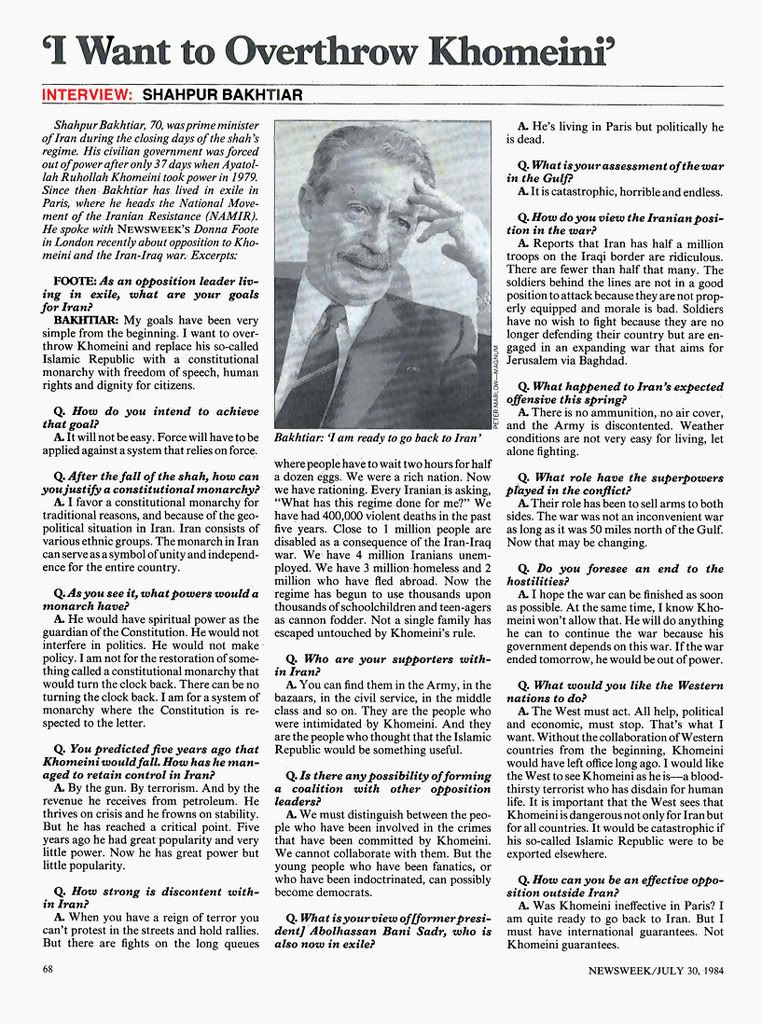 Also see this video-clip on Dr Bakhtiar giving one of his powerful nationalistic speeches in exile:
And finally visit this page which has been created in memory of this great Iranian patriot:
http://www.shapourbakhtiar.com/
My previous entry on H.E. PM Bakhtiar.
Tuesday, January 16, 2007
16th January, 1979
A dark day in Iran's history; a day when Iranians let down a great patriot and embraced their enemy.


16th January, 1979 ; on this cold and somber day, His Imperial Majesty the Shahanshah of Iran decided it would be best to calm tensions by leaving his beloved country.
Vicious anti-Shah propaganda published by the enemies of Iran, with the help of western news outlets like the BBC, had created a tense situation in Iran. The Islamists, Communists, Islamo-Marxists, and a group calling themselves ReligiousNationalists (oxymoron! >> Islamists in sheep's clothing) where all contributing their uttermost to destabilize the country and overthrow the Shah.
With a handful of Iranian soil, the Shahanshah and his wife the Shahbanou of Iran bid farewell to the country which they had dedicated their lives to. At the airport loyal members of the Imperial Guard tried to persuade the Emperor from leaving. Members of the cabinet paid their respects. The Shah had empowered PM Shahpour Bakthiar to save the country.
In the end the forces of darkness would take over the country and establish an Islamic Republic; ushering in their now 28 years of terror, war, death, destruction, poverty, misery, and dictatorship.
Today 70% of the Iranian population is under 30 years old. They had no hand in this treason which transformed their glorious country and ancient monarchy into an Islamic Republic. Today 70% of Iranians are paying the price of the "treasonous fathers and mothers of '79".
See album on 1979-1980
END POST
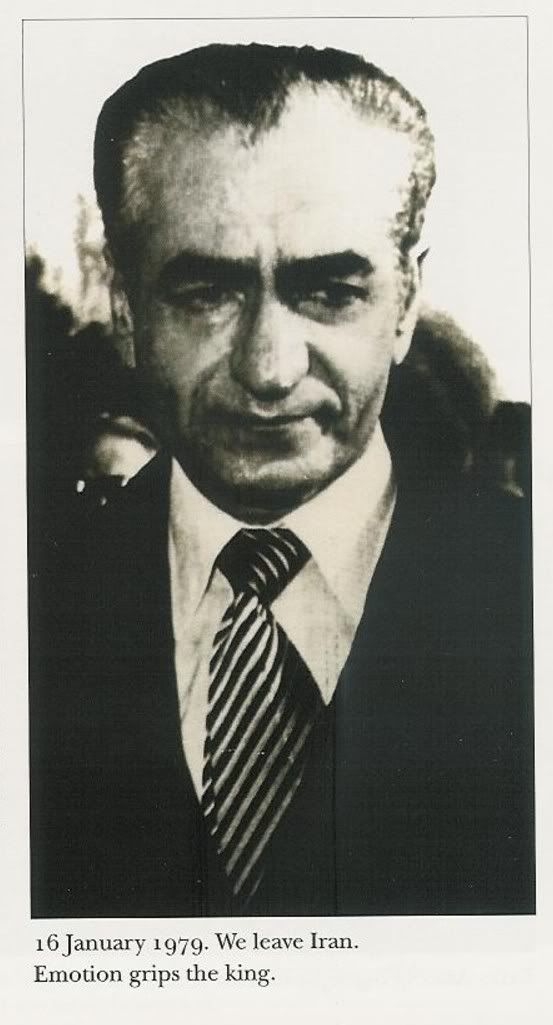
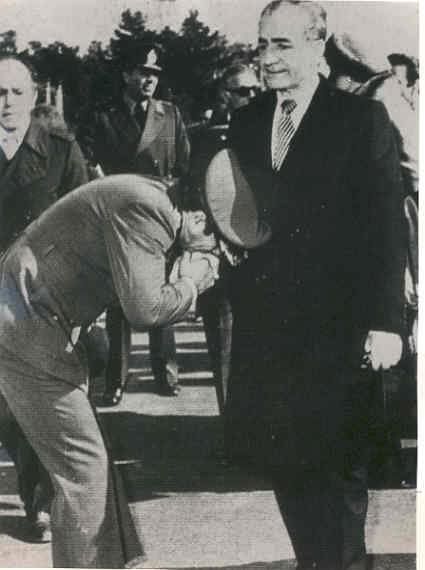

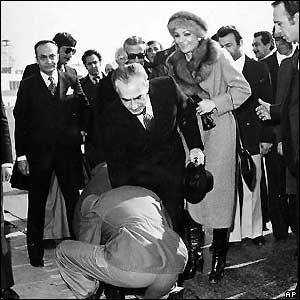
16th January, 1979 ; on this cold and somber day, His Imperial Majesty the Shahanshah of Iran decided it would be best to calm tensions by leaving his beloved country.
Vicious anti-Shah propaganda published by the enemies of Iran, with the help of western news outlets like the BBC, had created a tense situation in Iran. The Islamists, Communists, Islamo-Marxists, and a group calling themselves ReligiousNationalists (oxymoron! >> Islamists in sheep's clothing) where all contributing their uttermost to destabilize the country and overthrow the Shah.
With a handful of Iranian soil, the Shahanshah and his wife the Shahbanou of Iran bid farewell to the country which they had dedicated their lives to. At the airport loyal members of the Imperial Guard tried to persuade the Emperor from leaving. Members of the cabinet paid their respects. The Shah had empowered PM Shahpour Bakthiar to save the country.
In the end the forces of darkness would take over the country and establish an Islamic Republic; ushering in their now 28 years of terror, war, death, destruction, poverty, misery, and dictatorship.
Today 70% of the Iranian population is under 30 years old. They had no hand in this treason which transformed their glorious country and ancient monarchy into an Islamic Republic. Today 70% of Iranians are paying the price of the "treasonous fathers and mothers of '79".
See album on 1979-1980
END POST
Monday, October 02, 2006
"The Water Is Polluted In Its Source"

A very interesting and enlightening essay that i'd like to bring to your attention.
Posted and translated by our compatriot Khorshid on ActivistChat.com
Link to ActivistChat: An Essay By Amir Sepehr
**********************************
The Water Is Polluted In Its Source (click for original persian link)
By Amir Sepehr
Hezbe Mihan (Monarchist)
Jan 2005
(Unauthorized translation)
http://www.hezbemihan.com/
In evaluating our problems, we’ve fallen into the habit of occupying ourselves more with speculative discussions. I have personally experienced that those of us who are political occupy ourselves with opinions before dealing with facts. The same is true when we try to get a message across. We spin the morsel some fifty times before feeding it to the mind of our readers and listeners. We subject our speech to a thousand bends and turns and deliver it using unfamiliar terms to demonstrate our level of understanding. The result is that in our country they take people’s eyes out and cut off their limbs, but we style ourselves as the greatest intellectuals on the planet!
We’ve yet to learn that showing off in speech is a sign of ignorance and that it is such displays of talent (which would have no buyer even in the Bazaar for the artless) that has been the cause of our miseries and misfortunes. If I don’t write in such a way so that more than 70% of my readers get my message and comprehend what I’ve written, then I’ve only been showing off, that’s all. Even the learned among us confuse addressing ordinary people (and who isn’t one) with academic and specialized discussions of the university. This disease has even affected the clergy, so that these days, just about every Mullah in every single idiotic writing of his, will refer to two or three philosophers, and four or five world famous authors to imply his proximity to the society of the masters of Arts and letters!
I write this preface to underline the bitter truth that, alas, a society seemingly full of thinkers and intellectuals has fewer intellectuals in the true sense than the number of one’s fingers. If it had, how could it be in such a state of disgrace, helplessness and confusion? It’s not my intention to recite a mournful song, and begin a sorrowful story by recounting for the thousandth time, that which has brought us to this point. But if you and I remain silent, if you and I don’t try to understand, we will once again fail to recognize what we’ve been doing wrong. We are still going the wrong way, and not just one or two, here and there, but probably in tens or hundreds of thousand. And that, apparently the most educated among us (at least they regard themselves as such!). You may then add this to the preface: You know best!
What pained my illiterate mother (a most frugal woman from a village) or your house-owning aunt that, in order to have it relieved, they had to follow the likes of Mullah Khalkhali and Hadi Ghaffari? What about my poor late uncle, who had no idea what an Islamic revolution meant? Once he came to visit us from Ardabil, thinking of joining the protesters. When I objected, he shouted “Sonny, you mean to say that all these university folk, doctors, engineers, and intellectuals are all a bunch of donkeys to have chosen Imam Khomeini as their leader?” Perhaps, were he alive today, he would have realized the truth in the reply by hearing of which he then really lost his temper. Laughing
Let us go back twenty-five years. Our hopes had been met sooner than all other nations in that part of the world. We were, perhaps, the first to reach liberty. To reach the 1979 juncture, our parents had labored for some 200 years. We were two steps, yes two steps, away from liberty. I’m referring to the Shah’s last Prime Minister, Shapour Bakhtiar, who sacrificed his life for his country. His government was the result of several generations’ struggle and self-sacrifice. But where was one to find an intelligent person who understood the pulse of the nation. One may not have expected much from the “common” people, who with the flimsy rope provided them, had entered a bottomless pit looking for a treasure box. None among the self-styled intellectuals and political types understood that incomparable and unique window of opportunity, and did not realize that: Hey, enough! Henceforth we must protect what we’ve gained, and not continue burning banks, destroy governmental buildings, and sacrifice our reason, our mind, our country, our honor, our prestige, our history, our culture, our dignity, our good name, and our nation’s wealth to welcome the arrival of the Mullahs.
If our “intellectual” was intellectual, if our “nationalist” understood nationalism, if our political types had a clue about politics, you may judge for yourselves where we would be today. I wont pretend that we would be a Switzerland or Sweden, but I write without any doubt that not only we would be one of the wealthiest and most prosperous nations in the world, but that we would also have a democracy proportional to ourselves as well, along with a secular government, which we already had! Our children too, instead of starving in schools, would benefit from free milk and fruits, as they already did! Had we intellectuals and political activists worthy of such designations, would we have incurred a million dead and invalids from the war alone? How many millions of drug addicts would we have? Would we see our loved ones displayed for sale in Arabian slave markets? Would our honor and prestige been as blemished in the world? Would our national resources been put on sale?
Ebrahim Yazdi, himself a key figure in the transformation of Sheiks and Mullahs into the lords and chieftains atop the Iranian people, and the person most responsible for handing over the elites among the brave officers of the Iranian Imperial Armed Forces to the lunatic and bloodthirsty Mullah Khalkhali, happened to give an interview this year on the occasion of the anniversary of the occupation of the US embassy. Do you know what he said? I shall quote him verbatim so that we learn the condition of our economy as the Shah was leaving Iran. I do not have the slightest doubt that while speaking of these figures, Yazdi was not even a bit embarrassed or felt any pain of conscience. Let us understand what has happened to us in these dark years; let us think why the Iranian people are reduced to selling their kidneys in order to survive. Readers will note that the figures concern our holdings in the US government alone, as in the period under discussion we had tens of other investments in the US private sector. One of these was the ownership of one of the tallest buildings in Manhattan, which, when I was young, I had visited as an observance of my national pride. I had my picture taken in front of its entrance. It was 1977, two years before the revolution. The Islamic Republic sold the skyscraper and the Mullahs pocketed the money. A few years ago, when I chanced to pass by it again, I saw standing about a few Iranian-speaking drug addicts. One of them, who had a dog, and was about the same age as I, when I had first visited the building, stood begging near the spot where I had taken my picture. (Is it even possible not to burn with rage when thinking of common thieves who style themselves after “intellectuals”?)
In addition to investments, we had reserves of ready cash in all other industrial nations of the world. France had borrowed a billion dollars from us; so had Britain. But here is an excerpt from Yazdi’s interview with ISNA (Nov 2, 2004):
“Billions of dollars of US weapons, including strategic weapons, fighter jets and submarines had been paid for and needed spare parts, and we had to settle this. There were unfinished projects that had already been fully paid for, and we needed to settle that. In Iran’s revolving funds account in the US Department of Defense, there was some 33 billion dollars. Spare parts and military equipment for the Iranian armed forces were all paid for and waiting in US airports, ready for delivery. Before the revolution the surplus from the oil revenue was looked after in US banks. In the United States we had some 14 billion dollars of ready cash.”
I wrote that it is not my intention to bemoan the past; what has passed has passed. But have we, the intellectuals and the politically minded among us in particular, learned anything from the experience of our destructive acts? Have we? Perhaps I should share with you a day’s observation on the subject, leaving you to make your own conclusions. Of course, this is a simple and commonplace illustration. The individuals I’ll refer to I consider victims themselves, victims of those, whom from intellectualism have only learned how to abandon a nation wandering in the desert, and how to mistake the realm of the fantasy and the intangible with obvious things and actual potentials in the world of politics. Oh! May they have never read those 15 or so volumes they did read!
As you know I live in Stockholm. Here all the residential buildings have their own laundry room below the ground floor, normally used by the residents through reserving a time slot on a computerized board. Three days ago it was my turn. It usually takes about an hour to wash your clothes. After placing their washables in the machines, people either return to their apartments and return an hour later, or take a seat and pass the time by reading a book or newspaper.
Anyway, after throwing my clothes in the washer I returned to my apartment. I turned on the television. They were showing a ceremony in remembrance of the Swedes who had lost their lives in the Southeast-Asian Tsunami, in the same hall where the Nobel ceremonies take place. Their King, seated; the Queen, accompanied by their three children. The Prime Minister, all the ministers, present. Members of the Parliament. The clergy. According to the reporter in the live telecast, some 700 cultural and intellectual figures, the main leaders of all Swedish political parties, lawyers, artists and in short all the important people in Sweden are present in this gathering.
First, His Majesty Carl Gustaf, the King of Sweden, gives a very emotional and moving speech. This is followed by a speech by Prime Minister Goran Persson. A chorus of female students, beautifully and impeccably dressed, sings a very emotional song. A few religious songs in soprano follow. The musicians play their instruments so emotionally that one’s entire body becomes affected. In between, the clergy perform ceremonies of prayer and eulogy. The poets recite humanist poems, poems that bring people together. National harmony, the spirit of helping and cooperation, unity, sympathy, dignity, civilization, respect, proper attire, culture, humanism, serenity and, in one sentence, the poetic, intelligent and dignified aspect of humanity is displayed at its peak. I look at my watch. I’ve been so engaged with this program that I am 15 minutes late already to pick up my clothes. I’m very much moved by these aspects of civilization and social-cultural progress. I cry in my heart, “Until when…”
I enter the laundry room. As I enter, I see two Persian speakers engaged in a political discussion. (May God Bestow His Abundance! Thanks to the Mullahs’ “Justice of Imam Ali” regime, Iranian refugees can be found in every nook and corner!) I know one of them very well. Like 93% of all Iranians, he is a poet. But he had had money, and had published a few 17-paged booklets of poetry, thenceforth becoming one of the thinkers and intellectuals. He is a radical member of the MEK, and not very warm toward other views.
I know the other a little. I know that he calls himself a communist. The subject of their conversation is ideology (Mine is better than yours!). Besides a courteous hello, I have no desire at all to enter their discussion. But how is that possible, when they don’t leave you alone! Our Mister Communist regards Sweden, a country that has provided him with asylum and opportunities, a backward capitalist country. He speaks of nothing but Mansour Hekmat and labor issues in Iran. He is of the opinion that in a not so distant future his party will not only free Iran, but will free the world from the shackles of capitalism. Why did you settle in a backward monarchy like Sweden, I ask; why didn’t you go to an advanced country like Cuba or North Korea? He answers in a derisive tone, “Is that what your Shahzadeh Reza has been telling you?” He adds, “Really, one has to be pretty backward to want a monarchy.”
As to Mister Mojahed, well, he believes that Monarchy is the disgrace of history. When I remind him of the glories of history, that he and his friends began suicide missions long before the likes of Hamas and Islamic Jihad, he replies furiously that that is exactly what the Mullahs say! Adding: that’s why Masoud has repeatedly said no Shah and no Mullah! I tell him dear friend, I wish you had seen the ceremony I was just watching. I add, every nation has its own particular culture and history. Every country’s democracy is the result of struggles and historic events shaped and supported by its people. They reply, one somewhat differently than the other, that Sweden too should do away with all this Monarchy nonsense; these are all swindles by capitalism and class society. I reply with just one more sentence and pick up my laundry. Of course, I say it in my heart:
Why did God short-change the Swedes on the number of thinking poets and intellectuals so that the country’s backward and poor Shahollahi (Monarchist) population could too enjoy the benefits of a Supreme Leader, a Revolutionary Guards, and an Ansar al-Islam?
END POST
Subscribe to:
Posts (Atom)
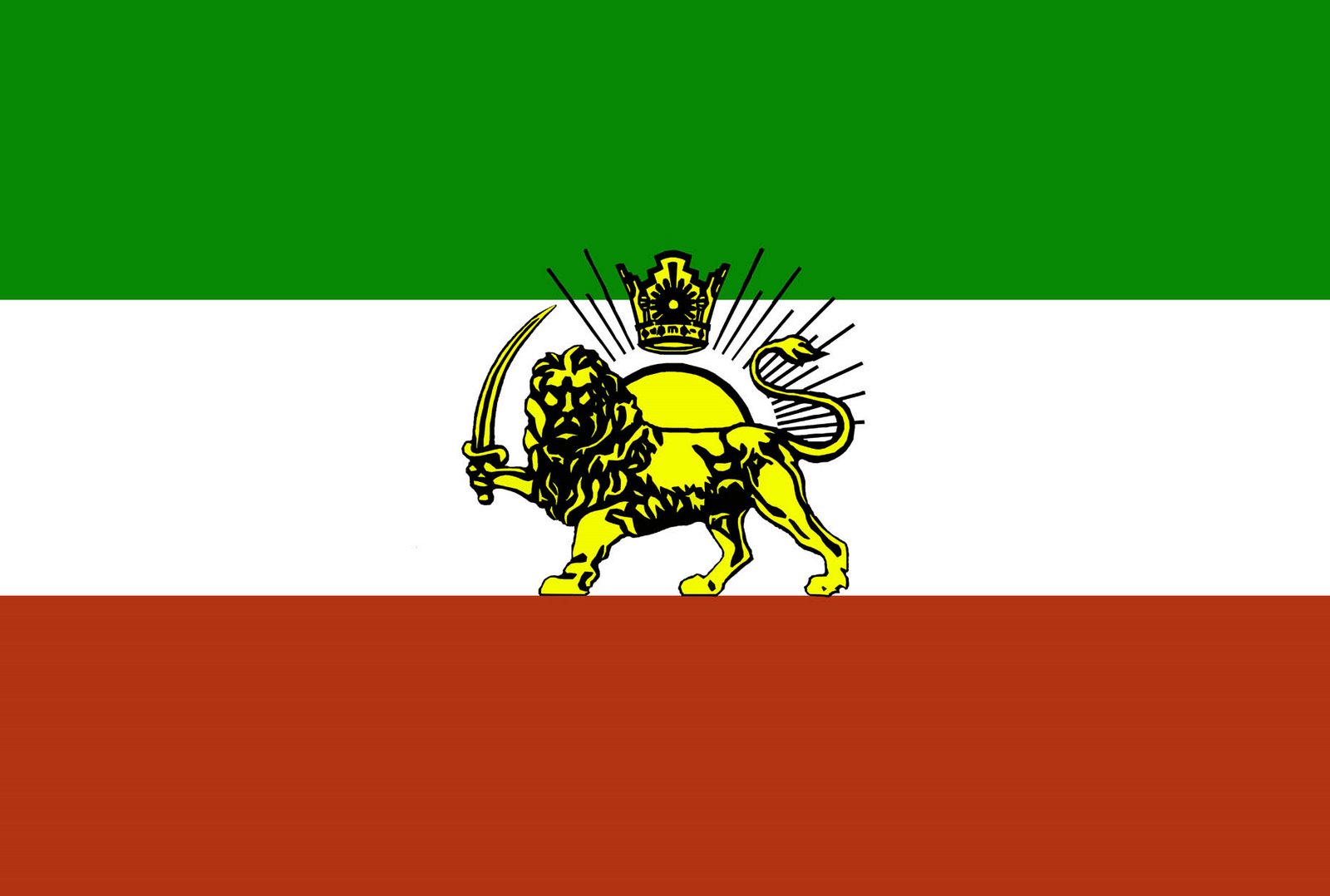


 Posts
Posts