HIM Reza Pahlavi II and HIM Shahbanou Farah Pahlavi's speeches at an official memorial service, held on Jan 23rd, for HIH Prince Ali-Reza Pahlavi:
A photoslide of the event can be found HERE.
Monday, January 24, 2011


Monday, January 10, 2011
Prince Ali-Reza - Cremation - Caspian Sea

There is little published information regarding Prince Ali-Reza Pahlavi of Iran.
Since his passing, there are some personalities that claim he may not have been free to express himself or partake in interviews - which seems very unfortunate.
However, from the little bits of information which we have been able to hear/read in the past few days since his passing, I'd like to share my personal views on Prince Ali-Reza Pahlavi.
It seems that Prince Ali-Reza Pahlavi was a very disciplined man much like his father and grandfather before him; an attribute that has been mentioned is that he had "military discipline which reflected his royal background". He was active in sports and had a strong interest and affection for his motherland and its rich cultural heritage. So much so that in forced-exile he chose to dedicate his time towards research in the field of ancient (pre-Islamic) Iranian studies and philology (ancient Iranian languages) both as a postgraduate master's and more recently on a phd level at Harvard University.
Family and friends close to him say that he always had a smile on his face and that he was an optimist. From a young age he was the more lively, playful, more daring perhaps, child of the late Shahanshah of Iran and Shahbanou Farah Pahlavi.
With this background information, Prince Ali-Reza Pahlavi's wish for his body to be cremated seems to be a powerful message regarding his personal beliefs. Someone that had a passion for pre-Islamic Iran and who had dedicated a significant part of his adult life studying in this field, and now with his passing having expressed his wish to be cremated and his remains to be scattered in the Caspian Sea in northern Iran - one cannot help but feel the late Prince's immense sense of patriotism - and in that a clear rejection of the hate-filled anti-Iranian Islamic ideology which has caused such pain to his fellow compatriots and which stands in stark contrast towards true and noble Iranian ideals. In Islam cremation is seen as something that is "categorically disapproved", "prohibited, disrespectful and a violation of islamic law", "forbidden, sinful and pagan" just to quote a few references to cremation by islamic scholars. Also noteworthy is that cremation was widely practiced in ancient Iran - even preceding Zoroastrianism (an ancient Iranian faith). If this is so, was his wish to be cremated then an act of defiance? an act of rebellion? a symbolic gesture? By doing this, was he finally able to express himself after so many years of being seemingly silenced? After so many years of not being able to express himself, his views, his hopes, his aspirations for his homeland...
Friday, January 07, 2011
Prince Ali-Reza - Caspian Sea
HIM Shahanshah Aryamehr with HIH Prince Ali-Reza Pahlavi walking along Iran's northern Caspian Sea shorelines during a family holiday (1970's).

HIM Shahbanou Farah Pahlavi with HIH Prince Ali-Reza Pahlavi at Iran's northern Caspian Sea shorelines during a family holiday (1970's).

According to HIM Crown Prince Reza Pahlavi his brother Prince Ali-Reza has left a will in which he expresses the wish for his body to be cremated and scattered in the Caspian Sea.
HIM Shahbanou Farah Pahlavi with her son Prince Ali-Reza.


HIM Shahbanou Farah Pahlavi with HIH Prince Ali-Reza Pahlavi at Iran's northern Caspian Sea shorelines during a family holiday (1970's).

According to HIM Crown Prince Reza Pahlavi his brother Prince Ali-Reza has left a will in which he expresses the wish for his body to be cremated and scattered in the Caspian Sea.
HIM Shahbanou Farah Pahlavi with her son Prince Ali-Reza.

Tuesday, January 04, 2011
HIM Prince Ali-Reza Pahlavi 1966-2011

It is with great regret that I just read HIM Crown-Prince Reza Pahlavi's statement on HIH Prince Ali-Reza Pahlavi's passing at the age of 45.
The Pahlavi family, as millions of Iranians worldwide and inside Iran, have endured tremendous hardship since the Islamic Republic usurping power in an armed insurgence in 1979 - from having to bare witness to the destruction of the efforts by some of the finest statesmen, civil servants, artists, military officials in Iranian history who helped build a proud, prosperous, and progressive nation, to an 8-year long war which led to hundreds of thousands of Iranian soldiers/civilians being needlessly killed. The reign of terror that has prevailed in Iran since the creation of this destructive anti-Iranian regime, the daily repression and savage murdering of innocent Iranian lives at the hands of Islamic terrorists, alongside the death of HIM the late Shah of Iran had a tremendous affect on the Pahlavi family and led to HIH Princess Leila Pahlavi ending her life in 2001 at the young age of 31.
I would like to convey my deepest condolences to the Iranian nation and the Pahlavi family - especially HIM the Empress and the Crown Prince.
May his soul be at peace.
********************
The Suicide Of Alireza Pahlavi: A Revolt Against Forced Exile
Sunday, December 26, 2010
Saturday, December 18, 2010
Brigadier General Saeed Mehdiyoun

An old account (2004) by Mahmoud Ghaffari on late Brigadier General Saeed Mehdiyoun.
************************
Top gunned down
Mastermind of the Nojeh coup attempt
Mahmoud Ghaffari
July 22, 2004
His left eye was gouged out, leaving an empty socket, his body was riddled with bullets, and his entire torso was black and blue from torture. This was the scene the wife of the late Brigadier General Saied Mehdiyoun saw, when she was summoned to reclaim the body of this great patriot. In fact she had to pay a dollar for every bullet used to murder him, so that his executioners could replace their inventory!
This is the scene replayed thousands of times in the Great Islamic Republic of Iran, during the first few years of the revolution and ominously still continuing to today.
Last week is the 24th anniversary of the Nojeh coup attempt, masterminded by this outstanding highest ranking officer of the Imperial Iranian Air force and many other patriots who lost their lives in the clutches of the Islamic fundamentalists. Any one, who remembers the events of those days, can only draw one conclusion; that the events of the world for the next twenty years were shaped by such animalistic and terrorist acts. We all kept quiet, solemnly dowsed in our own sorrows for the lost lives, but could never imagine, that a group of about 2000 backward clerics, can do such damage and cause so much mayhem, because of their blind and unsubstantiated faith in religion.
Heroes like Mehdiyoun are not amongst us any more, but imagine what Iran would be like today, had the heroic acts of this man and the hundreds like him who tried to save Iran from the clutches of abysmal tyranny would have succeeded.
Mehdiyoun was the son of a wealthy Tabriz merchant. He started his professional life as a dentistry student and for some reason or another switched over and joined the Imperial Iranian Air force. He moved through the ranks and became one of the handful of "Top Gun" F-4 Phantom fighter pilots. Schooled at a US Air Force base in Alabama, during the late 50's and early 60's, his star was on the rise through out his military career.
He was one of the few that the Imperial sovereign could trust. He was considered one of the top 5 commanders of the Air Force. His tenure in the Air Force took him to command positions for the Shahrokhi 3rd tactical air base in Hamadan, and Vahdati 4th Tactical air base in Dezful. His final command position was Commander of the Air Defense Command, or "Padafande Havaie".
Mehdiyoun was a loyal officer, one who had taken an oath to protect and serve the unity of Iran and serve his sovereign to the last drop of blood. This concept unfortunately is foreign to the zealots running Iran to the ground at the moment. Such loyalty and sacrifice stems back to the time of the Great Persian Empire and the Immortal guards of Cyrus the Great.
When His wife was signing the papers to release his lifeless body, a revolutionary guard present at his execution recounted that he never renounced his beliefs. When he was asked to kneel and get ready for his execution, he responded with, "I will never kneel in front of you ..."
Right or wrong, good or bad, we have to agree that commitment, dedication to excellence and the love of Iranian soil drove many of these heroes of Iran's great past. They may never be duplicated and until such time that the Islamic Republic is ruling Iran the armed forces will never be restored to its glorious level it had attained under the leaders of the past. We can concur, that if the Freedom Fighting Forces of the US decide to liberate Iran, many if not all the officers currently serving the regime will abandon their posts in a fraction of the time it took the Arab thugs to do so in Iraq.
I had the honor of knowing this man and experienced first hand his devotion to his oath of office. He was always forthright and candid, and I think that had to do with his Azeri upbringing, and it was his assertiveness and command of those reporting to him, that made the Monarch take a liking to this man.
I have been a sideline observer of the events inside Iran. Now in the post 9/11 world, I can see why actions by the likes of Mehdiyoun are so much part of world history -- not only Iran's. Had his heroic effort been successful, it would have propelled the world and its inhabitants into a much more benign existence. All of us, be it Americans, Iranians and members of other national boundaries, should salute these heroes, as they were set to change the face of history in a more positive wake.
Saturday, November 13, 2010
Lieutenant General Ali Mohammad Khademi & Iran Air
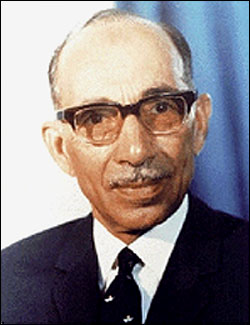
I've received the following very interesting articles on the late founder of Iran Air, Gen. Khademi, and would like to share it with the readers of this blog.
******************************************
KHADEMI, Ali Mohammad (1913-1978), Air Force officer, first general manager of Iran Air 1962-78
Encyclopedia Iranica
KHADEMI, Ali Mohammad (ʿAli Moḥammad Ḵādemi, b. Jahrom, Fars, 30 November 1913; d. Tehran, 7 November 1978), pilot, officer, and first general manager of Iran Air (FIGURE 1). Khademi was a career officer in the Air Force, who was promoted in 1966 to lieutenant general (sepahbod). He served from 1962 until 1978 as the general manager of Iran Air, the newly founded national flag-carrier, which under his stewardship became a very successful domestic and international airline. In 1970-71 he served as president of the International Air Transport Association (IATA).
Family and eduction. His father Loṭf-Allāh Ḵādemi belonged to a prominent Muslim family. In the early 1900s he joined the Bahai faith, and the subsequent persecution forced him to leave everything behind and to move in 1927 his family to Isfahan. ʿAli Moḥammad attended high school in Isfahan and graduated in 1932 at the top of his class. He passed the demanding entrance examination of the Military Academy (Dāneškada-ye afsari) in Tehran, and graduated with honors in aviation studies in 1936. The following year he graduated with distinction from the Air Force Flying School (Āmuzešgāh-e ḵalabānān-eniru-ye havāʾi).
Air Force. Khademi joined the Air Force (Niru-ye havāʾi-e Irān) in 1938, and continued with his pilot training. He was the first Iranian to receive a commercial pilot license from the British Civil Aviation Authority in 1948, and in 1957 he completed a training course at the U.S. Air Force University in Montgomery, Alabama. In 1958 he was promoted to Chief of Staff (raʾis-e setād), and became lieutenant general in 1966. Khademi contributed to the modernization and expansion of the Air Force by fostering cooperation with the U.S. Air Force, the most technologically advanced air force in the world (Aṭrvaš, p. 263).
Iran Air. In 1962, when Iran Air was founded, Khademi was selected as its general manager. Shortly after the appointment, he completed the Air Transport Senior Management course at the American University in Washington, D.C. During his 16-year tenure at Iran Air, the company was transformed from a fledgling domestic airline to a thriving national flag-carrier. Iran Air had started in 1962 with a fleet of 13 old propeller airplanes and less than 700 employees, and in 1978 the company owned a modern fleet of 37 Boeing jets and had close to 12,800 employees. Its routes included the major destinations in the Middle East, Europe, the U.S.A., and the Far East, and this expansion was the result of bilateral negotiations that were initiated and led by Khademi (Aṭrvaš, p. 13). Under Khademi's stewardship, the net equity of the company increased eight-fold, though the company did not receive any government subsidies. Iran Air became one of the country’s most profitable government-owned enterprises and the highest foreign-currency earner after the National Oil Company. The company attained one of the best safety records of any airline in the world, and maintained one of the first Middle East technical service stations in Iran, which was certified by the U.S. Federal Aviation Agency (Adams, p. 25). In addition to his responsibilities as general manager, Khademi served as the chairman of Iran Air's Board of Directors from 1977 until 1978.
Khademi’s management style was often praised by peers and colleagues, since he emphasized a team approach to develop the company's managerial skills (ʿAlāʾi, p. 203; Milani, p. 454; Rahavard." href="http://www.iranica.com/uploads/files/khademi_fig_2.jpg">FIGURE 2). He relied on the most advanced industry-wide technologies and practices, and consequently he played an active role in promoting modern management education in Iran. From 1968 until 1974 Khademi served as the chairman of the Board of the Iran Management Association (Anjoman-e modiriyat-e Irān), and became the driving force behind its expansion. The association founded seven new chapters in the capitals of Iran's major provinces, and government and private sector executives collaborated in order to organize management trainings. The first management congress was held in Iran, and Khademi became a prominent contributor to the Iranian Center of Management Studies (Markaz-e moṭālaʿāt-e modiriyat-e Irān) in Tehran, a management school affiliated with Harvard University. Between 1976 and 1977, Khademi was an early supporter and mentor of the European Economic Forum, the predecessor of the World Economic Forum (ʿAlāʿi, p. 203). Khademi was instrumental in founding the first College of Planning and Computer Science (Madrasa-ye aʿlā-ye barnāma rizi o kārbord-e kāmpiuter) in Tehran in 1973, and served as a member of its board until 1978. He also sat on the board of Damavand College, and was an advisor to the International Rotary Club.
Khademi was a member of IATA's Executive Committee, and was the organization's first Asian president from 1970 until 1971. He belonged to the Governing Board of Civil Aviation of Iran (Havā-peymāʾi-e kešvari-e Irān). In 1977 Khademi’s outstanding achievements in the fields of civil aviation and management were recognized with an honorary doctorate from Northrop University, which cited his leading role in the advancement of the airline industry in Iran as well as his important and effective services to the field of international air transport (Shell; FIGURE 3).
In 1944 Khademi married Bahia Moʾayyad, the daughter of Dr. Ḥabib Moʾayyad, the first physician from Kermānšāh who had been educated in Western medicine. They had one son and two daughters. Due to the political instability during the months leading up to the Revolution of 1979, Khademi resigned from his position as Iran Air's general manager on 9 September 1978. On 7 November 1978, two days after the declaration of martial law, Khademi was assassinated at his home before the eyes of his wife. Later investigations suggested that the assailants could have been SAVAK employees, but no motive was discovered and no one was ever charged. (Armed Forces of the Islamic Republic of Iran, Dādsetāni, file no. 401/68/3060; Dādgāh-e Kayfari, Šoʿba 180, file no. 193/64). The case remains unresolved.
**********************************
A Short Biography of
Late Lieutenant General Ali Mohammad Khademi,
The founder, chairman and managing director of IRAN AIR (1962-1978)
"No great man lives in vain. The history of
the world is but the biography of great men."
Scottish essayist and historian,
Thomas Carlyle (1795–1881)
"We all looked at him [Gen. Khademi] as a model.
He was a leader with broad views and yet able to keep
the rare qualities of a real human being."
Clemence Raffy, former Iran Air member of staff
The biographies of great people normally tend to demonstrate the magnitude of their lifetime achievements rather than their humane qualities. This short biography of Gen. Khademi, while it will illustrate the exceptional services he rendered his country and people, will certainly attempt to reveal his profound benevolent characteristics and moral fibre, some of which were not probably very well known to those other than the people associated closely with him.
Ali Mohammad Khademi was born in the Iranian southern city of Jahrom in the historical province of Fars on December 16, 1913. During his childhood the family life got pretty dour and though. When he was four years old, he lost his mother. Subsequently, the father and son left for the Iranian ancient city of Esfahan. They lived in Esfahan for several years, where he completed his primary and high school years. His exceptional intelligence was noticeable from his years at high school, when he taught mathematics and other subjects to his classmates. In 1932 after obtaining his high school diploma in mathematics, he went to Tehran to participate in the entrance examination of the military academy, where he stood first among hundreds of participants. At the end of his three year studies at the military academy he was transferred to the Iranian Imperial Air Force and soon after became a flight instructor. Around 1940 he began to fly for the Iranian State Airlines, a semi commercial airline operated by Iranian ministry of post and telegram, which at the time mainly carried mail, emergency cargo, some government personnel and occasional paying passengers. While flying as a pilot for the said airline with the rank of captain, he obtained his Airline Transport Pilot (ATP) license from the British as well as the Iranian Civil Aviation Organization and become the first ever Iranian commercial pilot.
Later when Iranian Airways started operations in 1946, he was one of the first Imperial Iranian Air Force pilot officers who were assigned to fly with the company as first officer and soon later as a captain. In 1949 he returned to the Air Force. Prior to becoming the Imperial Iranian Air Force Chief of Staff in 1958, he held senior training and operational positions and became the adviser to the Imperial Iranian Armed Forces’ general staff and commandant of the Air Force Staff College. During his tenure of service, he obtained a pilot and navigation license from Britain, attended the USAF command and Staff School of the Air University at Montgomery, Alabama as well as the Air Transport Senior Course in Washington, DC. In addition to that he never missed senior management seminars and courses.
Although this short biography will mostly concentrate on one of his most important achievements between 1962 and 1978 with Iran Air, it is most appropriate, however, to mention that his management ideas and valuable contributions to the Imperial Iranian Air Force helped this force to become one of the world’s best, was of utmost significance. Before his assignment to Iran Air, he held several prominent positions in the air force. He created, for the first time, the Air Force Air Transport Unit, when he was a colonel. His last position in the force was chief of staff.
In 1962, Gen. Khademi, with the rank of major general, was appointed managing director of Iran Air. From the very beginning, his vision for building and running a high standard international airline for Iran was very clear, because since many years prior to that, Khademi always had the dream of founding the ideal airline for his country.
At the outset, he clearly specified his objectives and prepared a detailed plan to accomplish them. The most important item on his agenda was the safety of Iran Air crew and passengers. While he did not count out the company's high standard service and profitability; but since by nature, he always had a great respect for and put high value on human beings lives, therefore, he reiterated that for him, nothing was ever more important than the airline's safety. As a result of that during his many years with the company, Iran Air did not have a single tragic accident. In 1973, three well known journalists who performed extensive research to write a book called "Destination Disaster", about the safety of the world's airlines, classified Iran Air as one of the few world’s safest. It was for the same reason that he put a great importance on the type of aircraft Iran Air acquired and the excellence of the company’s engineering and maintenance and flight operations department.
Khademi was greatly concerned about all the company staff’s overall welfare and training with a high priority for the flight crew and engineering personnel training. For the first time in the history of
commercial air transport in Iran, a group of most talented young men fresh from the school were selected and dispatched to the best schools in the United States to become professional pilots.
Whenever he wanted to make a decision or take an action in relation to the company, he first and foremost thought as how the most ordinary people and the travelling public would benefit from that. He, therefore, created a situation that made air travel available to every Iranian from all classes of society and not limited only to the affluent groups. To make this possible, he introduced a special 40% discount for the travel of government employees and their families, which was in fact widely expanded to beyond that group. This initiative made international travel affordable for almost every Iranian. In a short period of time Iran Air passenger and cargo traffic increased so significantly that more and more airplanes were needed every year. His success in building Iran Air to become a world class airline in a short period of time, amazed the aviation community around the world. At this stage Iran Air was regarded as the fastest growing airline in the world.
When he took over the company from Iranian Airways, the former owned only three turboprop Vickers Viscounts, three DC-6s and three DC-3s, and 600 employees with a limited network mostly operating within Iran and to the neighbouring countries. However, 16 years later the company possessed a fleet of 35 all jet aircraft of Boeings and Air Buses, a team of 12000 trained personnel and carried 5 million passengers per year on its routes in Iran and a worldwide from New York to Tokyo, covering 53 destination in Europe, Middle East, Asia, Far East and Persian Gulf. For the first time Iranians felt very proud of their national airlines.
Khademi had an exceptional talent in selecting the best people for Iran Air. He looked out and selected the most capable and qualified people to work with him. In the process he was particularly eager to choose young candidates from among the deprived societies and gave them extensive opportunities to grow within the company.
Being extremely factual, Khademi had a flair for and special interest in numbers. He often surprised his colleagues with quick calculations without using a calculator. He was an ardent believer in modern management and at one point he said and believed professional management is superior to expertise.
A large number of Iranian believed Khademi was one of the most outstanding men Iran had in a long time and some are of the opinion that had he given the opportunity to run the state instead of the airline he would have taken the country in a different direction and Iran would have been a completely different country than it is today. He was a symbol of hard working, smart and lots of fun and excitement to be around. No matter how tired he was, he was always anxious to get to work. His legacy is not just in his individual accomplishments, but also in his ability to lift the spirit of those around him to a higher level. He was an extremely brave man and a huge source of inspiration and motivation for the people working with him. Once he recognized the talent in a person, he would arouse so much confidence in that person to make him a incredibly self-motivated for the rest of his/her life.
He was the first airline chief from the Middle East countries to acquire this position and in this role too, he contributed significantly to the betterment of the international air transport, as admitted by the IATA and other airlines executives.
Khademi was an extremely conscientious and honest person. In Iran, the head of a national airline, like in most other countries, is much of a political position and in every country and government politic is a dirty game. Going through the process of holding a high office and coming out clean and uncorrupted takes an exceptional personality, and Ali. Mohammad Khademi was an outstanding example of this. Even 23 years after his departure from office and his death, still no one has attached any dishonesty or misconduct to him and his military or civil service.
General Khademi loved and was loved by his colleagues who nicknamed him simply as "Timsar," a title normally used before a general’s rank which implies respect. And he was indeed highly respected, not only by Iran Air employees but by any Iranian and non-Iranian who knew him. He was regarded and cherished for his good intentions, works and services to the country. Respecting superiors is a part of Iranian culture, however, the type of respect he received did not necessarily stem from his position; but was earned because of his knowledge, leadership, humane qualities and as the father of the Iran Air family. This self-made, quick moving man always respected his colleagues’ ideas and opinion. At the outset of Iran Air, he carried a pen and notebook and wrote down employees’ suggestions and comments to be considered and gradually acted upon in due course.
In the airline industry, in some ways, Gen. Khademi could be compared with Juan Tripp the famous American aviation legend and veteran, the Pan American's long time CEO. Tripp gave American aviation the most of what todays Americans are proud of. Gen. Khademi to Iran and Iran Air was what Juan Trip was to America and Pan American, with one distinction that after Trip left Pan Am, the airline collapsed. But Iran Air could have grown and prospered had the situation not changed. However, under Khademi’s leadership, Iran Air was so marvellously engineered and solidly structured so that even now, 24 years later, that this airline has been subjected to so much mismanagement and mishandling and despite the fact that the company’s most important assets, the majority of its experienced managers and personnel have left, the organization is still operative and serving Iranian people.
Khademi was a leadership and management genius. A man ahead of his time, he never took any nonsense from anyone unless it was beyond his power. When his colleagues were talking to him, they had to take extra caution not to make any unfounded statements. Suggestions, presentations and even simple talks should have been supported by facts and figures. He passionately believed in facts, figures, data and statistics.
Iran Air was his life; he loved Iran Air and its entire staff so much that when he was assassinated few months after he left office in November 1978, one Iran Air manager said, "In fact, he died on the day he left Iran Air," referring to his sad and emotional departure from his beloved airline and people.
There are numerous stories about his humane feelings and compassion. One day in a directors' meeting he started by saying, "In the winter, when you are sitting in your offices and you feel so warm that you pull off your jackets, or in the summer when you feel so cold that you put on your jackets; think about your colleagues who are working at the open areas of the airport day and night in the direct heat of the summer and under the freezing cold of the winter." He never forgot other people, particularly the underdogs.
One of the former Iran Air area managers in Europe was saying, one day when Gen. Khademi was hospitalized, he and his wife went to visit him. After few minutes of staying with him, he told the couple that there was an Iranian lady in the room down the corridor who apparently didn't have any relatives or friends in this town and he suggested to his visitors to share the time they have spared to visit him, with her.
Khademi was an ardent nationalist. He was one of the most ingenious self-made leaders and managers our country had seen in many years. He was a devoted husband to his wife, Bahieh (Moayed), and loving father to his two daughters, Mona and Minou and son Monib. Above all he was a most compassionate, considerate and kindhearted person whose love and legacy will remain and be remembered for ever.
Gen. Khademi, resigned from office as the Chairman and Managing Director of Iran Air in September 1978 and was brutally assassinated at his home in north Tehran on November 7, 1978. Certainly, this short biography will not cover all his outstanding achievements and superior personality. Therefore, it is very much hoped that the future book or books about him and the Iranian airline industry will pay him the tributes this great man deserves. May his soul rest in peace.
****************************
Mr Darius Kadivar's tribute to Gen. Khademi:
Lieutenant General Ali Mohammad Khademi, for a long time and before Iran Air, had the vision of building an ultimate flag carrier for Iran. He was a gifted, self-made, tireless, hard-working man and a management and leadership genius. He was an uncompromising fighter with unusual fortitude and self-confidence, who didn't accept anything less than perfect. Utterly fair and honest, he possessed a strong humane spirit, an extremely light heart and wonderful sense of humor. He hated favoritism and selected his colleagues on their merit. He gave young men and women, particularly those who were not from, or related to the privileged class, unprecedented opportunities for growth.
Obsessed with his dream and charged with infinite passion and stamina, he took over the airline and built a national carrier that every Iranian was proud of. While the Iran Air success story is attributed to a team of highly dedicated managers and staff, no one can ignore the fact that the history of modern aviation in Iran revolves around one person and that was Gen. Khademi, who among other things, hand-picked and coached a group of capable men and women to run Iran Air. Due to the political instability during the months leading up to the Revolution of 1979, Khademi resigned from his position as Iran Air's general manager on 9 September 1978. On 7 November 1978, two days after the declaration of martial law, Khademi was assassinated at his home before the eyes of his wife. The circumstances of his assassination and eventual culprits remain mysterious to this day. Khademi was a great man whose name will go down in history for the highest level of service to his country's aviation industry. Alas, the abrupt eruption of circumstances did not allow him to complete his dreams particularly the 15-year plan to expand Iran Air into one of the World's leading airlines. And a pity that Homaiyan, as he used to call the Iran Air family, and did not get the chance to give him that magnificent recognition he always deserved, during his lifetime. May his soul rest in peace.
Sunday, October 31, 2010
HIM Reza Pahlavi II founds two non-profit organizations
 HIM Reza Pahlavi II has founded two non-profit organizations, Iran Democratic Union (IDU) in the United States and Association pour le Rassemblement et la Democratie en Iran (ARDI) in Europe. The purpose of these non-profit organizations will be to support various Iranian pro-democracy and human rights initiatives. Financial support will be critical in realizing the planned goals and projects that are being pursued. For more information please visit: "Iran Democratic Union"
To view the results of the Q&A forum that was recently launched on HIM Reza Pahlavi II's official website please see "Reza Pahlavi II Q&A"
Friday, October 29, 2010
Reza Shah the Great & President Kamal Ataturk (1934)
Rare footage of Reza Shah the Great, founder of modern Iran, seen here conversing in persian & turkish with His contemporary President Ataturk at a state visit to Turkey.
Subscribe to:
Posts (Atom)



 Posts
Posts