"A Century Of War : Anglo-American Oil Politics and the New World Order", written by William Engdahl, a German historian, covers how oil and politics have been intertwined for the past 100 years.
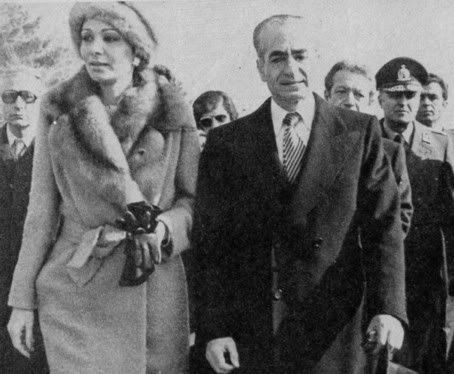
Below I have included a passage extract, concerning Iran, taken from this book. The author obviously has bought into the popularized version that the CIA re-instated the late Shah of Iran in 1953 when this is far from the truth as I have discussed earlier in my blog posts. What is interesting in this book though is how the author outlines the mechanisms that were put in place to undermine the Iranian Government, under the leadership of the Shah of Iran, and to support the radical opposition groups that worked against the Iranian state.
"In November 1978, President Carter named the Bilderberg group's George Ball, another member of the Trilateral Commission, to head a special White House Iran task force under the National Security Council's Brzezinski. Ball recommended that Washington drop support for the Shah of Iran and support the fundamentalistic Islamic opposition of Ayatollah Khomeini. Robert Bowie from the CIA was one of the lead 'case officers' in the new CIA-led coup against the man their covert actions had placed into power 25 years earlier.
Their scheme was based on a detailed study of the phenomenon of Islamic fundamentalism, as presented by British Islamic expert, Dr. Bernard Lewis, then on assignment at Princeton University in the United States. Lewis's scheme, which was unveiled at the May 1979 Bilderberg meeting in Austria, endorsed the radical Muslim Brotherhood movement behind Khomeini, in order to promote balkanization of the entire Muslim Near East along tribal and religious lines. Lewis argued that the West should encourage autonomous groups such as the Kurds, Armenians, Lebanese Maronites, Ethiopian Copts, Azerbaijani Turks, and so forth. The chaos would spread in what he termed an 'Arc of Crisis,' which would spill over into Muslim regions of the Soviet Union.
The coup against the Shah, like that against Mossadegh in 1953, was run by British and American intelligence, with the bombastic American, Brzezinski, taking public 'credit' for getting rid of the 'corrupt' Shah, while the British characteristically remained safely in the background.
During 1978, negotiations were under way between the Shah's government and British Petroleum for renewal of the 25-year old extraction agreement. By October 1978, the talks had collapsed over a British 'offer' which demanded exclusive rights to Iran's future oil output, while refusing to guarantee purchase of the oil. With their dependence on British-controlled export apparently at an end, Iran appeared on the verge of independence in its oil sales policy for the first time since 1953, with eager prospective buyers in Germany, France, Japan and elsewhere. In its lead editorial that September, Iran's Kayhan International stated:
In retrospect, the 25-year partnership with the [British Petroleum] consortium and the 50-year relationship with British Petroleum which preceded it, have not been satisfactory ones for Iran … Looking to the future, NIOC [National Iranian Oil Company] should plan to handle all operations by itself.
London was blackmailing and putting enormous economic pressure on the Shah's regime by refusing to buy Iranian oil production, taking only 3 million or so barrels daily of an agreed minimum of 5 million barrels per day. This imposed dramatic revenue pressures on Iran, which provided the context in which religious discontent against the Shah could be fanned by trained agitators deployed by British and U.S. intelligence. In addition, strikes among oil workers at this critical juncture crippled Iranian oil production.
As Iran's domestic economic troubles grew, American 'security' advisers to the Shah's Savak secret police implemented a policy of ever more brutal repression, in a manner calculated to maximize popular antipathy to the Shah. At the same time, the Carter administration cynically began protesting abuses of 'human rights' under the Shah.
British Petroleum reportedly began to organize capital flight out of Iran, through its strong influence in Iran's financial and banking community. The British Broadcasting Corporation's Persian-language broadcasts, with dozens of Persian-speaking BBC 'correspondents' sent into even the smallest village, drummed up hysteria against the Shah. The BBC gave Ayatollah Khomeini a full propaganda platform inside Iran during this time. The British government-owned broadcasting organization refused to give the Shah's government an equal chance to reply. Repeated personal appeals from the Shah to the BBC yielded no result. Anglo-American intelligence was committed to toppling the Shah. The Shah fled in January, and by February 1979, Khomeini had been flown into Tehran to proclaim the establishment of his repressive theocratic state to replace the Shah's government.
Reflecting on his downfall months later, shortly before his death, the Shah noted from exile,
I did not know it then – perhaps I did not want to know – but it is clear to me now that the Americans wanted me out. Clearly this is what the human rights advocates in the State Department wanted … What was I to make of the Administration's sudden decision to call former Under Secretary of State George Ball to the White House as an adviser on Iran? … Ball was among those Americans who wanted to abandon me and ultimately my country.[1][1]
With the fall of the Shah and the coming to power of the fanatical Khomeini adherents in Iran, chaos was unleashed. By May 1979, the new Khomeini regime had singled out the country's nuclear power development plans and announced cancellation of the entire program for French and German nuclear reactor construction.
Iran's oil exports to the world were suddenly cut off, some 3 million barrels per day. Curiously, Saudi Arabian production in the critical days of January 1979 was also cut by some 2 million barrels per day. To add to the pressures on world oil supply, British Petroleum declared force majeure and cancelled major contracts for oil supply. Prices on the Rotterdam spot market, heavily influenced by BP and Royal Dutch Shell as the largest oil traders, soared in early 1979 as a result. The second oil shock of the 1970s was fully under way.
Indications are that the actual planners of the Iranian Khomeini coup in London and within the senior ranks of the U.S. liberal establishment decided to keep President Carter largely ignorant of the policy and its ultimate objectives. The ensuing energy crisis in the United States was a major factor in bringing about Carter's defeat a year later.
There was never a real shortage in the world supply of petroleum. Existing Saudi and Kuwaiti production capacities could at any time have met the 5-6 million barrels per day temporary shortfall, as a U.S. congressional investigation by the General Accounting Office months later confirmed.
Unusually low reserve stocks of oil held by the Seven Sisters oil multinationals contributed to creating a devastating world oil price shock, with prices for crude oil soaring from a level of some $14 per barrel in 1978 towards the astronomical heights of $40 per barrel for some grades of crude on the spot market. Long gasoline lines across America contributed to a general sense of panic, and Carter energy secretary and former CIA director, James R. Schlesinger, did not help calm matters when he told Congress and the media in February 1979 that the Iranian oil shortfall was 'prospectively more serious' than the 1973 Arab oil embargo.[2][2]
The Carter administration's Trilateral Commission foreign policy further ensured that any European effort from Germany and France to develop more cooperative trade, economic and diplomatic relations with their Soviet neighbor, under the umbrella of détente and various Soviet-west European energy agreements, was also thrown into disarray.
Carter's security adviser, Zbigniew Brzezinski, and secretary of state, Cyrus Vance, implemented their 'Arc of Crisis' policy, spreading the instability of the Iranian revolution throughout the perimeter around the Soviet Union. Throughout the Islamic perimeter from Pakistan to Iran, U.S. initiatives created instability or worse."
-- William Engdahl, A Century of War: Anglo-American Oil Politics and the New World Order, © 1992, 2004. Pluto Press Ltd. Pages 171-174.
[1][1] In 1978, the Iranian Ettelaat published an article accusing Khomeini of being a British agent. The clerics organized violent demonstrations in response, which led to the flight of the Shah months later. See U.S. Library of Congress Country Studies, Iran. The Coming of the Revolution. December 1987. The role of BBC Persian broadcasts in the ousting of the Shah is detailed in Hossein Shahidi. 'BBC Persian Service 60 years on.' The Iranian. September 24, 2001. The BBC was so much identified with Khomeini that it won the name 'Ayatollah BBC.'
[2][2] Comptroller General of the United States. 'Iranian Oil Cutoff: Reduced Petroleum Supplies and Inadequate U.S. Government Response.' Report to Congress by General Accounting Office. 1979.






 Posts
Posts