Tuesday, February 10, 2009
'30 Years After the Islamic Revolution in Iran'
Click HERE to read an entry by my fellow blogger Potkin Azarmehr, who does an excellent job in delivering a status report 30 years after Leftist/Islamic alliance violently took to power in Iran.


Iranian Empress, Farah Pahlavi, Discusses New Documentary
'Light Will Win Over Darkness'
Iran's Former Empress Discusses New Documentary
By Golnaz Esfandiari, RFE/RL

The former empress of Iran, Farah Pahlavi, is the subject of a newly released documentary from an unlikely source -- Iranian-born filmmaker Nahid Persson, a former communist who took part in the 1979 revolution.
"The Queen And I" follows the former empress and her onetime opponent as they share ideas and concerns about the country they were both forced to leave. Farah Pahlavi speaks to RFE/RL correspondent Golnaz Esfandiari about her decision to participate in the documentary, screened at the Sundance Film Festival in January.
RFE/RL: Why did you agree to take part in "The Queen And I" -- the documentary by Nahid Persson, in which you are the subject?
Farah Pahlavi: I always have a positive view and affection toward my countrymen, especially those young artists who have been successful inside and outside Iran.
So, when Nahid Persson asked to do this -- since I had seen two of her documentaries, including one about prostitution in Iran, which was very painful but she had done it with courage, and also another one about a man in Iran who has four wives and wants to marry a fifth -- because of that I accepted to work with her and participate in the documentary.
RFE/RL: Were there any moments when you regretted your decision?
Pahlavi: Yes, this comes also in the movie. After some time [working together], I received several e-mails informing me that she was a communist in her youth, she was a member of a communist group that I hadn't heard of. Naturally I started having doubts, and I thought to myself, "All these 30 years, with all the problems, all the attacks against me by the Islamic republic or negative articles by opponents, all these years I did my best to tell, in hundreds of interviews with TV networks, press and other media, what I see as the truth and realities of the monarchy and also the realities of today's Iran."
I had doubts because the person who makes a documentary is in charge of the camera, filming, and also editing, so I was a bit concerned. I thought to myself, "This lady was young and was unfortunately from a [low-income family] and at that age and that time, they would think that communist ideas would bring justice and equality." And all the slogans at that time were about freedom. But I have traveled to [former] communist countries and there was no sign of social justice or freedom.
Then I thought, "Why shouldn't I have a dialogue with people who in the past had different political opinions?" What is important for us is that we're Iranians and we have to think about Iran's future, and I know that some of those who were part of the opposition have come and said with courage that they are sorry for what they did. It's true that there were some shortages at that time, but there was no need for such a horrible revolution. Of course, there are also those whose opinion will never change.
RFE/RL: What would you describe as the biggest highlight? The most interesting part of the documentary?
Pahlavi: For me, the interesting thing about this documentary is that two people in different positions and with different political ideas can talk to each other. In the documentary we don't have an official meeting, we talk to each other, we tell each other our problems.
I think in that sense it is interesting, but I leave it to the audience. Everyone might see a different thing in the documentary.
RFE/RL: How was your first meeting with Persson? Did you feel you were meeting someone from another world?
Pahlavi: Even in the past, during the monarchy, some of our ministers had a communist or leftist past, so it wasn't the first time for me. At first when we met, we didn't know each other. Aside from the differing political views, it takes time to get used to a new character and personal behavior. When we slowly got to know each other, it was easier to talk.
It's been 30 years that I haven't had the status I once had, yet I still have a special feeling for my countrymen.
RFE/RL: Have you seen the final version of the documentary? What did you think about it?
Pahlavi: I've seen the final version. Certain things are said there; there are certain issues that I don't agree with. To a certain degree she was free to do this, but I wished she had given me the same opportunity as she had given to herself to express her views when she was by herself, so that I could have also expressed my views. And I think it would have made the documentary more interesting and it would have been more fair.
RFE/RL: Could you give us an example?
Pahlavi: Well, for example, the notion that were no political freedoms in the past. I've said it myself in many places that the conditions of the country were such that, at the time, it was not possible to guarantee those freedoms and the late Shah [Mohammad Reza Pahlavi] always used to say that after him, his son, the prince, would rule differently.
And there were scenes that didn't make me happy, but one cannot be content about everything. I have given many interviews during these years, but I never knew what the results would be. I always express my views -- but a journalist, a filmmaker, also adds his or her view.
RFE/RL: What is the message of the documentary in your view?
Pahlavi: For me, the most important thing is that we're two people who have or had different political philosophies or views -- maybe we became closer. We have to think about Iran's tomorrow, we have to think about Iran's today, and we have to put the issues we had in the past behind us. I think this is the documentary's most important message.
I am sure that what may be an issue for some of us is not an issue anymore inside Iran. For the women of Iran, for Iran's young people, for Iranians from different classes and groups -- they want to have a better life, they want to be able to make a living, have jobs and a comfortable life, they want to be able to live freely, have better health care. You know, these are more important for Iranians inside the country than ideas and differences that we had 50 years ago.
RFE/RL: The 30th anniversary of the Iranian Revolution is being celebrated these days. What are your thoughts on this?
Pahlavi: Sometimes I can't believe that 30 years have passed, because I still live everyday with the thought of Iran and Iranians on my mind. I naturally think, like [many] Iranians, that if this horrible revolution hadn't happened, our country with its immense national wealth, natural resources, and its human richness, what a place it could have had in that region. It's really regrettable after what happened to the security of Iran, and the region is threatened, and its threat has reached the world.
I am really hopeful and I will not give up hope for the freedom of Iran, for the improvement of Iran's situation. I hope that Iran will regain the respected place it had in the international community -- and I greet all the women and young people; workers and intellectuals and villagers; and all Iranians who, despite all the problems and pressure, are still fighting to have a better life and for the future of their country. I always believe that light will win over darkness.
UPDATE 1: BBC interview with Empress Farah Pahlavi (in persian) can be found HERE.
Iran's Former Empress Discusses New Documentary
By Golnaz Esfandiari, RFE/RL
The former empress of Iran, Farah Pahlavi, is the subject of a newly released documentary from an unlikely source -- Iranian-born filmmaker Nahid Persson, a former communist who took part in the 1979 revolution.
"The Queen And I" follows the former empress and her onetime opponent as they share ideas and concerns about the country they were both forced to leave. Farah Pahlavi speaks to RFE/RL correspondent Golnaz Esfandiari about her decision to participate in the documentary, screened at the Sundance Film Festival in January.
RFE/RL: Why did you agree to take part in "The Queen And I" -- the documentary by Nahid Persson, in which you are the subject?
Farah Pahlavi: I always have a positive view and affection toward my countrymen, especially those young artists who have been successful inside and outside Iran.
So, when Nahid Persson asked to do this -- since I had seen two of her documentaries, including one about prostitution in Iran, which was very painful but she had done it with courage, and also another one about a man in Iran who has four wives and wants to marry a fifth -- because of that I accepted to work with her and participate in the documentary.
RFE/RL: Were there any moments when you regretted your decision?
Pahlavi: Yes, this comes also in the movie. After some time [working together], I received several e-mails informing me that she was a communist in her youth, she was a member of a communist group that I hadn't heard of. Naturally I started having doubts, and I thought to myself, "All these 30 years, with all the problems, all the attacks against me by the Islamic republic or negative articles by opponents, all these years I did my best to tell, in hundreds of interviews with TV networks, press and other media, what I see as the truth and realities of the monarchy and also the realities of today's Iran."
I had doubts because the person who makes a documentary is in charge of the camera, filming, and also editing, so I was a bit concerned. I thought to myself, "This lady was young and was unfortunately from a [low-income family] and at that age and that time, they would think that communist ideas would bring justice and equality." And all the slogans at that time were about freedom. But I have traveled to [former] communist countries and there was no sign of social justice or freedom.
Then I thought, "Why shouldn't I have a dialogue with people who in the past had different political opinions?" What is important for us is that we're Iranians and we have to think about Iran's future, and I know that some of those who were part of the opposition have come and said with courage that they are sorry for what they did. It's true that there were some shortages at that time, but there was no need for such a horrible revolution. Of course, there are also those whose opinion will never change.
RFE/RL: What would you describe as the biggest highlight? The most interesting part of the documentary?
Pahlavi: For me, the interesting thing about this documentary is that two people in different positions and with different political ideas can talk to each other. In the documentary we don't have an official meeting, we talk to each other, we tell each other our problems.
I think in that sense it is interesting, but I leave it to the audience. Everyone might see a different thing in the documentary.
RFE/RL: How was your first meeting with Persson? Did you feel you were meeting someone from another world?
Pahlavi: Even in the past, during the monarchy, some of our ministers had a communist or leftist past, so it wasn't the first time for me. At first when we met, we didn't know each other. Aside from the differing political views, it takes time to get used to a new character and personal behavior. When we slowly got to know each other, it was easier to talk.
It's been 30 years that I haven't had the status I once had, yet I still have a special feeling for my countrymen.
RFE/RL: Have you seen the final version of the documentary? What did you think about it?
Pahlavi: I've seen the final version. Certain things are said there; there are certain issues that I don't agree with. To a certain degree she was free to do this, but I wished she had given me the same opportunity as she had given to herself to express her views when she was by herself, so that I could have also expressed my views. And I think it would have made the documentary more interesting and it would have been more fair.
RFE/RL: Could you give us an example?
Pahlavi: Well, for example, the notion that were no political freedoms in the past. I've said it myself in many places that the conditions of the country were such that, at the time, it was not possible to guarantee those freedoms and the late Shah [Mohammad Reza Pahlavi] always used to say that after him, his son, the prince, would rule differently.
And there were scenes that didn't make me happy, but one cannot be content about everything. I have given many interviews during these years, but I never knew what the results would be. I always express my views -- but a journalist, a filmmaker, also adds his or her view.
RFE/RL: What is the message of the documentary in your view?
Pahlavi: For me, the most important thing is that we're two people who have or had different political philosophies or views -- maybe we became closer. We have to think about Iran's tomorrow, we have to think about Iran's today, and we have to put the issues we had in the past behind us. I think this is the documentary's most important message.
I am sure that what may be an issue for some of us is not an issue anymore inside Iran. For the women of Iran, for Iran's young people, for Iranians from different classes and groups -- they want to have a better life, they want to be able to make a living, have jobs and a comfortable life, they want to be able to live freely, have better health care. You know, these are more important for Iranians inside the country than ideas and differences that we had 50 years ago.
RFE/RL: The 30th anniversary of the Iranian Revolution is being celebrated these days. What are your thoughts on this?
Pahlavi: Sometimes I can't believe that 30 years have passed, because I still live everyday with the thought of Iran and Iranians on my mind. I naturally think, like [many] Iranians, that if this horrible revolution hadn't happened, our country with its immense national wealth, natural resources, and its human richness, what a place it could have had in that region. It's really regrettable after what happened to the security of Iran, and the region is threatened, and its threat has reached the world.
I am really hopeful and I will not give up hope for the freedom of Iran, for the improvement of Iran's situation. I hope that Iran will regain the respected place it had in the international community -- and I greet all the women and young people; workers and intellectuals and villagers; and all Iranians who, despite all the problems and pressure, are still fighting to have a better life and for the future of their country. I always believe that light will win over darkness.
UPDATE 1: BBC interview with Empress Farah Pahlavi (in persian) can be found HERE.
Sunday, February 08, 2009
Anti-Pahlavi propaganda on the Islamic Republic's TV channels IRIB's Jame-Jam 1 & 2
Please see fellow blogger SarbazeKuchak's blog on the Islamic Republic's stepped up anti-Pahlavi propaganda efforts during the terrorist regime's month of celebrations commemorating their takeover of the Iranian state.
This is how they try to brainwash younger generations to fall in line with their ideology through constant historical revisionism, lies, and exaggerations.
سرباز كوچك: propaganda-Jame Jam-irib 1-irib 2-islamic republic
This is how they try to brainwash younger generations to fall in line with their ideology through constant historical revisionism, lies, and exaggerations.
سرباز كوچك: propaganda-Jame Jam-irib 1-irib 2-islamic republic
Saturday, February 07, 2009
11 February, 1979 - Day of National Mourning - Iran
22 Bahman - Rooze Azaaye Melli
11 February, 1979 - Iranian Army command commit treason by declaring neutrality against the muslim and leftist guerilla forces, consequently leading to the takeover of the entire state by these terrorist entities. The occupational forces of the Islamo-Leftist alliance declare an Islamic Republic and commit mass executions of Iranian statesmen, military officials, and other personalities loyal to their King and Country. Ever since an Islamic occupation has been in place in Iran, with terrorist forces in charge of all government institutes and security forces.
30 years of death, destruction, thievery, and misery will have passed on this date this year.
Wednesday, February 04, 2009
Will there be an IRI 5.0?!

The Supreme Leader of the terrorist Islamic Republic occupying Iran have a laugh on how well they have fooled the Iranian nation and western audience with the idea of presenting their terrorist theocratic system with the notion that there exists a "conservative" and "reformist" faction within this very system, when in fact both these actors (reformist/conservative) are die-hard loyalists sworn to protect the very same terrorist regime and its anti-Iranian foundations!
The terrorist Islamic Republic occupying Iran is gearing up to fool the Iranian nation once again with promises of "reform". Mullah Khatami, the Islamic Republic's smiley-face, has recently announced his candidature for the Islamic Republic's sham elections. The Islamic Republic is once again playing their "reformist" card and the western media will be all over it once again with statements describing Mullah Khatami as "modernist", "reformist", "liberal", "progressive" etc. fooling their naive audiences with such utter nonsense. What is imperative now though is to see if the Islamic Republic succeeds once again in making a fool out of the Iranian nation or if Iranians have learned their lesson by now - which is that no faction of this terrorist ILLEGAL OCCUPYING force is legitimate nor do they exist to serve the best interest of the Iranian people. What should be pretty darn clear by now is that the only good mullah is one buried 6ft below the ground! Although the results of their sham elections are rigged and pre-determined, with candidates being handpicked by the regime, a strong statement in the form of visible boycotts/protests/demonstrations against this terrorist regime's daring game's will send a strong message to the western audience and the regime itself that ENOUGH IS ENOUGH. If not Iranians should prepare themselves to continue living as prisoners in their own country, as they have for the past 30 years, and stay idle as the terrorist Islamic Republic executes political activists, continues to destroy Iranian cultural heritage, degrade Iranian women to a 2nd rate citizens, etc etc...
LINK 1 (Khatami announces candidacy)
LINK 2 (IRI 1.0-4.0)
Monday, January 26, 2009
White Revolution (clip)
The late Iranian Emperor's expansive reform-programme launched in 1963 was named as the "White Revolution" due to it being a blood-less and progressive transformation.
Uploaded by Ariapars.
Friday, January 23, 2009
Anbanou / Shahbanou


"Shahbanou" is a persian term for "Empress" (Shah = Emperor / Banou = Lady). This is the title bestowed upon the current Iranian Empress (in exile) Farah Pahlavi (right in picture).
Iranians under Arabo-Muslim occupation are referring to the President of the occupational Islamic Republic's (AhmadiNejad) wife as "Anbanou" (left in picture). "An" which is a persian for "excrement" is a term Iranians have bestowed upon and use to refer to the occupational Islamic Republic's President AhmadiNejad. "Anbanou" recently came out of the miserable hole which AhmadiNejad keeps her in and made some comments about providing aid to palestinians, in which the above exclusive photo of this reclusive muslim specie was made.
"Antar" is another persian term meaning "monkey" which is also used to refer to AhmadiNejad due to his close resemblance to a monkey. Yet another term is "Ahmagh", meaning idiot, which fused with AhmadiNejad's name makes "AhmaghiNejad (Ahmagh = Idiot / Nejad = offspring/descendant/race = Descendant of Idiot). These are but a few references which Iranians use to refer to these inhumane anti-Iranian muslim creatures, thus you should not be surprised if you hear an Iranian refer to AhmadiNejad as "President AN", "Antar", "AhmaghiNejad" or his wife as "Anbanou" etc........
Hopefully in the near future Iranians will cleanse Iranian society of all these an's, antar's, & ahmagh's!!!
Wednesday, January 21, 2009
Anti-Shah Propaganda
The anti-Shah camp’s propaganda centres on a few topics which they ardently stick to and repeat to death until some ignorant fool buys into it. I was reading a commentary by an anonymous compatriot (on a certain site which I do not like to advertise on my blog) and would like to share this compatriot’s answers to the repetitive propaganda used by the anti-Shah camp. I have formatted the anonymous user’s replies and added my own commentary to it as well.
Anti-Shah propaganda (1): If Shah was so great as many claim here, why there was an uprising (revolution) by millions of Iranians who toppled him from power?
Answer: One might expect a short and sweet answer to this question but if one is not aware of the complex circumstances that built up to the Islamo-Leftist takeover one might very well be duped into believing that the revolt was a popular one. First of all, despite there being large crowds, reaching the hundreds of thousands, there are no confirmed statistics of the actual crowds that were demonstrating but the numbers which are used by the Islamic Republic and other symphatizers are based on actual eye-accounts with substantial exaggeration added to these subjective accounts that run in the millions (!). Having said that, there were indeed very large crowds out demonstrating, causing havoc, destruction and spilling of innocent blood.
Why were they demonstrating? Well for the Islamo-Leftist factions in these crowds they were against the late Shah’s democratization efforts and modernization plans that were in effect. The clergy was especially infuriated because they had lost the huge amount of lands which they had owned at the hands of the government which had confiscated these lands in their land redistribution plan. The muslim clergy was also feeling their influence and power over Iranian society slowly eroding due to the progressive agenda of the government and thus were fighting to keep their livelihoods of leeching upon Iranian society’s ignorance. The left in particular disliked the fact that the Shah was harsh on leftist guerrillas and factions whose allegiance were to the Soviet Union and the fact that he was such a close ally to the U.S. These two potent forces had thus joined in what the late Shah of Iran called an un-holy alliance of Red (Leftists) and Black (Islamists), hellbent on destroying the Shah and his progressive vision of a prosperous, democratic, and modern Iran. To this end they had embarked on a massive propaganda campaign to spread lies and exaggerations about the late Shah and the Iranian Government. As an example, according to Akbar Ganji and Emadin Baghi (themselves revolutionaries and intelligence officers of IRI), revolutionaries exaggerated corruption of the Shah’s Government (from murders to embezzlements and everything in-between) by factors of between 100 and 1500 to justify their take-over of the country. They also lied about the future, in the form of promises they made to the masses, from free bus service to free electricity and delivery of 350 tomans (Iranian currency) to everyone’s house every morning. In effect those who bought into these lies and exaggerations had ambitious expectations of heaven upon earth by supporting the armed insurrection and demonstrations against the Shah’s government – this despite their living standards being one of the best in the region, having risen from that of being a dirt poor, disease-ridden, lawless country to one of the world’s fastest growing economies. Ungratefulness and greed is what marked the participation of many politically non-affiliated demonstrators.
Another variable in this regard, was also the unfamiliarity of people with any other system of government, even the democracies of the west. Once the exaggerations were taken out, corruption in the Shah’s government was only slightly more than that in western democracies, and by the standards of neighbouring countries would make the Iranian government look exceptionally well! This was also an issue that had been acknowledged (corruption) by the Shah and which was continuously being addressed, taking into mind that Iran was still a developing country, which albeit having taking huge steps from the state it was before the Pahlavi Dynasty, still needed more time to reach the standards expected by people in the west. People knew none of this; that no government is perfect.
Another major factor in people joining the Islamo-Leftist Revolt was the religiosity of people: they were more comfortable with likes of Ayatollah Khomeini than the late Shah of Iran. Iran had for 1400 years been partly under the yoke of Arabo-Muslim Occupation and later under the influence and control of the Muslim clergy which exercised supreme power over the population for centuries; thus Iranian society at the turn of the 20th century was not only poverty/disease/-stricken and illiterate but they were also highly superstitious due to the influence of the mullah’s/ayatollah’s in the muslim clergy. Again, great strides had been taken by the Pahlavi Dynasty to modernize and educate the country. Illiteracy levels which were in the region of 99% at the turn of the century had experienced an impressive improvement by the 1970’s. However, even with a population that can read and write this did not present a definite cure to centuries-old ingrained/indoctrinated superstition. Thus their problem (the people who had joined the demonstrations) was not that the Shah was not good enough, their problem was that the Shah mandated their daughters to go to school without hejab (Islamic female headcovering), music to be played on radio, foreign films shown on TV, alcohol served in restaurants/cafe’s, females attending universities and mingling with men freely etc… which were all “haraam” (Islamic term meaning “forbidden”) in their views; otherwise the corruption of the Shah’s government had nothing to do with 99% of the population which went about their own business day in day out.
Tying in with what I laid out earlier, they had also forgotten where they came from. When Reza Shah the Great took over the country, Iran had 3% literacy, when the Shah left the most pessimistic views show that Iran had 65%+ literacy rate. That is +60% change in 54 years. Secondly, per capita income increased from about $150 to $2400 (without adjustment for inflation). Schools opened, engineers and doctors replaced the superstitious appeal of going to the shrine of some dead muslim killer/thief/opportunist that had been glorified to sainthood by the muslim clergy. Working for companies replaced opium trade in the bazaar (traditional marketplace). All of this and more was just too much for people to digest and to accept in such a short time span, and others became greedy and arrogant, attributing all successes and advancements to themselves and not the policies of the catalyst that was the late Shah of Iran.
Having outlined the affinity with backwardedness and superstitiousness, the majority of people who participated in the revolt thus made a better connection to a regressive and backward muslim clergyman like Ayatollah Khomeini, than with a patriotic/progressive/modern individual like the Shah of Iran and the new progressive clean-cut class of tehnocrats around him.
Anti-Shah propaganda (2): If he was a patriot working for people, why he had to resort to violence, imprisonment and torture of dissidents, SAVAK, Evin, etc.?
Answer: In hindsight, one of the late Shah’s flaws might have been his unwillingness to introduce political reform in a faster pace. His main worry was that an uneducated populace would easily be taken advantage by the country’s enemies, in particular the communists, which would use the opportunity to grasp power through the peoples’ political naivety. Literature which was not deemed “appropriate” was thus censored or banned, fueling anger by both the leftist and islamist camps. Although the reasons for this censorship might have been understandable, I do not think it was the right thing to do as it gave more material to the anti-Shah camps to use in their propaganda campaign and incite more hatred. In terms of SAVAK (the national security agency of Iran), there is no government in the world that tolerates violence against its sovereignty. The overwhelming majority of people who had been arrested by SAVAK were criminals and terrorists such as Ayatollah Ali Khamenei, Ayatollah Hashemi-Rafsanjani, Masoud Rajavi etc. In any society, there is some 1% that belong to prisons for the sake of the rest, and political prisoners (majority being characters as listed above) were somewhere around 3 thousand at the time before the Islamo-Leftist Revolt (figures published by Islamic Republic officials); that is 0.01% of the population and not 100’s of thousands as was claimed by the Islamo-Leftist mob; it was these very same prisoners who upon their release brought us 30 years of disaster, death, murder and thievery.
Anti-Shah propaganda (3): If Iran was independent, free and strong, why the foreign powers used to dictate everything to him?
Answer: I do not know what independence means in this day and age. Countries are not isolated entities anymore and international relations are based on give and take where powerful countries use not-so-powerful for their interests. PM Mosaddegh tried to borrow $300M for the daily operation of his government and failed to secure a loan from America. He needed America to survive and if he was not willing to reciprocate an American favour there was no chance of a mutually beneficial relationship. So people who try to use strong political relationships between two sovereign nations such as the USA and Iran, at that time, in branding the late Shah as a puppet being dictated by the Americans are just politically naive, irrational and emotional people. Yes, he gave points to westerners (such as selling oil to America during the Arab oil embargo) and received points from the west (such as admitting 50,000 students to American universities in a massive education campaign, gaining access to sophisticated military weaponry etc). A wise leader should be willing to cooperate/negotiate with other sovereign nations in making the best of a socio-economica-political situation to help his country progress. An ignorant, foolish, and irrational leader lives on slogans of independence and allows his people suffer and remain in the past (not too different to PM Mossadegh’s radical oil nationalization drive which threw the country into an economic collapse due to the expertise of operating such a complex industry did not exist in Iran at that time!). To conclude this then, by working with major powers of that time the late Shah was able to transform a backward country with a bleak future into a progressive, modernizing, prosperous country with a bright future in store for future generations.
It should be remembered that the main reason the Islamo-Leftist Takeover was able to take place in Iran (1979) was because a small loud group of radicals with backing by powerful foreign nations was able to dupe Iranians and terrorize/shut up the silent majority who were too terrified to stand up against their massacres and threats.
Thursday, January 15, 2009
30 years - January 16, 1979
Tomorrow will mark the 30th year on the day which the late Emperor of Iran, Shahanshah Aryamehr, left Iran in an effort to calm the tensions and violence which was being fueled by foreign powers in Iran through the leftist and islamist forces within the country. In a desperate attempt to find a peaceful solution, the Iranian Emperor left Iran to avoid any further bloodshed of his countrymen and further destruction of the country's national instutions and infrastructure at the hands of the islamist and leftist militias. As the Iranian Emperor left his beloved motherland with tears in his eyes, thousands of Islamist and Leftist supporters rejoiced in the leaving of His Imperial Majesty and many previously non-affiliated/apolitical Iranians who had been brainwashed by the consistent anti-Shah campaign also celebrated the Monarch leaving the country which he had wholeheartedly dedicated his life in service to, and which thanks to the efforts of the two Pahlavi Emperor's had become a regional, independent, progressive, modernised, prosperous, and powerful state from that of being a backward, illiterate, poverty and disease-stricken, lawless land abused by foreign powers at the turn of the century.
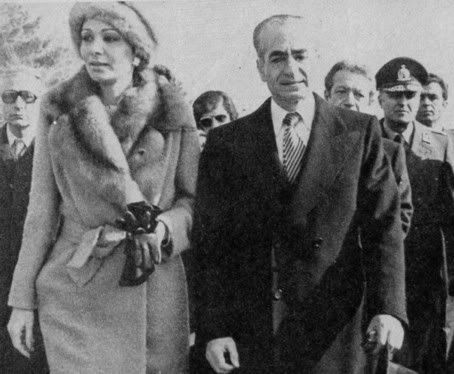 Emotion grips His Imperial Majesty, the Shahanshah of Iran, as he leaves the country he dearly loved and served for 37 years.

A member of the Imperial Iranian Armed Forces pays his last respects and reaffirms his loyalty to the leader of his country.

A member of the Imperial Iranian Armed Forces tries to prevent His Imperial Majesty from leaving.
Shortly after His Imperial Majesty left Iran, France was quick to charter a plane for Ayatollah Khomeini, the fundamentalist muslim religious leader which the west had groomed to oversee Iran's social, political, and economical destruction. On February 1, 1979, the Ayatollah arrived on a chartered Air France flight. Before landing Ayatollah Khomeini was asked by a foreign reporter what his feelings were upon returning to Iran after many years of exile - his answer was a cold and resounding "nothing"; which his translator/supporter (who apparently is somewhat more intelligent than the braindead muslim ayatollah) quickly re-interprets for the foreign journalist as: "he doesn't want to make any comments".
Furthermore at a meeting of the High Command of the Iranian Imperial Armed Forces, a treasonous declaration was agreed upon and issued (although not by all present) to declare neutrality in this conflict which threatened the Iranian nation's integrity and safety of its populace! In effect a large number of General's commited treason against the country they had sworn to serve and protect. By declaring their neutrality the Imperial Armed Forces, apart from loyal forces in the various military branches that stayed loyal to their King and Country till the very last breath of their lives, also allowed the Islamist and Leftist forces to kill and destroy as they pleased and eventually allowed the country to come under an anti-Iranian 2nd Islamic occupation.
Thousands of Iranians welcomed Ayatollah Khomeini, this anti-Iranian muslim preacher, as a "savior" whilst the majority of the Iranian nation, shocked at the events that were taking place, remained silent in their homes, too afraid to speak their minds amidst the violence and lawlessness, cautiously awaiting how the situation would develop.

Islamist and Leftist terrorist groups holding guerilla warfare & arms-instruction classes, and distributing weapons amongst their supporters in their efforts to destabalize the Iranian government and fueling more violence that will further fuel their propaganda efforts against the state.


Mass executions of Iranian statesmen, military officials, and opponents to the occupational and illegal Islamic Republic took place on a daily basis in the early years of the Islamic take-over.
After 30 years marked by war, socio-economical destruction, political repression and wide-spread executions of Iranian freedom activists, country-wide poverty, rampant prostitution and drug-use, harbouring and supporting islamic terrorist groups across the world with the Iranian nation's wealth - Iranians which were actively or passively part of those historical days today realize and admit to their naiveity, foolishness, cowardice, and anti-patriotic acts.
See my photobucket for related photos:
1979-1980 The Shahanshah of Iran
Islamic Takeover
Islamic Republic
Emotion grips His Imperial Majesty, the Shahanshah of Iran, as he leaves the country he dearly loved and served for 37 years.
A member of the Imperial Iranian Armed Forces pays his last respects and reaffirms his loyalty to the leader of his country.

A member of the Imperial Iranian Armed Forces tries to prevent His Imperial Majesty from leaving.
Shortly after His Imperial Majesty left Iran, France was quick to charter a plane for Ayatollah Khomeini, the fundamentalist muslim religious leader which the west had groomed to oversee Iran's social, political, and economical destruction. On February 1, 1979, the Ayatollah arrived on a chartered Air France flight. Before landing Ayatollah Khomeini was asked by a foreign reporter what his feelings were upon returning to Iran after many years of exile - his answer was a cold and resounding "nothing"; which his translator/supporter (who apparently is somewhat more intelligent than the braindead muslim ayatollah) quickly re-interprets for the foreign journalist as: "he doesn't want to make any comments".
Furthermore at a meeting of the High Command of the Iranian Imperial Armed Forces, a treasonous declaration was agreed upon and issued (although not by all present) to declare neutrality in this conflict which threatened the Iranian nation's integrity and safety of its populace! In effect a large number of General's commited treason against the country they had sworn to serve and protect. By declaring their neutrality the Imperial Armed Forces, apart from loyal forces in the various military branches that stayed loyal to their King and Country till the very last breath of their lives, also allowed the Islamist and Leftist forces to kill and destroy as they pleased and eventually allowed the country to come under an anti-Iranian 2nd Islamic occupation.
Thousands of Iranians welcomed Ayatollah Khomeini, this anti-Iranian muslim preacher, as a "savior" whilst the majority of the Iranian nation, shocked at the events that were taking place, remained silent in their homes, too afraid to speak their minds amidst the violence and lawlessness, cautiously awaiting how the situation would develop.

Islamist and Leftist terrorist groups holding guerilla warfare & arms-instruction classes, and distributing weapons amongst their supporters in their efforts to destabalize the Iranian government and fueling more violence that will further fuel their propaganda efforts against the state.


Mass executions of Iranian statesmen, military officials, and opponents to the occupational and illegal Islamic Republic took place on a daily basis in the early years of the Islamic take-over.
After 30 years marked by war, socio-economical destruction, political repression and wide-spread executions of Iranian freedom activists, country-wide poverty, rampant prostitution and drug-use, harbouring and supporting islamic terrorist groups across the world with the Iranian nation's wealth - Iranians which were actively or passively part of those historical days today realize and admit to their naiveity, foolishness, cowardice, and anti-patriotic acts.
See my photobucket for related photos:
1979-1980 The Shahanshah of Iran
Islamic Takeover
Islamic Republic
Subscribe to:
Posts (Atom)


 Posts