I found this clip an amusing way of depicting the fundamental nature of Mir-Hossein Mousavi - the former Prime Minister of the Islamic Republic, who oversaw the execution of tens of thousands of political prisoners in the 1980's, and which the regime has now tried to rebrand as a "reformist" alternative. All these stooges which the regime short-lists for people to vote for in their sham s-elections are regime-loyalists who defend the Islamic Republic and the rotten framework which it's built upon. It's incredibly sad to see that people would genuinely fall for this kind of obvious political charade by the Islamic regime, especially after 8 years of another of the regime's "reformist" projects - namely the smiling mullah Mohammad Khatami - which resulted in further prolonging the terrorist regime's life, more executions, arrests, and torture of Iranian pro-democracy activists all under the guise of the smiling "reformist" mullah who had hypnotized liberal western media-outlets.
Showing posts with label terrorism. Show all posts
Showing posts with label terrorism. Show all posts
Tuesday, June 08, 2010


Tuesday, February 10, 2009
Nuclear/Business...
This recommended page monitors international companies that do business with the terrorist occupational Islamic establishment in Iran. It's aim is to put pressure on these businesses and the terrorist Islamic Republic by bringing these relationships into the public eye. These companies are aiding an illegitimate TERRORIST regime through the lucrative deals which they conduct and their business dealings must be exposed for the public to judge.
Their mission purpose as stated on their page reads:
Given that the website is named "united against nuclear iran" I would like to clarify my position vis a vis this issue. My position on nuclear technology in Iran is that I fully support Iran's right to have nuclear energy as an alternative energy source and in terms of its military use that is something which I believe a responsible Iranian government has the right to have if deemed necessary for DEFENSIVE purposes - in the same light that countries like Israel, U.S.A, Russia, India, Pakistan etc have their own. What I am fully against and opposed to though is a TERRORIST, RECKLESS, SAVAGE, INHUMANE regime, like the Islamic Republic occupying Iran, having access to any nuclear technology which in their hands WILL endanger Iranian lives! I believe my stance represents the majority of freedom-loving patriotic Iranians.
Their mission purpose as stated on their page reads:
"Welcome to United Against Nuclear Iran’s (UANI) Iranian Business Registry (IBR), a running database of reputable media and academic reports of international business in Iran. Iran is uniquely susceptible to financial pressure and we hope the IBR can educate investors, policymakers, and other individuals on companies reported to have been doing business in Iran. If you have further reputable reports of international business activity in Iran or have questions regarding any of the reports, please feel free to contact UANI - we welcome all input."Iranian Business Registry (IBR)
Given that the website is named "united against nuclear iran" I would like to clarify my position vis a vis this issue. My position on nuclear technology in Iran is that I fully support Iran's right to have nuclear energy as an alternative energy source and in terms of its military use that is something which I believe a responsible Iranian government has the right to have if deemed necessary for DEFENSIVE purposes - in the same light that countries like Israel, U.S.A, Russia, India, Pakistan etc have their own. What I am fully against and opposed to though is a TERRORIST, RECKLESS, SAVAGE, INHUMANE regime, like the Islamic Republic occupying Iran, having access to any nuclear technology which in their hands WILL endanger Iranian lives! I believe my stance represents the majority of freedom-loving patriotic Iranians.
Saturday, February 16, 2008
Ebrahim Yazdi - yesterdays terrorists/criminals today's "reformists/dissidents"

Ebrahim Yazdi was born 1931 in the Iranian city of Qazvin, 165km northwest of the capital Tehran.
In 1953 Mohammad Mossadegh was removed from his Premiership (by Royal decree) due to his illegal acts against the constitution, appeasement of groups connected to the Soviet Union, and a disastrous economic policy. This event has falsely and erroneously been referred to as a coup d’ètat by the Shah and the American CIA which can’t be farther from the truth. The Shah of Iran was never “deposed” as these uninformed western sources and lying Iranian factions try to portray it as, the Shah had in fact appointed Mossadegh to the Premiership, so in effect no “coup” could come from the Shah’s part as he was the Chief of State and Head of the Armed Forces. If the term “coup” is to be used it can only be used in the context of PM Mossadegh going against the Iranian constitution of that time and suspending the Iranian Parliament. These factions who use such erroneous and revisionist statements to malign the late Shah of Iran do so under the protection of Mossadegh’s achievement of nationalizing Iranian oil – this makes it difficult for many Iranians to criticize Mossadegh since the overwhelming majority of Iranians support the nationalization of Iranian oil; having said that though, the way in which this nationalization went about was totally contrary to Iran’s interests and notably there were leaders before Mossadegh who had already brought up the idea of oil nationalization (PM Razmara) but through more pragmatic ways ensuring the national interests of Iran were taken into consideration without taking any hasty and radical decisions. Many Iranians still don’t understand the negative consequences of the way PM Mossadegh acted in the oil nationalization issue let alone domestic policy such as on the economy and illegal closure of the Parliament as well as appeasement of proxy groups of the Soviet Union seeking to undermine Iran’s national sovereignty and integrity. As for the CIA’s involvement in the events of 1953 there was an unsuccessful attempt to create unrest to topple PM Mossadegh and only after this unsuccessful attempt (whose documents are publically available) is it that Iranian masses take to the streets demanding the resignation of PM Mossadegh.
With this context in mind, it is after 1953 which Ebrahim Yazdi begins his involvement in activities undermining the state under the false excuse of being a “pro-democracy activist”. At this stage he joins a group called “The National Resistance Movement of Iran” of which one of its notable members is the notorious Islamist “intellectual” Ali Shariati. He is officially member of this group from 1953-1960. In 1960, thanks to the opportunities created for Iranian students by the Pahlavi Dynasty, Ebrahim Yazdi then 29 years old decides to continue his education in the United States. During his years in the U.S. Ebrahim Yazdi becomes a naturalized U.S. citizen - which has allowed him to travel back and forth to the U.S. unhindered (from 2000-2002 Ebrahim Yazdi was living in the U.S. and receiving cancer treatment before he returned to his colleagues in the Islamic Republic). A year after his arrival in the U.S. (1961) he becomes a founding member of a new organization referred to as the “Freedom Movement of Iran”, once again along notorious Islamo-Leftist “intellectuals” like Mostafa Chamran, Ali Shariati, and Sadegh Qotbzadeh. The term Islamo-Leftist is oxymoronic in itself as the Islamic and leftist ideology have vast ideological differences but nonetheless the common goal of undermining the Iranian government and maligning the late Shah of Iran had brought these two backward forces together in a common cause. Ebrahim Yazdi would stay in the U.S. (on and off spending time in various countries in Europe and the Middle East as well) until the Islamic coup d’état/Islamic revolution of 1979. The term Islamic in this context can be a bit misleading as it was an “unholy union by the reactionary forces of Red and Black” (as the late Shah of Iran referred to it as) which constituted the backbone of this black period in Iran’s modern history. By “black and red” it is meant the Islamic and Leftist forces respectively. It is only after the victory of the coup d’ètat/revolution that the Islamists usurp power and dissolve the unholy alliance which they had forged with the leftists (which constituted parties ranging from Communists, Marxists, Maoists etc).
During his years in the U.S. (1961-1979) Ebrahim Yazdi actively participated in the creation and running of numerous Muslim and so-called “Iranian” student association (this in addition to his political role in the “Freedom Movement of Iran”). Amongst these organizations which Ebrahim Yazdi assisted to form were the “Confederation of Iranian Students” (1960), “Muslim Students Association of the United States and Canada” (1963), the “Islamic Medical Association of the United States and Canada” (1967), and the “Islamic Society of Greater Houston” (1968).
Again the most prominent of these association in relation to the 1979 Islamic coup d’ètat/revolution in Iran was the “Confederation of Iranian Students”. This was an association whose membership was composed of none other than the leftist and islamic opposition united in their common goal of undermining the Iranian state and maligning the late Shah of Iran. As time passed this movement became further and further radicalized. Towards the second half of the 1960’s the leftist and islamist factions in Iran had launched an urban guerilla war against the Iranian state which claimed many innocent lives. Members of the “Confederation of Iranian Students” inside Iran had also attempted an assassination on the late Shah of Iran which was unsuccessful. Since their inception abroad the Confederation of Iranian students had engaged in heavy propaganda efforts against the Iranian state by gross exaggerations of the human rights situation inside the country and maligning the late Shah of Iran with false and misleading terms such as “bloodthirsty dictator”, “torturer”, “puppet” etc. As part of their propaganda efforts this group capitalized on the young, youthful, leftist movement in the west and actively built networks within their western counterparts’ associations and together orchestrated demonstrations against the Iranian government based on false propaganda and exaggerations. In Europe for example a visit by the late Shah of Iran to Germany in 1967 sparked militant student upheavals (from leftist factions) across the country and Europe-wide leftist student protests were very active in the period 1968-1969. In the U.S. members of the “Confederation of Iranian Students” joined the antiwar and radical student movements of the 1960’s and 1970’s to pursue their goals. In addition to being highly active in Germany and the U.S. other countries were this organization was vigorously involved in propaganda activities included France, England, Austria, Italy, Sweden, Turkey, Canada and even India! The goals of the “Confederation of Iranian Students” was alleviated by the fact that almost a half of Iran’s university-level student population was studying abroad – again thanks to the opportunities opened up by the Iranian government and the late Shah of Iran. Many students were indoctrinated into believing the false propaganda that this detrimental group propagated and were in this way recruited to participate in demonstrations and other efforts seeking to undermine the Iranian government. Ebrahim Yazdi also distributed cash payments to Iranian students for demonstrating against the Shah in the U.S.. In the 1970’s Ebrahim Yazdi became the primary liaison between Ayatollah Khomeini and the CIA. From this point onwards he would become a close confident of Ayatollah Khomeini and would even arrange the plans to transfer Khomeini from Iraq to France after the latter declared his presence in that country unwanted. In 1971 the activities of the “Confederation of Iranian Students” compelled the Iranian government to declare it an illegal organization. In 1975 Ebrahim Yazdi was tried in absentia by an Iranian military court for his activities against the Iranian state and was sentenced to 10 years imprisonment, with orders of arrest upon his return to Iran.
By having such an active and broad network across so many countries the “Confederation of Iranian Students” was able to the major role of influencing the public media in these countries. Soon international attention on Iran began focusing less on the rapid progress being made in the social and economic development of the country and instead began introducing terms used by the “Confederation of Iran Students” (and other opposition groups) into their reports such as “the Shah’s ruthless dictatorship”, “insurmountable repression”, “horrific torture”, “the Shah’s merciless secret police SAVAK” etc. These false and exaggerated terms were a direct result of the propaganda efforts by the Islamic and Leftist opposition groups to the Iranian government, and were quickly picked up by human rights organizations, news media, political circles, and governments each with their own interests and agenda in mind and how to exploit this.

Terrorist camp
Towards the late 1970’s militant activity by these groups against the Iranian government was prevalent and many had returned back to Iran to pursue the ongoing guerilla warfare with western human rights organizations, news media, and political circles cheering them on! In the period 1961-1979 Ebrahim Yazdi has later proudly admitted that he participated and spent time in Yasser Arafat’s terrorist PLO training camps in Lebanon in preparation for his role in the Islamic coup d’ètat/revolution; similar training camps were also provided by the Libyan government of Mohammad Qaddafi. The Shah was astounded to how old “friends” and “allies” were all of a sudden turning their backs towards Iran and supporting these terrorist factions. The Shah had underestimated the strength this radical movement possessed and in his state of terminal cancer was from the early 1970’s onwards in no state to be in a decision-making position.
 From left to right: Ebrahim Yazdi, Yasser Arafat, Hassan Khomeini, unidentified mullah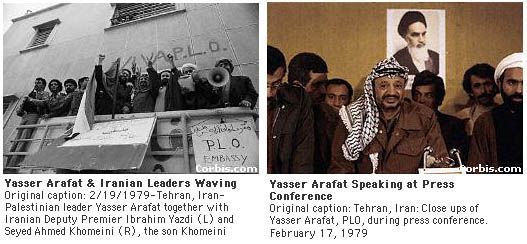
After the victory of the terrorist militants in 1979 Ebrahim Yazdi was elected as Deputy Foreign Minister of the Islamic Republic in an interim government. In this same year Ebrahim Yazdi celebrated the victory of the Islamist/Leftist revolutionaries by handing over the former Israeli Embassy in Iran to the notorious Arab criminal and head of the PLO Yasser Arafat.

This year marked the formation of kangaroo courts or “revolutionary courts” were summary trials of former statesmen, politicians, military officials, artists, political activists, and ordinary people who actively voiced their rejection the terrorist system were held – in which the entire process constituted the deliverance of execution sentences without defendants being given any legal aide or assistance to prove that the accusations against them were false and incorrect. The justice of these revolutionary courts were a mockery of justice itself. When Khomeini was asked in very early days what should be done to reorganize the Ministry of Justice, he replied: “anyone who is against me is against God and should be killed immediately on the spot as waging war against Allah. We do not need any other justice”. Yazdi was happy to oblige this mind set. The bloodbath that Khomeini and his minions like Ebrahim Yazdi let loose immediately after their takeover caused the deaths of tens of thousands of people, who were executed in the period 1980-1989, amongst them many of their former “brothers in arms” and allies from the leftist groups. In 1979 alone thousands were executed in these type of kangaroo/revolutionary courts primarily top diplomats, statesmen, military officials, and other notable personalities associated with the Iranian government and the Monarchy. In these kangaroo courts, Ebrahim Yazdi acted as Prosecutor General and in some instances held televised interrogations of principal military and civilian leaders of the Shah’s monarchy like Prime Minister Abbas Hoveyda, Police Chief General Mehdi Rahimi, Security Chief General Nematollah Nassiri, Army Air Wing commander General Manouchehr Khosrowdad, and paraded them, often bleeding and bruised, while taunting, threatening and humiliating them with instructions to confess their sins, all for Iran’s television viewers – and to strike widespread fear into anyone not immediately joining the Islamic take over.
Also in 1979, Ebrahim Yazdi led the Islamic Republic’s delegation to the 6th Summit of “Non-Aligned Nations” in Havana, Cuba, and later that year the Islamic Republic’s delegation to the United Nations 34th General Assembly. It is noteworthy to point out here that other than enthusiastically being received by President Castro of Cuba and having photo-ops with this “great revolutionary”, as Ebrahim Yazdi considers him, the purpose of the “Non-Aligned Nations” organization as stated in the Havana Declaration of 1979 is to ensure "the national independence, sovereignty, territorial integrity and security of non-aligned countries" in their "struggle against imperialism, colonialism, neo-colonialism, racism, Zionism, and all forms of foreign aggression, occupation, domination, interference or hegemony as well as against great power and bloc politics. Again this is not terminology that we are unfamiliar with almost 30 years onwards from the inception of the first terrorist theocratic state in modern history and the beginning of Islamic terrorism as we know and experience it today.
These events allowed Ebrahim Yazdi to serve as a spokesperson on behalf of Ayatollah Khomeini (the leader of the Islamic Republic) and to try and legitimize the illegal and occupational revolutionary regime. In November 1979, Ebrahim Yazdi resigns from his post as the Islamic Republic’s Foreign Minister in protest to the U.S. Embassy takeover which he said was “contrary to the national interest of Iran”. Again these are nothing but superficial statements from a man concerned about the preservation of the terrorist Islamic system which he has created through such hard dedication throughout his life. After resigning to save face from this embarrassing event (hostage taking of U.S. embassy personnel) he decides to instead run for a less high-profile position in the first post-revolutionary “Islamic Consultative Assembly”. Formerly this body was referred to as the Iranian Parliament or the “National Consultative Assembly” – emphasis is stressed on the term “Islamic” (used post-1979) and “National” (used pre-1979). Ebrahim Yazdi is successful in this bid and along other members of the “Freedom Movement of Iran”, such as Mehdi Bazarga, Mustafa Chamran, Ahmad Sadr, Hashem Sabbaghian, and Yadollah Sahabi, become elected to serve in this newly formed Islamic parliament; Yazdi serves from 1980-1984. After his term in the Islamic Republic’s parliament ran out in 1984 Ebrahim Yazdi does not seek re-election based on the fact that he considers Ayatollah Khomeini’s insistence on continuing the war with Iraq as not being in the interest of the revolution and the Islamic Republic. Yet again Ebrahim Yazdi tries to save face and credibility despite the physical and cultural genocide that had taken place on a daily basis upto that period. His steadfast support and loyalty and concern for the system he has helped create is clearly visible. Ebrahim Yazdi later sought to nominate himself in Presidential (2005), parliamentary, and city council elections but was barred by the senior theocratic leadership due to his public objections in the past. He did however serve as head of Keyhan for a short period which is a regime-sponsored publishing group. Ebrahim Yazdi's most recent affirmation of support for the Islamic Republic came when he became concerned about the Islamic Republic's President AhmadiNejad's comments on "wiping Israel off the map" - these statements Ebrahim Yazdi is quoted as saying "provoke the international community against us. It's not to Iran's interests at all. It's harmful to Iran to make such statements. These comments give Israel justification for urging the world to take a tougher stand against Iran and refer its nuclear programme to the UN Security Council [for possible sanctions]".

Ebrahim Yazdi running for the Islamic Republic's sham Presidential elections in 2005
In regards to the revolutionary courts, Ebrahim Yazdi has of late began refuting the notion that he had any part in them or with the murder’s/executions” which took place in them. Specifically he has recently brought up General Rahimi’s trial were he acted as nothing less than Prosecutor General! He has gone on record saying he “is not a lawyer” to be in the position to give legal advise on what course of action should have been taken. He has also said that he was against the execution of General Rahimi and other leaders of the Iranian government related to the Monarchy! This is nothing new from Ebrahim Yazdi and the like, in fact another criminal who participated in the creation of this terrorist establishment – Abolhassan Bani-Sadr who served as President for the Islamic Republic and who also as of late has gone on record trying to clear his name by saying he had no idea what kind of man Ayatollah Khomeini was going to be! This despite the Ayatollah’s documented speeches and statements against modernity, democracy, women, and especially his sick Islamic thoughts spelled out in his written and published books. In effect what Abolhassan Bani-Sadr is saying is that he was a naïve, incompetent politician, and uninformed person who miraculously became President of the Islamic Republic in a system created by a man he had no information on! Also noteworthy is that Abolhassan Bani-Sadr in a recent interview states that Ebrahim Yazdi was the man who suggested the creation of a “revolutionary justice system” and the establishment of the “revolutionary guards of the Islamic Republic”. The blame-game is in full swing! And everyone is trying to whitewash their involvement and crimes under this barbaric and terrorist regime that has occupied Iran and held innocent Iranians hostage for nearly three decades!

General Rahimi - Commander of Martial Law in Tehran
Despite Ebrahim Yazdi’s claims that he had no involvement in General Rahimi’s trial and that he even opposed the execution of this brave and honorable General there is documented evidence showing Ebrahim Yazdi’s involvement in this sham trial in a revolutionary tribunal in which he himself acts as General Prosecutor! In the film clip available for the public to see Ebrahim Yazdi acting as the prosecutor of General Rahimi clearly states: “We know that Mr [General] Rahimi is guilty and has to be punished…and this has to be done according to sharia law”. And make no mistakes General Rahimi was executed according to correct Islamic fashion under strict shariah law.
Since it is clear from the documented evidence that Ebrahim Yazdi is acting as the prosecutor in this revolutionary tribunal one should ask this man who today tries to whitewash his crimes and distance himself from them; where was General Rahimi’s defense lawyer in the revolutionary tribunal which you were participatory of? Who was the judge in this tribunal? Where are the public records of this trial? Where was the freedom and justice at the time he was giving execution-orders to Iran’s finest statesmen and honorable military officials? Where was this freedom and justice which he speak of today, to once again misled people?
During the trial of General Rahimi a psychologically deranged mullah, Ayatollah Khalkhali, tells the General to order the Imperial Armed Forces to express their loyalty to the leader of the Islamic coup d’ètat (Ayatollah Khomeini). General Rahimi defiantly replies that he will take no orders but that of his “Commander in Chief His Imperial Majesty Shahanshah Aryamehr Mohammad Reza Pahlavi”. General Rahimi would at the end of his trial punch Ebrahim Yazdi in the face and call him a SOB - which lead to Ebrahim Yazdi ordering that the General's right hand be cut off before his execution. Later on when he is facing his execution squad, right before the execution order is given by a mullah, the General loudly reaffirms for the last time his allegiance to his country and King by shouting out “Javid Iran! Javid Shah!” (“Long Live Iran! Long Live the King”). General Rahimi was executed because he refused to break his oath and allegiance to protect and serve his Country and King.

General Jahanbani
Another honorable and prominent military official, General Jahanbani, entered his sham trial with severe bruising across his face from beatings he had received at the hands of the Islamists/Leftists. He was soft-spoken and gentle man who had clearly been beaten and tortured. He refused to honor the bogus and illegal kangaroo court and thus refused to defend himself in front of the mullah’s. He was subsequently taken out into a courtyard and shot several times.
Empress Farah Pahlavi of Iran writes in her memoirs "An Enduring Love - My Life with the Shah" (p.307):
"A bit later, I managed to contact by phone a dear friend whose husband, Air Force General Nader Jahanbani, had just been executed. Insulted by one of the guardians of the revolution, he had the courage to slap him in the face before dying. She was sobbing and I, who should have been able to find words to comfort her, could do nothing but cry with her. That evening, in despair, I wrote these few lines in my notebook: "I don't feel I have the strength in me to go on fighting. I would prefer to die for my country with honor rather than be dragged toward death by the depression that is overtaking me. Dear God, if you are there, give me the strength to go on."

General Rahimi's lifeless body with his right hand clearly having been amputated
(p.339):
"As for Ibrahim Yazdi, he sat with the judges and torturers who had, among other things, given the death sentence to men who were remarkable for their courage, dignity, and their loyalty, among them Generals Mehdi Rahimi* and Nematollah Nassiri.
*General Rahimi had his right arm cut off before his execution for having saluted when the King's name was spoken."
The amputated right arm of General Rahimi can be seen on photos showing the life-less body of the General.
Apart from General Rahimi’s sham trial, Ebrahim Yazdi’s participated in the trial and subsequently executions of General Jahanbani, General Khosrowdad, General Mohaqeqhi. Ebrahim Yazdi also helped organize the trial of ex Prime Minister H.E. Amir-Abbas Hoveyda who was shot from the back by yet another mullah (purportedly Ayatollah Ghaffari).
Ebrahim Yazdi is also said to have expressed his displeasure as to why the late Shah of Iran did not order the Imperial Armed Forces of Iran to open fire on demonstrators because this would have helped further support to his cause of establishing an Islamic Republic and make Islam victorious! Ebrahim Yazdi and the revolutionaries used every tactic in the book to fuel public anger against the state and one such method was importing terrorist from foreign countries like Palestine, dress them with Iranian military uniforms and open fire on both the public and the Imperial Armed Forces. One such instance is the events surrounding the “Jaleh Square” were Palestinian gunmen (of which there were a few thousand in the country by that time) opened fire at Iranian soldiers from buildings adjacent to were large crowds had gathered. The soldiers had received strict orders not to open fire unless they were in lethal danger and this situation required them to act, and the only logical conclusion was that the shots were coming from gunmen from within the demonstrators. These kind of events further radicalized public sentiment to favor that of the revolutionaries.
 Ebrahim Yazdi shakes hands with former colleague Mohsen Sazegara (one of the founders of the Islamic Revolutionary Guards Corps.)
Cold blooded criminals such as Ebrahim Yazdi and his likes who today are trying to distance themselves from their past crimes need to be exposed. Individuals such as Ebrahim Yazdi who personally presided over the most inhumane sham trials of thousands of innocent Iranians who were beaten and executed under his orders need to be held accountable! When Ebrahim Yazdi was to give a speech at the University of Westminister in England (2005) on “The Future of Islamic Democracy”, Iranian exiles mobilized and filed charges of “crimes against humanity” against this criminal which subsequently led to him canceling his trip.

Ebrahim Yazdi sitting next to the former Islamic Republic Foreign Minister Seyed Kamal Kharazi
Let us not be fooled about this criminals’ unsuccessful attempts to run for further political seats in the Islamic Republic. This man despite how western media try to make him look victimized and despite his self-proclaimed status as a “dissident” lives a luxurious life (from the state funds appropriated by the revolutionaries after the victory of the Islamic coup d’ètat), participates in sessions of the Islamic parliament (!), roams freely, and is nothing but a tool kept by the Islamic Republic as a back-up plan to once again fool people in case his services (and those of his organization “Freedom Movement of Iran”) should be needed to preserve the revolution and the Islamic Republic; that is afterall what Ebrahim Yazdi’s goal has been since day one of the Islamic Republic’s inception. He lives a comfortable life and occasionally makes some noise to please his followers and to deceive others. If anything he can be referred to as the “loyal opposition” to the Islamic Republic occupying Iran. These terrorists of yesterday have today changed colors into becoming “reformists” and even “dissidents”! It should not come as a surprise that Ayatollah Khalkhali one of the revolutions most fervent and most bloodthirsty servants who personally executed many prominent Iranians towards his latter days began associating himself with the so-called “reformist-faction” which is nothing but a charade the Islamic Republic has created to keep people busy and to prolong its own longevity/survival!

Ebrahim Yazdi attending a student conference; if only these students knew who this person is and what role he played in killings of thousands of Iranians!
We will not rest until these criminals stand trial in legitimate Iranian courts of law where they will be answerable to their past actions.

Ebrahim Yazdi with mullah's in the Islamic parliament
Wednesday, October 03, 2007
Mullah lobbyists penetrating U.S. Political System
Trita Parsi, Bob Ney, and Iran’s Oil Mafia:
Penetrating the U.S. Political System
By Hassan Daioleslam
See SOURCE for full list of references.
Inside the National Iranian-American Council.
Hassan Dai is an independent researcher and writer who worked closely with two experienced investigative reporters inside Iran to explore and expose Iran's lobbying enterprise in the United States.
hassan.dai@yahoo.com
Read more articles in Foreign Affairs, National Defense.
Read more articles by Hassan Daioleslam
Penetrating the U.S. Political System
By Hassan Daioleslam
See SOURCE for full list of references.
Inside the National Iranian-American Council.
Robert William (Bob) Ney is a current federal prisoner and a former Ohio Congressman from 1995 until November 3, 2006. On October 13, 2006 Ney pled guilty1 to charges of conspiracy and making false statements in relation to the Jack Abramoff lobbying and bribery scandal. Ney reportedly received bribes from Abramoff, other lobbyists, and two foreign businessmen – a felon and an arms dealer – in exchange for using his position to advance their interests.
Conspicuously missing from this dossier of disservice to the country is Ney’s masterful creation of an active and disguised Washington-based lobbying enterprise for the Iranian theocratic regime, The National Iranian-American Council (NIAC). NIAC is an effective node of Tehran’s comprehensive US lobbying web. This article will address the creation of NIAC, the motives underlying its formation, NIAC’s manifesto, Tehran’s role, NIAC’s connection to Iran’s oil mafia, and NIAC attempts to penetrate the US political system.
Creation of NIAC
The National Iranian-American Council (NIAC) was founded by four non Iranian-Americans: Roy Coffee, Dave DiStefano, Bob Ney and Trita Parsi. Coffee and DiStefano, both Washington lobbyists, were investigated by the Justice Department for arranging a trip for Bob Ney to meet a known felon and a Syrian arms dealer in a conspiracy to circumvent sanctions to sell US-made airplane parts to Tehran.2
Roy Coffee sent a letter to the Dallas Morning News in February 2006 to justify his relationship with the two London-based felons. Part of the letter discussed the creation of NIAC in 2002. In this letter, Coffee described the events following the meeting of his former classmate Darius Baghai (who had just returned from Iran) with Bob Ney:
From that meeting, Darius, Dave and I began to work with Trita Parsi, another Iranian-American, to try to form a political action committee of Iranian-Americans to pursue a strategy of normalization of relations between the two countries. The 4 of us worked very hard for about 9 months to form this committee.
Trita Parsi at the time was a Swedish-Iranian graduate student in his early twenties with ties to Iran’s ambassador in Sweden.3 He was working part-time as a Congressional aid in Ney’s office in Washington on a temporary visa. Parsi was subsequently appointed president of NIAC. Should we believe that one of the most expensive lobbying teams in the US, one of the most corrupt lawmakers in Washington and a Congressional aid in his office, none of them Iranian-American, worked hard for nine months out of their humanitarian concern for the Iranian people?
The New Lobby
In the 1990’s, the American-Iranian Council (AIC), with backing from multinational oil companies, was a front for the Iran’s lobbying efforts in the US. Houshang Amir-Ahmadi served as its president. Amirahmadi has been an active pro-Tehran player in the US since the early 1980s. While residing in the US, he was also a presidential candidate in Iran’s elections. He officially collaborated with different Iranian institutions and notably the foreign ministry.4 In 1999 and 2000 Trita Parsi was closely working with Amirahmadi and was well positioned in the leadership of AIC.5,6
In 2001, the pro-Iran lobby in the United States became intensely active to prevent the renewal of the Iran Libya Sanctions Act (ILSA), and to improve US-Iran relations. Despite extraordinary pressure from the lobby, ILSA passed overwhelmingly.
Prior to his imprisonment, Bob Ney, in concert with AIC, was Tehran’s dogged warrior in Washington as he relentlessly led Congressional efforts to end ILSA and initiate Tehran-friendly policies. Ney, disappointed and angered by the ILSA vote, began to plan for the next battle of the war.
The ILSA vote doesn’t look very promising, but that doesn’t mean the struggle should stop on this entire issue. It is a matter of education and re-education and people getting together and forming a citizen’s lobby to make sure that members of Congress and their offices are educated on this issue.
– Speech to AIC, June 2001,7 (Emphasis added).
While Ney was hard at work “forming a citizen’s lobby,” Trita Parsi claimed that the majority of lawmakers voted against their true wills. In a tone apologetic to Tehran, he expressed his hope that the Iranian regime understood that he and his colleagues had worked hard to prevent this result:
Hopefully, Tehran will recognize that an honest attempt was made to defeat or at least weaken the sanctions. The call for a review and Speaker Hastert's pledge to insist on Congressional action based on the review must also be interpreted by Tehran as a step in the right direction.
– IranAnalysis, July 2001, Peyvand’ Iran News.
Their failure to block the renewal of ILSA marked the start of a new era for the pro-Iran lobby in the United States. The lobbyists recognized that they must broadly reach out to Iranian-Americans. Iran became directly involved in creating, organizing and implementing a far-reaching lobbying campaign in the US, fundamentally different in its organization, which targeted the strategic needs of Tehran’s rulers. The creation of NIAC as the main executer of this new endeavor had been meticulously planned since the late 1990s. Parsi stepped down from the board of directors of the AIC. An influential US Congressman and a posh Washington lobbyist came to Tehran’s help to create NIAC. An unknown Iranian Swedish student was selected to serve as president of this new organization.
Trita Parsi was the regime’s trusted man within the new network. Tehran’s faith in Parsi was so profound that in 2003 when Iran decided to send a highly secret proposal for negotiations to the White House, Parsi was called on to arrange the delivery of the message through Bob Ney to Karl Rove.8 Parsi, moreover, was among the few chosen men (along with Mahallati, Iran’s former ambassador to UN) to present the results of a shady Tehran-friendly poll of the Iranian population which indicated the popularity of Iran’s nuclear program.9,10
Trita Parsi and the Regime’s Inner Circle
During the eight years of Rafsanjani’s presidency, which ended in 1997, the Iranian regime had attempted without success to attract the Iranian Diaspora to its cause. Khatami’s presidency recharged Tehran’s efforts. With the Supreme Leader’s direct involvement, the High Council for Iranian Compatriots Overseas9 was created in 2000 under the auspices of the Foreign Ministry. The President heads the Council, and the Foreign Minister serves as its deputy director. The Ministry of Intelligence and the Ministry of Culture and Islamic Guidance collaborate to implement the decisions of the council. The objective was to create a network of organizations to infiltrate and seemingly represent the Iranian community abroad, and promote policies favorable to the Iranian government. Tehran anticipated that this strategy would neutralize opposition activities abroad and legitimize the new lobby.
State-sanctioned Iranian newspapers started a campaign to promote Trita Parsi and NIAC. Pro-government publications outside Iran followed suit. The former head of the Iran interest in Washington, Ambassador Faramarze Fathnejad, was thrilled about Trita Parsi’s efforts and NIAC, highlighting11 “the importance of relations with Iranian organizations in the U.S. and specially pointed to NIAC and his young leader who is a consultant to CNN and has been very successful in his efforts.” The Iran Ambassador even claimed 20,000 members for NIAC (while only 150 is claimed by NIAC itself)!
But token rhetorical support would not alone turn an inexperienced graduate student and a corrupt Washington politician into a lobbying enterprise. Entities with ample financial resources and direct access to Iran’s top leaders had to enter the scene. Understanding the NIAC’s activities in the US necessitates familiarity with Trita Parsi’s main partner in Iran, Siamak Namazi, one of the most important figures of this new lobbying enterprise and a prominent member of the Iranian oil Mafia.
Namazi, along with his sister Pari and brother Babak, control the Atieh enterprise12 in Iran and its three sister companies Atieh Roshan, Atieh Bahar and Atieh Associates, as well as numerous other direct and indirect partnerships, including13 Azar Energy, Menas companies in England, Atieh Dadeh Pardaz, FTZ Corporate services and MES Middle East Strategie.12 Particularly noteworthy is the fact that Baquer Namazi14 (the father) is the Chairman of Hamyaran, an umbrella organization for the NGOs in Iran – a man of considerable influence in the internal and foreign affairs of the country.
Atieh claims to be a “. . . fully private strategic consulting firm that assists companies to better understand the Iranian market, develop business and stay ahead of competition.” People familiar with the oil industry in Iran know what this description is code for. In reality, Atieh is notorious for being a conduit for racketeering, bribery and money laundering, mainly for corrupt Iranian rulers. Atieh’s customers include the foreign corporations who wish to do business in Iran and find no choice but to bribe officials. One of their fiascos involved Norway’s Statoil,15 a customer of Atieh Bahar.16 Their bribery of Iranian officials through consultants was exposed by the US Securities and Exchange Commission and the Department of Justice. A number of high officials in the company were fired and the company had to pay tens of millions of dollars in penalties to the US and Norwegian governments for “payments to an Iranian official in 2002 and 2003 in order to induce him to use his influence to obtain the award to Statoil of a contract to develop phases 6, 7 and 8 of the Iranian South Pars gas field.”
The most recent debacle of Atieh enterprise was in March of 2007, when the CEO of the French oil company Total SA17 was charged for bribery of Iranian high officials to secure contracts. Total is one of the major customers of the Namazi’s Atieh enterprise and is mainly represented in Iran by Atieh and its affiliate companies. Tens of millions of dollars of bribes were paid by Total through individuals and third party corporations.
Tehran’s trust in Namazi is elucidated by the fact that his enterprise provides the network and computer services for almost all Iranian banks, parliament, and other important institutions. Namazi’s groups monitor18 nearly all Iranian economic or political activities and have access to the country’s most sensitive data. This is a clear indication of his prominent place inside the inner circle of power in Tehran.
While representing Tehran, Namazi, disguised as a scholar,19,20 travels to the US to seemingly pursue academic activities through think-tanks close to the Iranian regime. This link between the Iranian oil Mafia and “scholarly” pursuits in the US is hardly isolated. Three former Iranian deputy foreign ministers currently live in Boston posing as “scholars:” Mohammad Mahallati21 who was also the Iranian ambassador to the UN in the late 1980s, Farhad Atai and, Abbas Maleki.22 In addition to his diplomatic past, Maleki has been one of the most important figures within the Iranian oil Mafia.
Trita Parsi and Namazi worked very closely on developing the details of the grand plan of forming an Iranian-American “Citizen’s Lobby” in the US. They traveled to Iran together.23 They organized joint conferences and meetings, launched lobbying projects and wrote joint papers.24
The Roadmap
In 1999, Parsi and Namazi presented a joint paper titled, “Iranian-Americans: The bridge between two nations,” at the DAPIA conference organized by the Iranian government in Cypress. This report comprises the manifesto and roadmap of the new Iranian lobby in the US. In this paper, the authors suggest that: “an Iranian-American lobby is needed in order to create a balance between the competing Middle Eastern lobbies. Without it, Iran-bashing may become popular in Congress again.” The “competing lobby” was AIPAC (American Israeli Public Affairs Committee). The pillars of the road map were24:
• To have the appearance of a citizen’s lobby.
• To mimic the Jewish lobby in the US.
• To impede Iranian opposition activities.
• To infiltrate the US political system.
• To break the taboo of working with Iran’s cleric rulers for the Iranian Diaspora
• To improve the image of the Iran’s government abroad.
In their report, Namazi and Parsi admitted that the Iranian community by large rejects the clerical regime and there is no hope that this community will help a pro-regime lobby in the US.
This group’s [Iranian Americans] role has not been utilized anywhere close to its potential, however, for several reasons: A good portion of them were against the IRI [Islamic Republic of Iran], therefore would not do anything to help.
The point is, the said group [Iranian Americans] was not about to form a lobby group that would benefit the establishment in Tehran, or benefit the Iranian-Americans themselves as a community, nor was it for the most part interested in forming a pressure group against the Islamic Republic.
This was also underlined by Roy Coffee, one of the NIAC’s founders:25
We [NIAC’s founders] found that most Iranians do not want to get involved in politics because of their experiences in Iran during and after the revolution. They have come to this country to make a better life for themselves and their children and don't want to get involved.
The lack of genuine participation from the Iranian-American community in this lobby has been overcome with a sophisticated machine of professional lobbyists and “friendly” circles who favor a rapprochement with the Iranian regime.
Tehran’s Advice: Mimic Jewish Lobby in Washington
One of the hallmarks of the new lobby was its desire to rival the “Israeli Lobby” in the United States. This aspiration was so strong that an organization26 was created and called IAPAC (Iranian American Political Action Committee) as compared with AIPAC (American Israeli Public Affairs Committee). Three of IAPAC’s board members came from the AIC’s leadership.27
In their 1999 DAPIA paper, Parsi and Namazi analyzed at length the techniques used by AIPAC, and suggested that the same approach should be taken to create an Iranian lobby in Washington:
Creating similar types of seminars and intern opportunities to Iranian-American youth may not improve Iran-US relations in the short run, but it will help integrate the Iranian-American community into the political life of America. In the long run, a strong and active Iranian- American lobby, partly established through these seminars and by the participants of these programs, may serve to ensure that the US and Iran never find themselves in violent opposition to each other again.
Trita Parsi has been reciting this comparison to the Israeli lobby since the late 1990’s, about the time that the High Council was formed. At the beginning his tone was more contentious and resembled the mullah’s usual rhetoric. While he has toned down his anti-Israeli remarks in his English communiqués, the governmental newspaper Aftab published on December 28, 2006 an interview with Trita Parsi.28 In his introduction, the reporter underlined the role of Parsi’s lobby on behalf of the Iranian regime. The article’s title is interesting: “The Iranian Lobby Becomes Active.” Translation:
The conflict between Iran and the West on Iran’s nuclear file has entered a critical state. The government must now utilize all the possible resources to defend the national interest. In this, we have not paid enough attention to the potentially significant influence of the Iranian American society in moderating the extremist policies of the White House. In comparison of this untouched potential to the influence of the Jewish lobby in directing the policies of Washington in supporting Israel, we see the difference between what is and what could be.
In coordination with Trita Parsi, Siamak Namazi also started singing the same songs:29
I propose that we should start showing up to the leadership training seminars and other events organized by the American-Israeli Political Action Committee (AIPAC) for their youth. Not only will this create an opportunity to learn the fine skills of community organization and grassroots lobbying, but it also takes away from AIPAC's ability to spread misinformation about Iran through a deliberate campaign to further its own political agenda.
Not Lobbyists?
As Ney’s criminal bribery and lobbying fiasco became more public, NIAC’s president Trita Parsi attempted to deny the lobbying nature of NIAC. NIAC was not registered as a lobbying organization, and lobbying activities would have been illegal. Furthermore, being lobbied by a former aid would have added to Ney’s already complicated and ugly situation and impede Parsi’s career in Washington! Therefore in an interview with Washington Prism in 2005, Parsi in response to a direct question asking whether his group lobbies the US congress, declared:30
Our group does not do any lobbying at all. We do not contact the Congressmen to support or oppose a bill.
Reality exposes the falsehood of Parsi’s claim. NIAC has strived to penetrate the US political system as per the 1999 roadmap by Namazi and Parsi. NIAC’s actions lucidly reveal the nature of the organization. The Washington Post reported on June 25, 2006:31
The NIAC helped persuade a dozen conservative House members to sign a letter to President Bush earlier this month calling for unconditional negotiations with Iran's regime.
The external communications of Parsi and other NIAC leaders shed further light on NIAC’s lobbying activities.32
The NIAC members have educational and experimental knowledge on the lobbying process and politics in America.
. . . we must establish connections on Capitol Hill to establish early-warning systems about proposed votes or bills that may oppose the best interests of Iranian-Americans.
Bob Ney, Roy Coffee, and Dave DiStefano arranged numerous workshops, training classes, seminars and speeches in which they themselves and others with experience prepared members and affiliates of NIAC to lobby and influence Congress. Parsi, Namazi and Ney organized public gatherings and discrete and exclusive fundraiser events (with $1,000 plates). They developed training manuals on lobbying.
NIAC itself admits that,32 “In 2002, Congressman Ney benefited from letters sent by Iranian-Americans through NIAC's Legislative Action Center in support of his resolution on US-Iran relations.”
Infiltrating Congress
Trita Parsi, Namazi and company fully intended to infiltrate the US Congress. Its methods included both engaging unsuspecting Iranian-Americans working in various Congressional offices and recruiting and placing young Iranian-Americans to serve as interns or pages in these offices by offering room, board and financial incentives. NIAC’s website brags of success stories in this venture. The young Iranian-American Press Secretary for Rep. Marcy Kaptur is drafted to help in improving the lobbying skills of NIAC members and affiliates. An Iranian-American student at the University of Minnesota receives a financial scholarship in his senior year and becomes an intern in Senator Norm Coleman’s (R-MN) Washington office.33 Another intern, a graduate of the University of South Florida, is placed in Congressman Jim Davis’ (D-FL) Washington, D.C. office. Expanding the operation to penetrate the US political system, NIAC has now formally implemented a paid trainee program and is actively in search for unwary Iranian- American youth.
Conclusion
Since the early 1990’s, Tehran has embarked on developing a sophisticated lobby enterprise in the United States. Iran’s government has devoted significant manpower and financial resources to this cause. This lobbying enterprise consists of a complex, convoluted and intermingled web of entities and organizations with significant overlap of leadership and rank and file, and heavy involvement of the notoriously mafia-like inner circles of the Iranian regime. Disguised as scholars, many of the former Iranian government officials reside in the US and constitute an important piece of the lobbying machine. NIAC and its major figures, such as Bob Ney and Trita Parsi, are effective nodes of Tehran’s efforts to manipulate US policy toward self-serving ends.
Endnotes
1. Kiel, P. "Ney Faces Possible 2 Years Plus in Prison."
http://www.tpmmuckraker.com/archives/001532.php (09-15-2006).
2. Bresnahan, J. "Casino Chips Sealed Ney’s Fate."
http://www.citizensforethics.org/press/pressclip-print.php?view=3266 (2006).
3. Dialog between Iranian Ambassador and Iranian exiles in Sweden.
http://www.payvand.com/news/00/mar/1050.html (03/13/00).
4. Parvin, M. "Boxed In on Iran."
http://article.nationalreview.com/print/?q=MjhiYmYyOWM5ZTBjMDI5NWI0NjQwYzBhZTY3Nzk0MjY= (June 12, 2006).
5. "The Iranian Presidential Elections and Its Implications for US-Iran Relations."
http://payvand.com/news/01/jun/1009.html (6/4/01).
6. Javid, J. "Act as a community."
http://www.iranian.com/Opinion/2002/May/Group/ (ed. Iranian, T.) (May 10, 2002).
7. AIC UPDATE - Vol. 2, No. 20.
http://www.american-iranian.org/pubs/aicupdate/05262005.html (May 2005).
8. Clemons, S.
http://www.thewashingtonnote.com/archives/001953.php (ed. Note, T.W.) (February 17, 2007).
9. "Council to defend Iranian expatriates: Iran's FM"
http://www.iranmania.com/News/ArticleView/?NewsCode=32645&NewsKind=Current+Affairs (June 18, 2005).
10. "Public Opinion in Iran and America on Key International Issues."
http://www.sfcg.org/documents/iranus.pdf (ed. World Public Oppinion, S.f.c.g.) (January 24, 2007).
11. http://www.topiranian.com/ngo/archives/009103.html.
12. http://www.atiehgroup.com/default.htm.
13. http://www.atiehgroup.com/Relatedcompanies.htm.
14. http://www.wilsoncenter.org/index.cfm?fuseaction=events.event_summary&event_id=152278.
15. "Statoil chairman resigns from anti-corruption group board after Iran bribery case," Intl. Herald Tribune - Europe (October 20, 2006).
16. http://www.atiehbahar.com/WhoWeAre/index.htm.
17. PIERRE-ANTOINE SOUCHARD, A. "Total CEO held for questioning over company's Iran activities." (March 21st, 2007).
18. http://www.adpdigital.net/content/en/adp/clientList.aspx.
20. National Endowment for Democracy.
http://www.ned.org/forum/past.html.
21. Ilex Foundation. http://ilexfoundation.org/.
22. Senoir Researcher. http://bcsia.ksg.harvard.edu/.
23. Namazi and Parsi pictures in their joint Iran trip are on:
http://www.iranian.com/SiamakNamazi/2000/August/Water/index.html.
24. Namazi, S. & Parsi, T. "Iran-Americans: The bridge between two nations," in DAPIA Conference (Cyprus, November 1999).
25. http://frontburner.dmagazine.com/archives/013069.html.
26. http://www.iranianamericanpac.org/.
27. http://www.iranianamericanpac.org/leadership/ov.shtml.
28. "The Iranian Lobby Becomes Active." Aftab Newspaper (December 28, 2006).
29. Namazi, S. If Mahdi doesn't come.
http://www.iranian.com/SiamakNamazi/Nov98/Reform/index.html (November 9, 1998).
30. http://www.washingtonprism.org/eng/showarticle.cfm?id=50. Washington Prism (2005).
31. "Iran on the Potomac." Washington Post
http://www.washingtonpost.com/wp-dyn/content/article/2006/06/23/AR2006062301345_pf.html(June 25, 2006).
32. http://www.niacouncil.org/.
33. http://www.niacouncil.org/index.php?option=com_content&task=view&id=398&Itemid=2.
Hassan Dai is an independent researcher and writer who worked closely with two experienced investigative reporters inside Iran to explore and expose Iran's lobbying enterprise in the United States.
hassan.dai@yahoo.com
Read more articles in Foreign Affairs, National Defense.
Read more articles by Hassan Daioleslam
Monday, May 07, 2007
Visit by terrorist Foreign Minister to Sweden condemned!


 Condemnation of visit by the Islamic Republic's terrorist Foreign Minister to Sweden!
Based on this prominent Swedish Newspaper's report (see below link) on this event i'd like to recount the report in English for my audience.
http://www.dn.se/DNet/jsp/polopoly.j...47417&rss=2216
****
Loud demonstrators protested the Islamic Republic's terrorist Foreign Minister's visit to Sweden.
Demonstrators shouted "killer/murderer" at the entrance to the Swedish National Defence College and Swedish Institute of International Affaires on the same day that the Islamic Republic's Foreign Minister Manochehr Mottaki was to visit Stockholm.
Up to 200 demonstrators had gathered to protest the shameful government-sponsored event. Half an hour before the Islamic Republic's terrorist Foreign Minister was to show up demonstrators protested loudly and some twenty police officers tried to keep them away from the entrance.
On some of the placards your could read "Down with the Islamic Republic in Iran". The police got reinforcements and ten minutes before the terrorist foreign minister was scheduled to arrive the demonstrators were pushed away from the entrance. Many decided to sit on the street in an act of civil disobedience but there were no violent confrontations.
The demonstrators who were mostly Iranian exiles, shouted through loudspeakers "throw out the killer/murderer". The Police, who had closed off Queen Kristina's Road, were about the same in numbers as the demonstrators.
At 12 o'clock the Islamic Republic's terrorist Foreign Minister Manochehr Mottaki was yet to show up to the shameful event hosted by the Swedish government at the Swedish Institute of International Affaires in Stockholm. His scheduled talk on "multi-lateral diplomacy and global security" was supposed to have begun at 12 o'clock.
***
In light of this shameful event the Association for Democracy in Iran, a Sweden based activist group formed by politically active Iranian youth, released a condemnation of the event which was sent to the Swedish Foreign Minister Carl Bildt:
http://www.setiz.se/sv/prs/brev/utrikm.pdf
ADI Homepage:
http://www.setiz.se/
Also see this report in English by a Swedish Newspaper which writes in English:
http://www.thelocal.se/7219/20070507/
UPDATE #1 : The terrorist Foreign Minister of the Islamic Republic, Manochehr Mottaki, showed up to the Swedish Institute of International Affaires at 12.20 P.M.
At 12.30 P.M. the demonstrators tried to break through the police cordon to enter the building. One police officer fell to the ground and received a few kicks. The person who kicked the police officer was apprehended and the police was able to keep the demonstrators from entering the building where the terrorist Foreign Minister of the Islamic Republic was being hosted by the Swedish Government.
Tuesday, February 27, 2007
France' support of Islamic Fundamentalists in 1979
 Valéry Giscard d’Estaing - President of the French Republic from 1974-1981
In addition to the entries i've had on U.S. involvement in the creation of the terrorist Islamic Republic occupying Iran - credit goes to the Carter Administration here - I recently came across this entry by a fellow blogger discussing the "French Connection" leading to the success of the Islamist Coup D'ètat of 1979: "France and the Iranian Revolution"
To see my previous entries on Carter's support of Islamists see:
President Carter's involvement in the betrayal of the late Shah of Iran
Pre-1979 Iran-US relations
END POST
Thursday, November 16, 2006
Guiv - a talented and patriotic Iranian child
A few entries down you saw my entry on the Islamization of Iran and one of the youngest victims of this vicious anti-Iranian process. The videoclip of the brainwashed Iranian child imitating a mullah (Islamic religious leader) is very disturbing. If it is not for these very children of our motherland and future generations to come that we are in this cause for then what is it....
The Islamic Republic is an anti-Iranian terrorist Islamic regime that has to go - I cannot stress this enough. If you are an Iranian you have a patriotic duty - a duty to your country and countrymen. A duty to protect Iran and Iranians from all evil. Evil reigns in Iran today. Compatriot, never seize in carrying out your patriotic duty!
Having said that i'd like to present Guiv, a talented Iranian child who is denied to live in his occupied homeland but yet sings, at his young age, for the love of his country. One day not to far away all Iranian children will be as in touch with their heritage and love their country, above all else, the way Guiv does.
God bless this young talent.
Soroode Keshvaram Iran - By Guiv
CLICK HERE for a link to this clip and more clips by Guiv.
END POST
The Islamic Republic is an anti-Iranian terrorist Islamic regime that has to go - I cannot stress this enough. If you are an Iranian you have a patriotic duty - a duty to your country and countrymen. A duty to protect Iran and Iranians from all evil. Evil reigns in Iran today. Compatriot, never seize in carrying out your patriotic duty!
Having said that i'd like to present Guiv, a talented Iranian child who is denied to live in his occupied homeland but yet sings, at his young age, for the love of his country. One day not to far away all Iranian children will be as in touch with their heritage and love their country, above all else, the way Guiv does.
God bless this young talent.
Soroode Keshvaram Iran - By Guiv
CLICK HERE for a link to this clip and more clips by Guiv.
END POST
Subscribe to:
Posts (Atom)


 Posts
Posts