Showing posts with label Darius Kadivar. Show all posts

Saturday, November 13, 2010

Lieutenant General Ali Mohammad Khademi & Iran Air


I've received the following very interesting articles on the late founder of Iran Air, Gen. Khademi, and would like to share it with the readers of this blog.


******************************************

KHADEMI, Ali Mohammad (1913-1978), Air Force officer, first general manager of Iran Air 1962-78
Encyclopedia Iranica

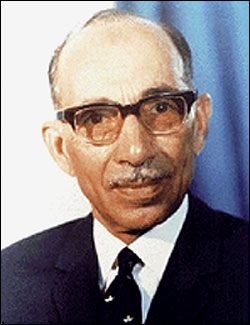
KHADEMI, Ali Mohammad (ʿAli Moḥammad Ḵādemi, b. Jahrom, Fars, 30 November 1913; d. Tehran, 7 November 1978), pilot, officer, and first general manager of Iran Air (FIGURE 1). Khademi was a career officer in the Air Force, who was promoted in 1966 to lieutenant general (sepahbod). He served from 1962 until 1978 as the general manager of Iran Air, the newly founded national flag-carrier, which under his stewardship became a very successful domestic and international airline. In 1970-71 he served as president of the International Air Transport Association (IATA).

Family and eduction. His father Loṭf-Allāh Ḵādemi belonged to a prominent Muslim family. In the early 1900s he joined the Bahai faith, and the subsequent persecution forced him to leave everything behind and to move in 1927 his family to Isfahan. ʿAli Moḥammad attended high school in Isfahan and graduated in 1932 at the top of his class. He passed the demanding entrance examination of the Military Academy (Dāneškada-ye afsari) in Tehran, and graduated with honors in aviation studies in 1936. The following year he graduated with distinction from the Air Force Flying School (Āmuzešgāh-e ḵalabānān-eniru-ye havāʾi).

Air Force. Khademi joined the Air Force (Niru-ye havāʾi-e Irān) in 1938, and continued with his pilot training. He was the first Iranian to receive a commercial pilot license from the British Civil Aviation Authority in 1948, and in 1957 he completed a training course at the U.S. Air Force University in Montgomery, Alabama. In 1958 he was promoted to Chief of Staff (raʾis-e setād), and became lieutenant general in 1966. Khademi contributed to the modernization and expansion of the Air Force by fostering cooperation with the U.S. Air Force, the most technologically advanced air force in the world (Aṭrvaš, p. 263).

Iran Air. In 1962, when Iran Air was founded, Khademi was selected as its general manager. Shortly after the appointment, he completed the Air Transport Senior Management course at the American University in Washington, D.C. During his 16-year tenure at Iran Air, the company was transformed from a fledgling domestic airline to a thriving national flag-carrier. Iran Air had started in 1962 with a fleet of 13 old propeller airplanes and less than 700 employees, and in 1978 the company owned a modern fleet of 37 Boeing jets and had close to 12,800 employees. Its routes included the major destinations in the Middle East, Europe, the U.S.A., and the Far East, and this expansion was the result of bilateral negotiations that were initiated and led by Khademi (Aṭrvaš, p. 13). Under Khademi's stewardship, the net equity of the company increased eight-fold, though the company did not receive any government subsidies. Iran Air became one of the country’s most profitable government-owned enterprises and the highest foreign-currency earner after the National Oil Company. The company attained one of the best safety records of any airline in the world, and maintained one of the first Middle East technical service stations in Iran, which was certified by the U.S. Federal Aviation Agency (Adams, p. 25). In addition to his responsibilities as general manager, Khademi served as the chairman of Iran Air's Board of Directors from 1977 until 1978.

Khademi’s management style was often praised by peers and colleagues, since he emphasized a team approach to develop the company's managerial skills (ʿAlāʾi, p. 203; Milani, p. 454; Rahavard." href="http://www.iranica.com/uploads/files/khademi_fig_2.jpg">FIGURE 2). He relied on the most advanced industry-wide technologies and practices, and consequently he played an active role in promoting modern management education in Iran. From 1968 until 1974 Khademi served as the chairman of the Board of the Iran Management Association (Anjoman-e modiriyat-e Irān), and became the driving force behind its expansion. The association founded seven new chapters in the capitals of Iran's major provinces, and government and private sector executives collaborated in order to organize management trainings. The first management congress was held in Iran, and Khademi became a prominent contributor to the Iranian Center of Management Studies (Markaz-e moṭālaʿāt-e modiriyat-e Irān) in Tehran, a management school affiliated with Harvard University. Between 1976 and 1977, Khademi was an early supporter and mentor of the European Economic Forum, the predecessor of the World Economic Forum (ʿAlāʿi, p. 203). Khademi was instrumental in founding the first College of Planning and Computer Science (Madrasa-ye aʿlā-ye barnāma rizi o kārbord-e kāmpiuter) in Tehran in 1973, and served as a member of its board until 1978. He also sat on the board of Damavand College, and was an advisor to the International Rotary Club.

Khademi was a member of IATA's Executive Committee, and was the organization's first Asian president from 1970 until 1971. He belonged to the Governing Board of Civil Aviation of Iran (Havā-peymāʾi-e kešvari-e Irān). In 1977 Khademi’s outstanding achievements in the fields of civil aviation and management were recognized with an honorary doctorate from Northrop University, which cited his leading role in the advancement of the airline industry in Iran as well as his important and effective services to the field of international air transport (Shell; FIGURE 3).

In 1944 Khademi married Bahia Moʾayyad, the daughter of Dr. Ḥabib Moʾayyad, the first physician from Kermānšāh who had been educated in Western medicine. They had one son and two daughters. Due to the political instability during the months leading up to the Revolution of 1979, Khademi resigned from his position as Iran Air's general manager on 9 September 1978. On 7 November 1978, two days after the declaration of martial law, Khademi was assassinated at his home before the eyes of his wife. Later investigations suggested that the assailants could have been SAVAK employees, but no motive was discovered and no one was ever charged. (Armed Forces of the Islamic Republic of Iran, Dādsetāni, file no. 401/68/3060; Dādgāh-e Kayfari, Šoʿba 180, file no. 193/64). The case remains unresolved.


**********************************


A Short Biography of
Late Lieutenant General Ali Mohammad Khademi,
The founder, chairman and managing director of IRAN AIR (1962-1978)


"No great man lives in vain. The history of
the world is but the biography of great men."
Scottish essayist and historian,
Thomas Carlyle (1795–1881)

"We all looked at him [Gen. Khademi] as a model.
He was a leader with broad views and yet able to keep
the rare qualities of a real human being."
Clemence Raffy, former Iran Air member of staff

The biographies of great people normally tend to demonstrate the magnitude of their lifetime achievements rather than their humane qualities. This short biography of Gen. Khademi, while it will illustrate the exceptional services he rendered his country and people, will certainly attempt to reveal his profound benevolent characteristics and moral fibre, some of which were not probably very well known to those other than the people associated closely with him.

Ali Mohammad Khademi was born in the Iranian southern city of Jahrom in the historical province of Fars on December 16, 1913. During his childhood the family life got pretty dour and though. When he was four years old, he lost his mother. Subsequently, the father and son left for the Iranian ancient city of Esfahan. They lived in Esfahan for several years, where he completed his primary and high school years. His exceptional intelligence was noticeable from his years at high school, when he taught mathematics and other subjects to his classmates. In 1932 after obtaining his high school diploma in mathematics, he went to Tehran to participate in the entrance examination of the military academy, where he stood first among hundreds of participants. At the end of his three year studies at the military academy he was transferred to the Iranian Imperial Air Force and soon after became a flight instructor. Around 1940 he began to fly for the Iranian State Airlines, a semi commercial airline operated by Iranian ministry of post and telegram, which at the time mainly carried mail, emergency cargo, some government personnel and occasional paying passengers. While flying as a pilot for the said airline with the rank of captain, he obtained his Airline Transport Pilot (ATP) license from the British as well as the Iranian Civil Aviation Organization and become the first ever Iranian commercial pilot.

Later when Iranian Airways started operations in 1946, he was one of the first Imperial Iranian Air Force pilot officers who were assigned to fly with the company as first officer and soon later as a captain. In 1949 he returned to the Air Force. Prior to becoming the Imperial Iranian Air Force Chief of Staff in 1958, he held senior training and operational positions and became the adviser to the Imperial Iranian Armed Forces’ general staff and commandant of the Air Force Staff College. During his tenure of service, he obtained a pilot and navigation license from Britain, attended the USAF command and Staff School of the Air University at Montgomery, Alabama as well as the Air Transport Senior Course in Washington, DC. In addition to that he never missed senior management seminars and courses.

Although this short biography will mostly concentrate on one of his most important achievements between 1962 and 1978 with Iran Air, it is most appropriate, however, to mention that his management ideas and valuable contributions to the Imperial Iranian Air Force helped this force to become one of the world’s best, was of utmost significance. Before his assignment to Iran Air, he held several prominent positions in the air force. He created, for the first time, the Air Force Air Transport Unit, when he was a colonel. His last position in the force was chief of staff.

In 1962, Gen. Khademi, with the rank of major general, was appointed managing director of Iran Air. From the very beginning, his vision for building and running a high standard international airline for Iran was very clear, because since many years prior to that, Khademi always had the dream of founding the ideal airline for his country.

At the outset, he clearly specified his objectives and prepared a detailed plan to accomplish them. The most important item on his agenda was the safety of Iran Air crew and passengers. While he did not count out the company's high standard service and profitability; but since by nature, he always had a great respect for and put high value on human beings lives, therefore, he reiterated that for him, nothing was ever more important than the airline's safety. As a result of that during his many years with the company, Iran Air did not have a single tragic accident. In 1973, three well known journalists who performed extensive research to write a book called "Destination Disaster", about the safety of the world's airlines, classified Iran Air as one of the few world’s safest. It was for the same reason that he put a great importance on the type of aircraft Iran Air acquired and the excellence of the company’s engineering and maintenance and flight operations department.

Khademi was greatly concerned about all the company staff’s overall welfare and training with a high priority for the flight crew and engineering personnel training. For the first time in the history of
commercial air transport in Iran, a group of most talented young men fresh from the school were selected and dispatched to the best schools in the United States to become professional pilots.
Whenever he wanted to make a decision or take an action in relation to the company, he first and foremost thought as how the most ordinary people and the travelling public would benefit from that. He, therefore, created a situation that made air travel available to every Iranian from all classes of society and not limited only to the affluent groups. To make this possible, he introduced a special 40% discount for the travel of government employees and their families, which was in fact widely expanded to beyond that group. This initiative made international travel affordable for almost every Iranian. In a short period of time Iran Air passenger and cargo traffic increased so significantly that more and more airplanes were needed every year. His success in building Iran Air to become a world class airline in a short period of time, amazed the aviation community around the world. At this stage Iran Air was regarded as the fastest growing airline in the world.

When he took over the company from Iranian Airways, the former owned only three turboprop Vickers Viscounts, three DC-6s and three DC-3s, and 600 employees with a limited network mostly operating within Iran and to the neighbouring countries. However, 16 years later the company possessed a fleet of 35 all jet aircraft of Boeings and Air Buses, a team of 12000 trained personnel and carried 5 million passengers per year on its routes in Iran and a worldwide from New York to Tokyo, covering 53 destination in Europe, Middle East, Asia, Far East and Persian Gulf. For the first time Iranians felt very proud of their national airlines.

Khademi had an exceptional talent in selecting the best people for Iran Air. He looked out and selected the most capable and qualified people to work with him. In the process he was particularly eager to choose young candidates from among the deprived societies and gave them extensive opportunities to grow within the company.

Being extremely factual, Khademi had a flair for and special interest in numbers. He often surprised his colleagues with quick calculations without using a calculator. He was an ardent believer in modern management and at one point he said and believed professional management is superior to expertise.

A large number of Iranian believed Khademi was one of the most outstanding men Iran had in a long time and some are of the opinion that had he given the opportunity to run the state instead of the airline he would have taken the country in a different direction and Iran would have been a completely different country than it is today. He was a symbol of hard working, smart and lots of fun and excitement to be around. No matter how tired he was, he was always anxious to get to work. His legacy is not just in his individual accomplishments, but also in his ability to lift the spirit of those around him to a higher level. He was an extremely brave man and a huge source of inspiration and motivation for the people working with him. Once he recognized the talent in a person, he would arouse so much confidence in that person to make him a incredibly self-motivated for the rest of his/her life.

He was the first airline chief from the Middle East countries to acquire this position and in this role too, he contributed significantly to the betterment of the international air transport, as admitted by the IATA and other airlines executives.

Khademi was an extremely conscientious and honest person. In Iran, the head of a national airline, like in most other countries, is much of a political position and in every country and government politic is a dirty game. Going through the process of holding a high office and coming out clean and uncorrupted takes an exceptional personality, and Ali. Mohammad Khademi was an outstanding example of this. Even 23 years after his departure from office and his death, still no one has attached any dishonesty or misconduct to him and his military or civil service.

General Khademi loved and was loved by his colleagues who nicknamed him simply as "Timsar," a title normally used before a general’s rank which implies respect. And he was indeed highly respected, not only by Iran Air employees but by any Iranian and non-Iranian who knew him. He was regarded and cherished for his good intentions, works and services to the country. Respecting superiors is a part of Iranian culture, however, the type of respect he received did not necessarily stem from his position; but was earned because of his knowledge, leadership, humane qualities and as the father of the Iran Air family. This self-made, quick moving man always respected his colleagues’ ideas and opinion. At the outset of Iran Air, he carried a pen and notebook and wrote down employees’ suggestions and comments to be considered and gradually acted upon in due course.

In the airline industry, in some ways, Gen. Khademi could be compared with Juan Tripp the famous American aviation legend and veteran, the Pan American's long time CEO. Tripp gave American aviation the most of what todays Americans are proud of. Gen. Khademi to Iran and Iran Air was what Juan Trip was to America and Pan American, with one distinction that after Trip left Pan Am, the airline collapsed. But Iran Air could have grown and prospered had the situation not changed. However, under Khademi’s leadership, Iran Air was so marvellously engineered and solidly structured so that even now, 24 years later, that this airline has been subjected to so much mismanagement and mishandling and despite the fact that the company’s most important assets, the majority of its experienced managers and personnel have left, the organization is still operative and serving Iranian people.

Khademi was a leadership and management genius. A man ahead of his time, he never took any nonsense from anyone unless it was beyond his power. When his colleagues were talking to him, they had to take extra caution not to make any unfounded statements. Suggestions, presentations and even simple talks should have been supported by facts and figures. He passionately believed in facts, figures, data and statistics.

Iran Air was his life; he loved Iran Air and its entire staff so much that when he was assassinated few months after he left office in November 1978, one Iran Air manager said, "In fact, he died on the day he left Iran Air," referring to his sad and emotional departure from his beloved airline and people.
There are numerous stories about his humane feelings and compassion. One day in a directors' meeting he started by saying, "In the winter, when you are sitting in your offices and you feel so warm that you pull off your jackets, or in the summer when you feel so cold that you put on your jackets; think about your colleagues who are working at the open areas of the airport day and night in the direct heat of the summer and under the freezing cold of the winter." He never forgot other people, particularly the underdogs.

One of the former Iran Air area managers in Europe was saying, one day when Gen. Khademi was hospitalized, he and his wife went to visit him. After few minutes of staying with him, he told the couple that there was an Iranian lady in the room down the corridor who apparently didn't have any relatives or friends in this town and he suggested to his visitors to share the time they have spared to visit him, with her.

Khademi was an ardent nationalist. He was one of the most ingenious self-made leaders and managers our country had seen in many years. He was a devoted husband to his wife, Bahieh (Moayed), and loving father to his two daughters, Mona and Minou and son Monib. Above all he was a most compassionate, considerate and kindhearted person whose love and legacy will remain and be remembered for ever.

Gen. Khademi, resigned from office as the Chairman and Managing Director of Iran Air in September 1978 and was brutally assassinated at his home in north Tehran on November 7, 1978. Certainly, this short biography will not cover all his outstanding achievements and superior personality. Therefore, it is very much hoped that the future book or books about him and the Iranian airline industry will pay him the tributes this great man deserves. May his soul rest in peace.


****************************

Mr Darius Kadivar's tribute to Gen. Khademi:

Lieutenant General Ali Mohammad Khademi, for a long time and before Iran Air, had the vision of building an ultimate flag carrier for Iran. He was a gifted, self-made, tireless, hard-working man and a management and leadership genius. He was an uncompromising fighter with unusual fortitude and self-confidence, who didn't accept anything less than perfect. Utterly fair and honest, he possessed a strong humane spirit, an extremely light heart and wonderful sense of humor. He hated favoritism and selected his colleagues on their merit. He gave young men and women, particularly those who were not from, or related to the privileged class, unprecedented opportunities for growth.

Obsessed with his dream and charged with infinite passion and stamina, he took over the airline and built a national carrier that every Iranian was proud of. While the Iran Air success story is attributed to a team of highly dedicated managers and staff, no one can ignore the fact that the history of modern aviation in Iran revolves around one person and that was Gen. Khademi, who among other things, hand-picked and coached a group of capable men and women to run Iran Air. Due to the political instability during the months leading up to the Revolution of 1979, Khademi resigned from his position as Iran Air's general manager on 9 September 1978. On 7 November 1978, two days after the declaration of martial law, Khademi was assassinated at his home before the eyes of his wife. The circumstances of his assassination and eventual culprits remain mysterious to this day. Khademi was a great man whose name will go down in history for the highest level of service to his country's aviation industry. Alas, the abrupt eruption of circumstances did not allow him to complete his dreams particularly the 15-year plan to expand Iran Air into one of the World's leading airlines. And a pity that Homaiyan, as he used to call the Iran Air family, and did not get the chance to give him that magnificent recognition he always deserved, during his lifetime. May his soul rest in peace.

Thursday, May 31, 2007

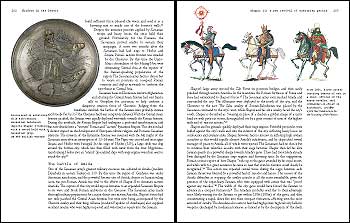
Shadows in the Desert - Ancient Persia at War

Dr Kaveh Farrokh is a great Iranian patriot who has published invaluable works on pre-Islamic Iranian history. I strongly recommend that all Iranians whose genuinely care for Iran buy and read about their history and culture by distinguished scholars like Dr Farrokh and others including the Great Iranologist Dr Richard Nelson Frye.

Without knowing our roots we won't be able to build a solid future. Knowing our roots is especially important in light of efforts by Islamists and the current Islamic occupational government to eradicate our roots and replace them with foreign ideologies and an anti-Iranian/un-Iranian culture.


Dr Farrokh's book "Shadows in the Desert - Ancient Persia at War":

http://www.amazon.com/Shadows-Desert.../dp/1846031087


*****************


Shadows in the Desert
Ancient Persia at War
(General Military)

By: Dr. Kaveh Farrokh

http://www.rozanehmagazine.com/MayJu...DrFarrokh.html

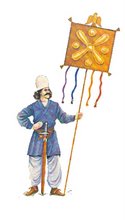
Two extracts from Shadows in the Desert: Ancient Persia at War


Chapter 3
Darius the Great


Darius (Old Persian: Darayavahush) (521-486 BC) was originally an arshti-bara (lit. spear-bearer) in Kambujiya's army in Egypt. It is likely that Darius held a position of high office, as he was a member of the Achaemenid royal family. Darius' family, however, was of the Ariaramnes branch of the Achaemenid line.
Darius and six other conspirators had plotted to seize the throne of Persia; however, there remained the question of who would be king. According to Herodotus, the seven conspirators agreed to meet at a designated spot with their horses at the break of dawn. He whose horse neighed first would become emperor of the Persian Empire. Darius' horse was reputedly the first to neigh, settling the issue. This “ascension” was, of course, a formality at best, as Darius now faced a truly daunting task. The Empire was being ripped asunder by royal pretenders, rebels, and breakaway movements that Darius had to confront before assuming the mantle of imperial government.

Darius defeats the rebels

The rebellion that the late Kambujiya had been informed of just before his death was allegedly being led by his brother Bardiya. Bardiya had announced his claim to the throne on March 11, 522 BC to the Persians and the Medes who generally supported him. Babylon officially accepted him on April 14, and by July 1 Bardiya was the recognized leader of the Empire. He was immensely popular especially after his suspension of state taxes and military service for three years. While such policies endeared Bardiya to the common population, he was not on entirely good terms with the magi or the Aryan feudal lords. The magi were apparently unhappy with Bardiya's policies with respect to the Aryan cults, while the ruling oligarchy may have seen the new taxation and war-levy policies as a direct challenge to their absolute authority, wealth and power.

There are serious questions as to the identity of the rebel Bardiya. One version of events states that the real Bardiya had already been killed before the “Bardiya” rebellion. Herodotus, who identifies the real Bardiya as “Smerdis,” notes that he had been killed by Prexaspes, Kambujiya's chief advisor, and that the murder had been kept secret from the Empire's populace. If true, then who was the rebel claiming to be Bardiya? Darius is certainly clear that the real Bardiya had already been slain by his brother Kambujiya before the Egyptian campaign in 525 BC. The rebel claiming his name was the imposter Gaumâta, a member of the magi, who managed to convince the Medes and Persians that he was the real Bardiya. Olmstead, however, disagrees with this version of events and suggests that Darius simply usurped the throne from the real Bardiya and falsified the truth to legitimize his own rule.5 Whatever the actual truth, historians unanimously agree that Darius defeated and killed Bardiya/Gaumâta on September 29, 522 BC at the Sikayauvatish fortress in Media.

Darius' termination of the eight-month reign of Bardiya/Gaumâta was only the first step to power. The Bardiya/Gaumâta coup d'etat had acted as a catalyst for major rebellions throughout the Empire. Sources report on the appearance of a “king” in Elam as well as a “Nebuchadnezzar III” in Babylon by early October 522 BC. Darius' army was reportedly small, yet, it was a well trained and professional force composed of those Mede and Persian warriors who had served in the Egyptian campaigns.

Darius first moved into Elam in 522 BC where the weak rebellion quickly collapsed and order was temporarily restored. By December 522 BC, Darius and his forces crossed the Tigris into Babylon. After fighting two battles, the rebels of Babylon were subdued and Nebuchadnezzar III was executed. Meanwhile, yet more rebellions in Elam had to be suppressed by 519 BC, and Assyria also remained to be subdued. However, the most serious challenges came from Darius' Iranian opponents. The Behistun inscription is clear that there were anti-Darius revolts in Persis and Media. Persis had produced a certain Vahyazdata making claims to the Achaemenid throne. The Medes, who were led by Fravartish, endeavored to reestablish the authority of the House of Cyaxares. Meanwhile, serious anti-Achaemenid rebellions had broken out in Armenia.

Eastern Iran also broke into open revolt. In Margiana a certain Frada led a rebel movement of his own. To defeat these threats, Darius dispatched his army to fight in Persis, Parthia, Margiana, and Armenia. The leaders of Darius' armies were from his closely trusted inner circle as evidenced by his father leading the battles in Parthia, and Vidarna, one of the original conspirators, leading the campaign in the Zagros Mountains. Darius spearheaded the drive into northern Media where he crossed into Rhagae (Rayy), near modern-day Tehran. From there he wheeled northwest across Media Atropatene (Iranian Azerbaijan). It was probably sometime during this operation that the battle of Kundurush was fought. The securing of Media Atropatene allowed for the pro-Darius forces to swing northwards into Armenia in the Caucasus. The subjugation of Media, Persis, and Armenia allowed Darius to concentrate his entire might against the Parthian rebellion, finally bringing their stubborn resistance to an end. These battles were especially fierce, partly attested to in the Behistun inscription. The Parthian, Armenian, and Persian campaigns resulted in around 36,000 rebels being taken prisoner or killed, while in Media alone casualties were at least 20,000.

Interestingly, the satrapies of Asia Minor had remained neutral in the fighting, perhaps waiting to see who would seize the throne in Persia. The only act of retribution in Anatolia after the rebellions was the killing of a certain satrap of Lydia, Oriontes, who had taken advantage of the fighting in Persia to seize control of much of Achaemenid Asia Minor. A rebellion had broken out in Egypt, however this was most likely a local “Egyptian” revolt, which was suppressed by Darius by 518 BC.

By August 521 BC, Darius had completed the Herculean task of stabilizing the Empire, and was firmly in control. In the northeast, Bactria and Margiania had also been bought under Darius' authority, but the Saka Tigrakhauda and Massagetae had yet to be subdued. The Saka, who were outside the Empire at the time, had militarily intervened on the side of the rebels. The potential danger of future attacks by these Sakas ensured that Darius would have to fight them in the near future.

Darius reestablishes the oligarchy

The inscriptions at Behistun in western Iran state that Darius “restored to the people” what Bardiya/Gaumâta had confiscated, namely land, pastures, slaves, and herds. The sanctuaries which Bardiya/Gaumâta had destroyed were also restored. The “people” that the Behistun inscription describes can only be the ruling oligarchy who had lost property. The rebellion was certainly as much about political leadership as it was between the prosperous few and the large “have-not” segment of the population. This would explain why Persian peasants as well as Medes joined Bardiya/Gaumâta. Darius' victories certainly benefited the social status and power of the Aryan feudal lords who were now more strongly bound to the Achaemenid royal house. There may have been a theological aspect to the rebellion suggesting that certain Aryan cults were siding with Bardiya/Gaumâta while others were with Darius and his supporters. There may be merit to suggestions that Bardiya/Gaumâta may have offended the followers of the cult of Mithra. Bardiya/Gaumâta also destroyed the non-Aryan temples of the Elamites, a process which Darius reversed.

Darius owed his success to his well-organized entourage, the disgruntled nobility, and the loyalty of the Medo-Persian professional core of the army. Another factor in Darius' success was the inability of his enemies to unite against him, resulting in all of them being isolated and crushed separately. Darius had demonstrated his genius at leadership and war: in the course of one year Darius had defeated numerous enemies, restored the authority of the Empire, and installed himself as emperor. He would also prove to be one of history's greatest statesmen.

Darius' reinstitution of ancien regime elements was to contribute to the later corruption and nepotism of the court, which in turn adversely affected imperial administration and military performance. This was accompanied by a steady rise in the fossilization and rigidity of Aryan codes of conduct, especially in the court. In contrast to Cyrus, the Achaemenid kings were to become increasingly aloof and distant from the people. Even the king's closest advisors were constrained in the way they could communicate with him. All of these factors resulted in many negative outcomes such as treachery and the pursuit of short-term interests. Another outcome was sycophancy as shown by court counselors providing inaccurate updates of military affairs to Xerxes during his invasions of Greece in 490 BC.


--------------------------------------------------------------------------------

Chapter 13
Shapur II: a new revival of Sassanian Persia


Shapur II was perhaps one of the most enigmatic rulers of ancient Persia. Ruling literally from the cradle to the grave, Shapur's 70-year reign (r. 309-379 AD) spanned the passage of ten Roman emperors and witnessed desperate battles with the Arabs, Chionites, and Romans. The latter, under the leadership of Julian the Apostate, came very close to destroying the Sassanian Empire. Shapur steered Persia through these crises, and also laid the foundations of a powerful learning tradition. That legacy was to profoundly influence the later Islamic, and European, traditions of learning and medicine.

The Arab incursions

The first serious attacks by the Arabs occurred when Shapur II was an infant. The Arabs successfully launched deep raids into Persia from islands in the Persian Gulf. Their primary targets were the southern territories of the Sassanian Empire. The Bundahishn notes that “in the reign of Shapur son of Hormuz, the Arabs came and seized the banks of the River Karun (Ulay) and remained there for many years pillaging and attacking…”1 Geographical factors may have also encouraged the Arab assault, notably the lowering of the water levels to the east of Arabia.2 Many of Iran's border towns and villages were looted and destroyed, and their inhabitants killed or taken as slaves. Emboldened by these raids, the Arabs even began making thrusts into the interior of Mesopotamia, with hopes of reaching Ctesiphon. The Arab successes were mainly due to the absence of any meaningful Sassanian military response. The boy-emperor Shapur II was surrounded by a large number of indecisive and mediocre andarzbad (lit. advisors), who proved incompetent at stopping the Arabs. The Sassanian military machine was certainly capable of at least containing the Arab raids. It is a mystery as to why the advisors of the boy-king failed to mobilize the armed forces to confront the threats.

The Arabs, however, may have erroneously concluded that their successes had been due to military prowess. Rather than vacate the Sassanian territories they had recently raided, the Arabs decided to forcefully settle in southwestern Iran and the Sassanian Persian Gulf coastline. It was in these circumstances that the young Shapur formally ascended the throne in Ctesiphon. The advisors were pushed aside and Shapur immediately ordered the Savaran to crush the Arab invaders and expel them back across the border. The Bundahishn notes that “Shapur became of age and drove away those Arabs and took the land from them. He killed many rulers of the Arabs and scattered many of them.”


Mounted Arab troops on camel and horse lacked the ability to stand up to the armored knights, especially in close-quarter fighting. Horse and foot archery must have taken a terrible toll on the Arabs, and the Sassanians also fielded a regular force of armored infantry that was trained for close-quarter combat. The Savaran had little difficulty when they entered the Arab-occupied southwest in the vicinity of modern Persis and Khuzistan. Shapur's Savaran were overwhelmingly successful: all occupied lands were liberated, including the entire Persian Gulf coastline. Shortly after the liberation of the southern territories, the Savaran boarded ships and sailed across the Persian Gulf. Shapur was determined to greet the Arab raiders on their own soil: the Savaran landed in Bahrain, Ghateef, and Yamama, and once again the Arabs were overpowered and defeated, as corroborated by Islamic sources.

Judging from historical accounts, Shapur was especially ruthless in the treatment of his defeated Arab foes. One clearly embellished account incredibly states that Shapur had his Arab prisoners led to captivity across the desert on a rope threaded through their pierced shoulders. The Arabs of Arabia's interior, Bahrain, and Yamama, were to remember their humiliating defeats and nurse a multi-generational grievance against the Sassanians, brutally expressed in the Arab invasions of the 7th century AD.

The seriousness of the Arab raids prompted the Sassanian high command to take military measures to protect the southern regions against future assaults. Defensive walls began to be constructed along the western regions of modern-day southern Iraq in an attempt to contain future Bedouin raids. The model for these walls was at least partly derived from the Roman system along the Romano-Syrian borders further west. Shapur's defenses facing Arabia became known as the “Khandaq-e-Shapur” (Shapur's ditch). The Sassanians also cultivated friendly relations with those Arab tribes who had earlier entered the Mesopotamian plains near Syria. Of these, the Bani Lakhm or Lakhmids proved to be excellent warriors who maintained the peace along the southern frontiers. The Sassanians soon trained and equipped the Lakhmids to fight like the Savaran. The settling of warrior peoples along the Empire's borders may have been inspired by the Roman limitanei system.

Shapur II prepares for war


Soon after the conclusion of hostilities in the south, the Sassanians were faced with challenging developments in Armenia. In 312, Emperor Constantine (r. AD 306-337) recognized Christianity as one of the religions of Rome. Constantine rebuilt the ancient city of Byzantium on the Bosphorus, which became Constantinople, the capital of the eastern Roman Empire, or Byzantium. The Byzantines, however, were referred to as Romans or “Rum” by their contemporaries and chief rivals, the Sassanians. Tirdad (Tiridates), the King of Armenia, followed Constantine in accepting Christianity. This development was viewed with trepidation by the magi and Sassanian nobility. The fear was that the Romans could potentially use religion to drive a wedge between the Armenians and the Iranians. The magi, acting in concert with the nobles, pressured Shapur to force the removal of Tirdad from the Armenian throne in favor of Arshak, who maintained his ties to the Aryan cults and Zoroastrianism. Having achieved this coup in the Caucasus, the magi now initiated a vigorous anti-Christian campaign in Persia and Armenia. The stage was set for a bitter confrontation between Rome and Persia, resulting in the division of Armenia and the Caucasus between the two powers. Nevertheless, Armenia's adoption of a “Roman” religion never severed her profound cultural and historical ties to Persia. Armenian knights were in fact welcomed into the highest ranks of the elite Savaran cavalry up to the last days of the Sassanian dynasty.

The three sons of Constantine shared the throne on his death in 337. The Christian Constantius (r. AD 337-361), who initially ruled just the east of the empire, was hostile to Persia from the outset. From the perspective of war planners in Ctesiphon, a major Roman assault was inevitable. Rome would immensely benefit from the restoration of a Christian monarch in Armenia, as this could diminish Sassanian influence. Fear of a Roman invasion led Shapur to plan for a preemptive strike. He commissioned his military commanders to make thorough military preparations, especially in the introduction of military innovations.

Preparation of Shapur's army

Experimentation with the “super-heavy” cavalry concept could have evolved as a countermeasure against constantly improving Roman military performance. The Sassanian army may have concluded that a heavily armored force of Savaran could succeed in breaking through the Roman lines. The notion of having these troops specializing in archery warfare appears to have been abandoned in favor of a more powerful lance charge and close-quarter fighting. The new heavily armored Savaran were armed with a plethora of hand-to-hand weapons, such as swords, daggers, darts, maces, etc. These troops were trained and armed to break through Roman lines, and maintain close-quarter combat against Roman troops. Missile support was provided by the armored horse archers.

Sassanian doctrine placed the “super-heavy” Savaran knights in the van, followed closely behind and in the flanks by the regularly armored Savaran and armored horse archers. While the new “armored fist” certainly came as a surprise to the Romans at first, by the time of Julian's invasion of Persia they had learnt to exploit their weaknesses. These were limited battlefield vision due to helmet design, and heavy armor, which drastically limited endurance and combat time on the battlefield. In practice, the battlefield merits of the new super-heavy cavalry proved at best mixed against Julian. It also proved to be a total failure against the Hephthalite Huns.

The Sassanians appear to have adopted the war elephant from their Kushan contacts. Shapur II's battle elephants are reported by the Romans:
With them, making a lofty show, slowly marched the lines of elephants, frightful with their wrinkled bodies and loaded with armed men, a hideous spectacle, dreadful beyond every form of horror, as I have often declared.

Elephants were also used to combat Emperor Julian during his invasion of Persia in 363. These operated closely with regular and experimental super-heavy Savaran in strike packages against Roman troops. The elephant's key advantage in those battles would have been its high platform, allowing for accurate and devastating archery. Later reports by Arabs describe Sassanian elephants entering battle in elaborate regalia and decorations.

Western historians have often derided the quality of Persia's infantry, basing their conclusions on Greek experience against the Achaemenids. The Roman impression of Sassanian infantry is also negative. Nevertheless, Ammianus Marcellianus does provide descriptions of a heavy professional Sassanian infantry force. While these certainly stood and fought at Ctesiphon, they were defeated by the forces of Julian and were forced to retreat. The Sassanians were cognizant of the merits of a heavy infantry force and made efforts to raise such units to the last days of their dynasty. These, however, could never match their Byzantine counterparts, obliging the Sassanians to rely on their Savaran cavalry as their primary strike force. The most effective infantry to come from Sassanian Persia were the Dailamites, who began to noticeably appear in the armies of Khosrow I.

By the time of Shapur II, the Sassanians were successfully applying their engineering skills towards the use of water in siege warfare. This was vividly demonstrated by the forces of Shapur II in the siege of Nisibis and the Antioch campaign of 540. The Sassanians were not only highly capable hydrodynamic engineers, but were equally adept at bridge building. In addition to military techniques, the Sassanians employed a variety of other methods to facilitate the capture of an enemy fortress. One technique was to attach false and alarmist messages to arrows and then shoot these into the enemy fortress. Spies and sympathizers were also used to collect information, sow confusion and discord, and to undermine the morale of the defenders. After the defeat of Julian the Apostate in 363, Sassanian engineers were able to closely examine the excellently constructed Roman defenses. Shapur ordered his engineers to develop similar defenses along the Romano-Sassanian borders. The Sassanians soon developed an impressive array of forts, walls, ditches, and observations posts all along the Roman frontier, stretching to southern Mesopotamia and Arabia.

Monday, March 05, 2007

Pahlavi meets Napoleon at Egypt expo in Paris


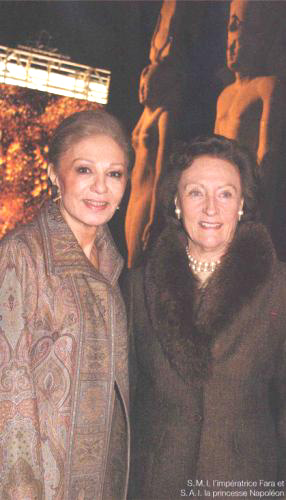
HIH Princess Napoleon Bonaparte (descendant of French Emperor Napoleon) and HIM Shahbanou* Farah Pahlavi of Iran met in Paris during an exhibition in Paris’ Grand Palais entitled Les Trésors Engloutis D’Egypt (The Sunken Treasures of Egypt).

Darius Kadivar has the story...Pahlavi meets Napoleon at Egypt expo in Paris (CLICK)

God bless our Empress. May we soon see her return to the motherland.

I really do hope that Iranians will stand up and reclaim their country from the black reactionary forces that have kept them and their country hostage for 28 years! The bastard child of a lowly human and an ape (AhmadiNejad) and those of his ilk have to be brought before Iranian courts of justice for their crimes against the Iranian Nation and humanity!


*just to clarify any confusion - "Shahbanou" is the Iranian term for "Empress"

Wednesday, May 17, 2006

BULLDOZERED Palace of Darius the Great discovered by archeologists!

Bulldozered Palace of Darius the Great discovered by archeologists! Yes BULLDOZERED Palace! Remember how the Arabo-Muslims wanted to bulldozer Persepolis to the ground after their takeover of Iran in 1979! Well it seems they found a less known site to carry out their evil deeds! These bastards are bulldozering Iranian cultural heritage sites! The Sivand Dam that the Occupational Islamic Republic will soon make operational will FLOOD a vast land of Iran's MOST VALUABLE cultural heritage sites! And as reported in the below article the humidity caused by the dam will also DESTROY the newly discovered Palace of Darius!

Where are the protests?! Where is the outrage!? Where is this nation!? Where are the descendants of Darius?! Where are the children of Cyrus!? Where are the brothers and sisters of Babak Khorramdin!? Have you become slaves to the Arabo-Muslims!? Have you lost any sense of nationhood?! Are you a "LIVING DEAD" NATION!?

Silence in face of these atrocities that are meant to destroy our culture and impose the misery of Islamic culture upon us is at work in every sector of society! Can you not see it!? If you have one shred of decency, dignity, honor, patriotism then voice your opposition to what you see is happening to our motherland!


**********************************


Palace of Darius the Great Discovered in Bolaghi Gorge


Discovery of remains of a gigantic palace in Bolaghi Gorge and its similarity to the constructions of the time of Darius I, Achaemenid King, in Persepolis show that it was built during the same period of time.


Tehran, 15 May 2006 (CHN) -- Iran-French joint archeology team at Bolaghi Gorge succeeded in discovering and identifying the remains of a gigantic palace, believed to be from the Achaemenid era (648 BC–330 BC), during their second season of excavations in the area.

"Before the start of this season of excavations, our geophysical tests in area number 33 of Bolaghi Gorge had revealed to us the possible existence of a huge building near the Sivand Dam. Clay artifacts found in this area showed that this building used to be the residential palace of the Achaemenid kings. With the start of the new excavation season, we resumed our excavations in area number 33 with this attitude," said Mohammad Taghi Ataee, head of the Iran-French joint archeology team at Bolaghi Gorge.

"After we started our excavations in the historic hill where this monument is located, we realized that it consisted of one historic layer only. Since no other layers were constructed on top of this layer, archeologists were hoping to unearth the entire palace intact. However, after they made their trenches they got to a number of wells which had been dug by illegal smugglers and also traces of bulldozers which had caused serious damage to this ancient Achaemenid palace," said Ataee.

Plundering of archeological sites by the smugglers has become a common issue in archeology. However, according to Ataee, archeologists believe that illegal diggers cannot be held responsible for destroying of this palace by bulldozers, and it was a deliberate act by an unknown person or group of people who intended to devastate this place for a reason that is not clear for archeologists.

"The archeology team kept removing the debris caused by the bulldozers until they got to the base of a pillar similar to those used in the construction of the palace of Persepolis in Fars province, although smaller in size.
The base of this pillar which looks like an inverted bell is built by the same stones used in the construction of Persepolis. The stone is so carefully varnished that one may clearly see the reflection of oneself in it," added Ataee.

The height of this discovered base is 35 centimeters and it has a diameter of 50 centimeters. There are signs on this base which were meant to level it off, a method commonly practiced during the Achaemenid era.

"Based on the evidence, this palace must have belonged to either Darius the Great, the Achaemenid King who ruled between 521 and 486 BC and built the famous Palace of Persepolis, or the kings who preceded him. However, it is more likely that the palace belonged to Darius," said Ataee.

In addition to this pillar base, the royal seat of this palace, built using soil and condensed sand, several pieces of clay bricks, and three clay walls constructed in a row were discovered by the archeologists. The top of the walls has been destroyed by bulldozers; however, archeologists are hoping to find the construction plan of this palace by studying these walls more carefully.

Regarding the size of these clay bricks, Ataee said, "These clay bricks are in different size, some are 35 by 33 cm, some 17 by 33, and some others are 33 by 33 centimeters. They were probably used to cover the floor."

Bolaghi Gorge is an endangered historical site in Fars province, near the ancient site of Pasargade, threatened by the Sivand Dam built in its vicinity. Although the dam is not flooded yet, it is clear that with its inauguration Iran will say farewell to one of its most valuable cultural heritage sites.

Although Ataee announced that inauguration of the Sivand Dam will not directly affect this Achaemenid Palace since it is located in an area which is relatively far from the Sivand Dam, the humidity caused by the dam will certainly destroy this palace in a long run.

The Iran-French archeology team will continue its excavations in Bolaghi Gorge until June 5 to save this ancient site as much as possible before the inauguration of the dam, the date of which has not been announced yet.